Archive for October, 2008

More about learning 2.0

October 31st, 2008 by Graham Attwell

Another post on the IPTS seminar on Learning 2.0 in Seville. This workshop was interesting becuase it brought togther researchers and practitioners from all over Europe. And, somewhat to my surpise, there was a fair degree of consensus. We agreed social software provided many opportunties for creating, raher than passively consuming learning. We agreed that learnng opportunities were being developed outside the classroom. We even agreed that the locus of control was switching from institutions to the learners and that this might well be a good thing. We agreed we were moving towards individual learning pathways and that learners needed to be supported to finding their pathways.

We agreed that the context of learning was important. Mobile learning would become increasingly important with the development of context sensitive devices. (Also see Serge Ravet’s post on User Generated Content or User Generated Contexts).

But there were also limits to the consensus. Whilst there appeared agreement on new roles for teachers, no-one was sure what that role was?

Much of the discussion centred on the scaffolding of learning. How much support did leaners need and how much of that support would come from teachers?

Neither were participants agreed on the future role of institutions. More critically, was Learning 2.0 something which happened outside the school, and had only a limited impact on institutional practice, or did it pose a fundamental challenge for the future of schooling?

There was even greater disagreement over curriculum. Should there be a curriculum for basic skill and knowledge that everyone should learn? Did learners need a basic grounding in their subject before theyc oudl develop their own learning pathways? Who should define such a curriculum? What was the role of ‘experts’ and who were they anyway?

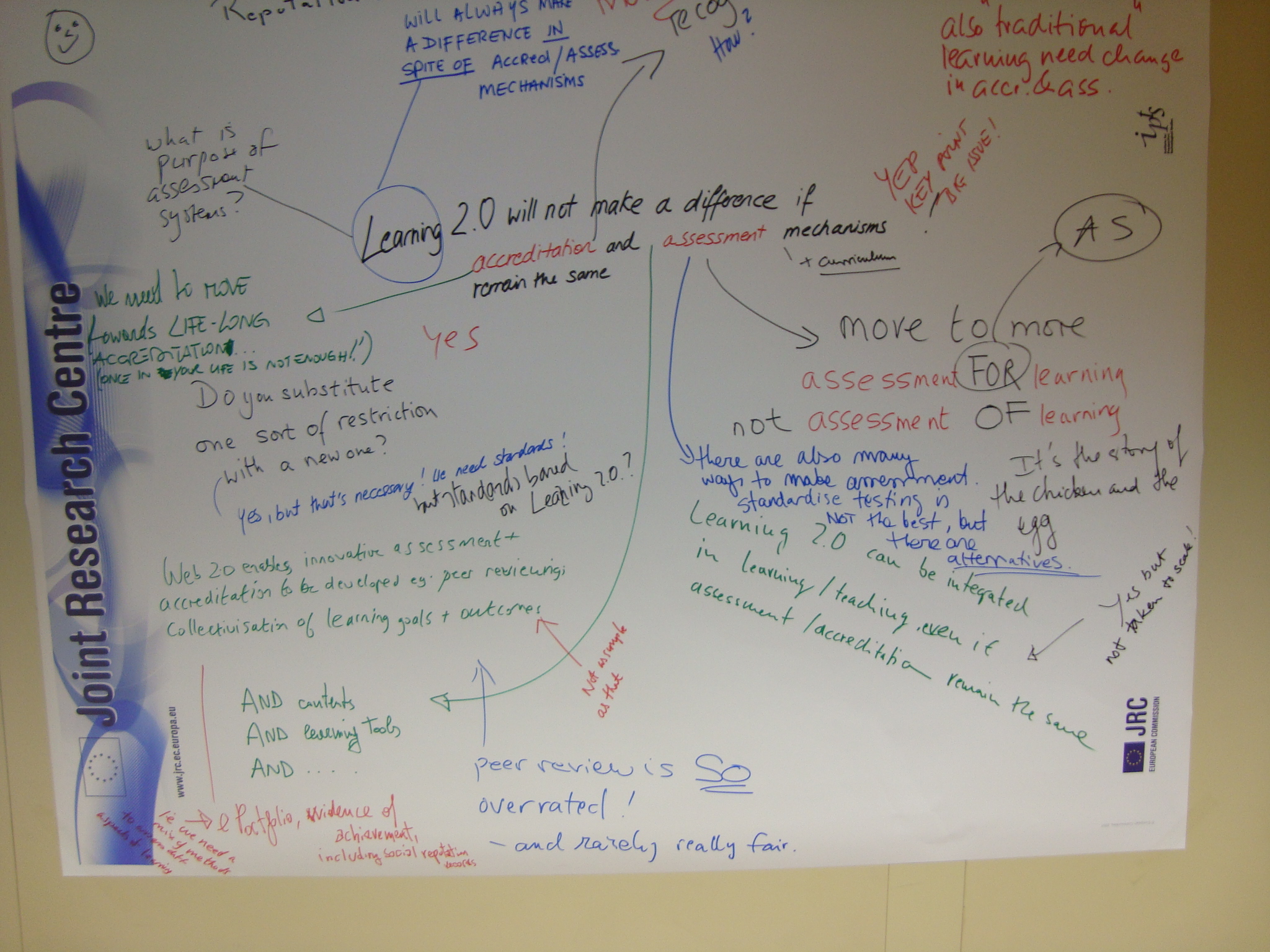
And perhaps the greatest disagreement was over assessment and accreditation. Many of us felt that we needed to move towards community based formative assessment. Employers, we said, would be more interested in what people were able to do than formal certicates. Others, pointing to occupations such as doctors and plumbers felt there should be some form of standards against which people should be assessed and accredited.

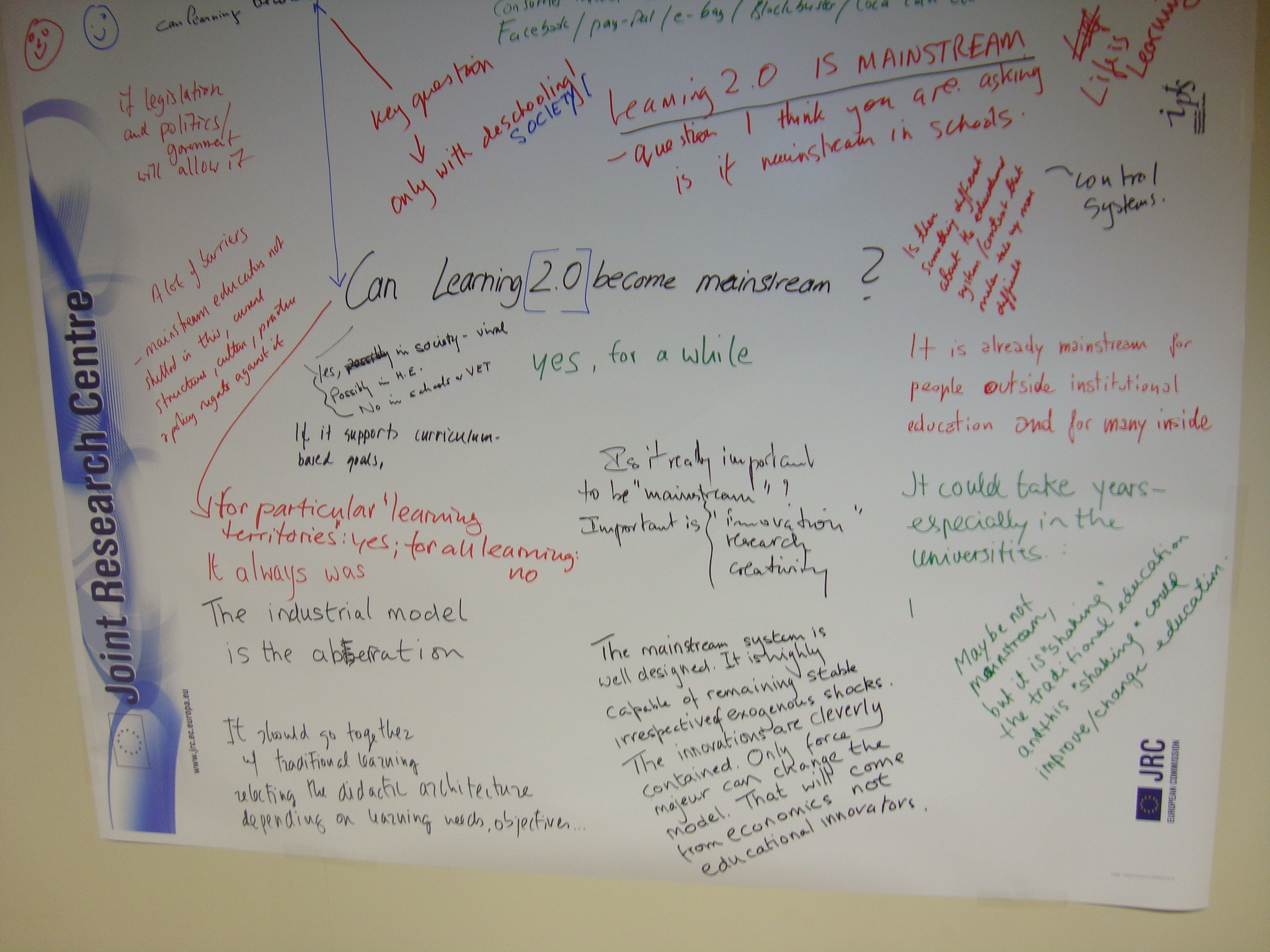
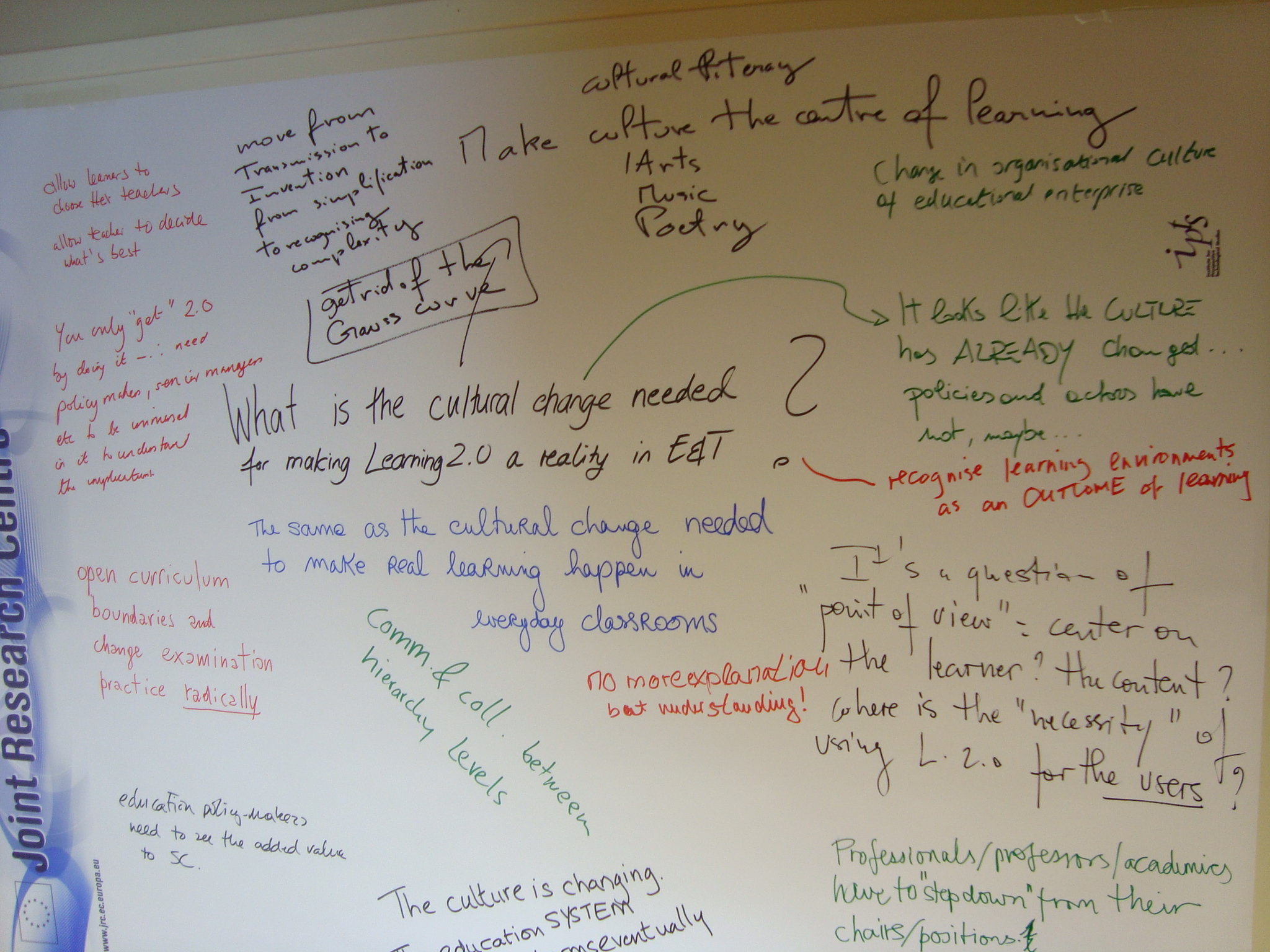
A final comment on the form of the project. Although the work is about Learning 2.0 the present form of the work is decidedly Research 1.0. This research is important enough that it needs to be opened out to the community. It seems a wiki is being d veloped and when it is up I will blog here about it. In the meantime here are some of the photos of the flip charts used for brainstorming around different issues at the workshop. I will pass on any comments on this post to the project organisers.

The web is the platform

October 30th, 2008 by Graham Attwell

I am still at the IPTS seminar on Learning 2.0 in Seville. Much of interest and I wil write a few more blogs on this. But  one issue, which has just come up, is this of platforms. The director of IPTS has asked us what platforms we see being used in the future.

And we have said – we know the platform. It is called the World Wide Web. I think that is very important. We do not need more and more platforms. We do need control over our own data and the ability to be able to develop and use that data.

What technologies change people’s lives?

October 29th, 2008 by Graham Attwell

There are some interesting issues kicking around at the IPTS workshop on the impact of Web 2.0 innovations on Education and Training in Europe.

there are plenty of examples of innovative practice. But there is little example of any findamental change at either a systems level or even at the level of the institution. This raises a whole series of questions:

  • is it possible to change pedagogic processes and improve opportunities for learning through the use of social software within the present system?
  • or as Roberto has just said what is the disruptive technology which can spark such chnage in peoples lives.

It may be that such change will not origin within the education system but will happen from human interactions in the wider communities through different ‘value propostions’ – through ideas, approaches and technologies which add value to people lives.

Are we hung up with systems approaches?

October 29th, 2008 by Graham Attwell

As always it is the extra curricula activities which are the highpoint of conferences. And i don’t just mean in the bar. I had an interesting lunchtime conversation with Martin Owen where we were talking about the problems with the classificatory systems being put forward for analysing a database of practice examples developed for the IPTS study on the impact of Web 2.) innovations on education and training in Europe.

One issue we discussed is the continued use of systems approaches for defining research design and analysis. All too often findings which do not fit into a pre-defined system are just viewed as ‘noise’ and therefore ignored. But it may be in that noise that cannot be analysed in a systems driven approach that the real issues lie. It is how learners are using social software that is critical to me and not how the system adapts or more often rejects the use of such software.

Teaching or learning?

October 29th, 2008 by Graham Attwell

I am at a workshop on Learning 2.0: The impact of Web 2.0 Innovations on Education and Training organised by the Institute of Prospective Technology Studies in Seville.

They have done a lot of work. however, I feel that in focusing on the use of technology for learning within the existing educational organisations they miss the main issues. How do we bring together informal learning and learning from formal sources? How do people not enrolled on courses use technologies for learning? How do we transform institutions? How can we empower learners to structure their own learning? How can we open up educational resources – materials but not just resources – to the wider community.

How also can we develop research designs and methodologies to address these issues?

New url for Sounds of Bazaar

October 27th, 2008 by Graham Attwell

We have chnaged hte url for todays LIVE radio broadcast – it will now be on http://radio.jiscemerge.org.uk:80/emerge.m3u

Is instructional design dead?

October 24th, 2008 by Graham Attwell

Martin Lindner raises some important issues in a recent blog post.

“Even “e-Learning 2.0″ still seems to be discussed primarily from the perspective of institutions or organisations. But the Web 2.0 obviously is “user-centered”. Every This was the starting point for discussing “PLEs” (Personal Learning Environments) as opposed to LMSs (Learning Management Systems) and VLEs (VirtualLearinng Environments) that has been led by Scott Wilson, Leigh Blackall, Stephen Downes and many others in 2005.

The main point has been nailed by Leigh in his notorious “Die LMS Die! You too PLE!” blog post:
‘So while I whole heartedly agree with the PLE and Scott’s reasoning for rejecting the LMS/VLE, I can’t say I’m with them on their alternative. In my view, the VLE, LMS and PLE are the same. A suggestion that the Internet, and informal networked learning are not enough. That people still need to come to school to learn. That people need to distinguish learning from life, that people need to download and install an application that will solve their learning needs.’

The ultimate learning environment is “the Web” itself. But the Web conssits of a applications which trigger designed user experiences. That is the question: Is there room left for instructional design of any kind in a Web environment? And how can we help mainstream users with low “Web literacy” to exploit the new possibilities for their personal empowerment?”

I have to say I worry when I hear people talking about PLE applications. But Martin makes the point himself in asking how we can help users to exploit the new possibilities – although in my view it is not just users with ‘low web literacy’ but all users. For this we need tools though I have long asked whether they should be regarded as social tools rather than learning tools. And learners need support in developing their own Personal Learning Environment to make the computer do what they want it to do for learning. Also we need to open out learning resources to ensure that they can be utlised within a PLE.

Is instructional design dead? It depends I suppose on just what you mean by instructional design. Yes in the narrow meaning of the learning objects debates and in the heavily sequenced teacher controlled applications. But no if we are talking about designing materials to help people learn. Its just that more and more people are involved daily in instructional design and most of them without training themselves. Just witness the flourishing of videos on You Tube designed to show us how to do something!

One final comment. Martin says “The ultimate learning environment is “the Web” itself.” No Martin, the ultimate learning environment is the world around us – which of course includes the web. But it also includes people, books and our (physical) working environment. One big challenge for the future is how to ensure such an environment is rich with learning possibilities.

Emerging Mondays LIVE internet radio – Digital Identities

October 23rd, 2008 by Graham Attwell

The next edition of our monthly Emerging Mondays Sounds of the Bazaar LIVE internet radio takes place next Monday 27 October at 1800 UK time, 1900 Central European Time. The programme will last for about an hour.

The theme of the programme is Digital Identities. The programme notes are included below in this email.

Guests include:

Steve Warburton – Kings College London on the Eduserve sponsored Rhizomes Identities project
Lars Heineman – Bremen University on cultural and vocational identities
Andy Powell – Eduserve
David White – Oxford University on identities in Second Life
Jenny Hughes – Pontydysgu – on how young children develop digital identities
Helen Keegan – Salford University on how audio and video students develop their owen line presence
Eileen Luebcke – Bremen University on culture and identities
Jenny Bimrose – University of Warwick – what is the role of careers guidance in developing identities

Plus our regular music and poetry spots, Cyber Gran Leila and surprise guest spots.

How can you take part? You can just sit back and enjoy the show by going to http://icecast.commedia.org.uk:8000/emerge.mp3.m3u in your browser. This will open the LIVE radio stream in our MP3 player of choice.

If you are feeling more active you can come on the show by phone or through skype. Just email or skype Graham Attwell – graham10 [at] mac [dot] com and we will bring you in. Or follow the show in our chatroom – http://tinyurl.com/soundschat (no account needed) where Cristina Costa will be hosting.

The banking crisis ends the myth that the private sector is better

October 17th, 2008 by Graham Attwell

I am surprised how little attention edubloggers have been paying to the collapse of the banking system and the ensuing credit crunch. Education does not exist in a vacuum, still less educational policy.

So what does it all mean for education. Well one pretty obvious thing is that if different governments can afford to spend this much money on bailing out bankrupt banks, why has so little been spent on education globally. Imagine the effect of such mindbogglingly huge sums of money on education in less developed countries. Every child in the world could have a laptop with money to spare. However – there is no point in dreaming – banks will always be nearer the heart of lawmakers than education.

The short term effects of the banking crisis for education could be quite grim. In any recession training is one of the first things to be cut by companies. And obviously there is likely to be a squeeze on public expenditure in the coming years to finance the loans to the banks.

On the other hand the ideological fall out from the crisis coudl be extremely beneficial. I see education as likely to undergo profound – perhaps paradamatic – change in the next ten years with a change from homogeneous central curriculum determined classroom learning to individual learning pathways. I am enthusiastic about such change. But the danger whch has always concerned me has been the threat of privatisation. Depsite a history of publically finded and goverend education in Europe, we have seen the slow development of a private university sector in many European countries. And thw UK government has pursued an agenda of creeping privatisation through so called public-private partnerships and the encourgement of privately funded and goevrened trust schools. Ideologically they have encouraged the myth that business people know better how to run schools than do teachers or the local community. Industry has been handed control of vocational currcicula.

That myth has now been blown sky high. Bankers are now a subject of derision rather than respect and rightly so. These are not the kind of people anyone would trust to run our schools. And I suspect that the companies so keen to invest in trust schools may now be forced to focus on their core business – rather than interfering in something they know nothing about. Furthermore, the banking crisis has restored the repsectability of public ownership. And rightly so – education should be owned by the community and free to learners. What we should now do is start to fight back and exmaine different models of community governance. Models which allow a community to shape the learning opportunities and the curricula to meet the needs of that community. Models that can extend access and opportunity for learning for all.

Such a change could be far more important than the short term funding implications of the crisis.

ThoughtFest08 – an unconferencing event

October 16th, 2008 by Graham Attwell

12 and 13 December 2008

A totally unConference event !!!! in Manchester / University of Salford.

ThoughtFest 08 (Twemes: #TFest08) is a two-day event being organized by Pontydysgu with the support of the JISC Evolve network and the European Mature-IP project. The event will bring together researchers in Technology Enhanced Learning in an open forum to debate the current issues surrounding educational technologies and discuss how and where research impacts on practice and where practice drives research.

Full details on the Thought Fest  and how you can get involved can be accessed here: http://tinyurl.com/4q7hcf

Deadline for  submissions is 26th October 2008

  • Search Pontydysgu.org

    News Bites

    From a Jisc press release:

    Over 14,000 items of archived TV footage from 17 European countries are now available via the EUscreen online portal for teaching, research and general interest.

    EUscreen – the result of a collaboration between 36 partners across Europe – provides a rich insight into Europe’s television heritage with content dating from the 1920s to the present day.

    The portal includes rare footage and commentary on key events in history, including a 1962 interview with Martin Luther King about racial discrimination in the US.

    John Ellis, Professor of Media Arts at Royal Holloway and principal investigator on the EUscreen project, said: “This is a valuable resource for anyone interested in social history or indeed TV history, as it brings together tens of thousands of clips from across Europe. The portal is available to anyone (not only academics) and it is very easy to get absorbed and spend hours browsing all of the footage.”

    The expansive footage has also proved popular as a learning aid for foreign language students, with clips available in 14 languages.

    By the end of September 2012, there will be around 30,000 items of digital content freely available on the portal as the European providers continue to add carefully selected material.

    Explore the EUscreen footage


    Open online seminar

    Jisc are hosting an open, online seminar on ‘Making Assessment Count (MAC)’ on Friday 3rd Feb – 1-2pm. The presenters are Professor Peter Chatterton (Daedalus e-World Ltd) and Professor Gunter Saunders (University of Westminster).

    The mailing for the seminar says” “The objective of Making Assessment Count is primarily to help students engage more closely with the assessment process, either at the stage where they are addressing an assignment or at the stage when they receive feedback on a completed assignment. In addition an underlying theme of MAC is to use technology to help connect student reflections on their assessment with their tutors. To facilitate the reflection aspect of MAC a web based tool called e-Reflect is often used. This tool enables the authoring of self-review questionnaires by tutors for students. On completion of an e-Reflect questionnaire a report is generated for the student containing responses that are linked to the options the student selected on the questionnaire.”

    You can find out more ans sign up for the seminar at  http://jiscmac.eventbrite.co.uk/


    EC-TEL 2012

    The EC-TEL 2012: Seventh European Conference on Technology Enhanced Learning 21st Century Learning for 21st Century Skills takes place on 18-21 September 2012 at Saarbrücken in Germany.

    The focus for the conference includes:

    - How can schools prepare young people for the technology-rich workplace of the future?
    - How can we use technology to promote informal and independent learning outside traditional educational settings?
    - How can we use next generation social and mobile technologies to promote informal and responsive learning?

    The deadline for proposals is April 2.


    Visitors and Residents

    David White (University of Oxford) and Dr. Lynn Silipigni Connaway (OCLC) have been attracting quite a stir with their JISC-funded work on Visitors and Residents: What Motivates Engagement with the Digital Information Environment?, being undertaken as part of the Developing Digital Literacies programme webinar series.

    Slides, audio and a recording of the Blackboard Collaborate session where they presented some of the findings of their work can be found at http://bit.ly/jiscdiglitvr.


    ECER 2010

    The keynotes, videos, radio shows and interviews from the ECER 2010 Conference in Helsinki:

    On the ECER 2010 website.

    Taccle handbook for teachers order form

    Here you find the Taccle handbook for teachers order form.

    Twitter

    Follow Graham Attwell on Twitter Follow Cristina Costa on Twitter Follow Dirk Stieglitz on Twitter

    Other Pontydysgu Spaces

    • Pontydysgu on the Web

      blip.tv
      Watch the Pontydysgu Videos
      pbwiki
      Our Wikispace for teaching and learning
      Sounds of the Bazaar Radio LIVE
      Join our Sounds of the Bazaar Facebook goup. Just click on the logo above.

      Our next programmes will be live from the German Moodlemoot in Emsden. Full details coming soon

  • Sounds of the Bazaar AudioBoo

  • Recent Posts

  • Archives

  • Meta

  • Upcoming Events

      There are no events.
  • Categories