Knowledge development and Personal Learning Environments
I am in Innsbruck for four days for a meeting of the EU funded research project, Mature-IP. Over the next few days I will try to report on what theproject is doing.
The Mature project has always interseted me in its approach to Personal Learning Environments. Whilst most projects based on PLEs have looked at learning within schools and univeristies, Mature looks at knowledge maturing processes in work.
And the project has adopted a user based approach working with a number of different user groups, in the UK from the Careers services, in developing and iterating a PLE based on knowledge development services. The project has also developed a series of knowledge indicators, based on these services.
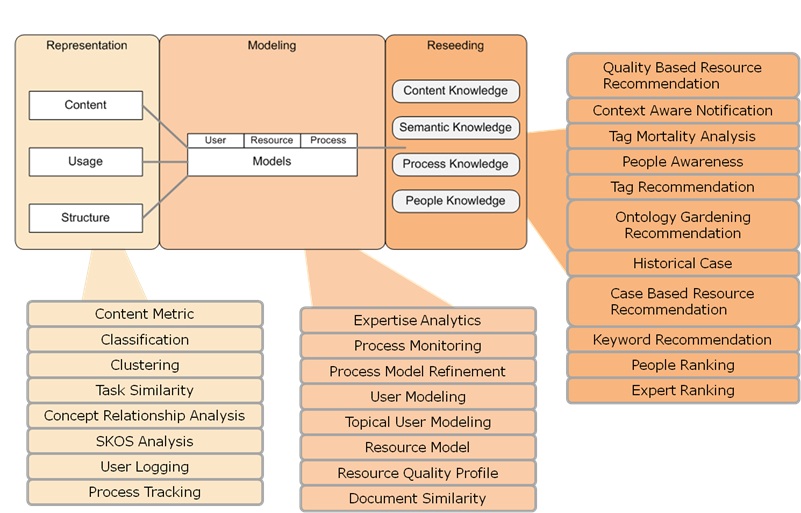
Is it working? It is a little early to tell. But the project acknowledges the importance of different forms of learning leading to knowledge development and sharing in the workplace and also takes account of differences in context. The services developed have been based on the idea of represneting, modellinga nd reseeding knowledge delopment or maturing processes as seen in the diagramme above. Twenty seven services have been developed to date and can be combined in what are being called insubstatiations to take account of such contexts. I realise these may seem somewhat abstract but they have served in bridging between social and educational researchers working on the project and software develers. These services are:
Representation Services:
Content
- Content metric service: Provides a wrapper for encapsulating various content metric implementations
- Classification service: Classifies resources to a given set of categories based on their content. Classification can be improved by the help of user feedback
- Clustering Service: Groups items regarding a special feature
Structure
- Task Similarity Service: Computes the similarity between tasks
- Tag Mortality Analysis Service: analyses tags / concepts and their activity to predict their death
- Concept Relationship Analysis Service: Analyzes concept hierarchy and usage of concept for annotations to derive recommendations for adding broader/narrower relationships
- oSKOS Analysis Service: analyzes a SKOS ontology for potential redundant or missing information
Usage
- Usage Logging Service: collects usage data from the user’s interaction with the MATURE systems
- Process Tracking Service: logs process and task execution
Model Services
User
- User Modeling Service: Detects a user’s knowledge from his or her usage data
- Topical User Modeling Service: Provides an aggregated topical profile of a person
Task
- Process Monitoring Service: Provides the means to query and browse log data provided by the Process Tracking Service in aggregated form
- Process Model Refinement Service: Compares the modelled process with the actual process executions and suggests improvements on the process model based on it
Resource
- Resource Model Service: Describes resources based on usage data
- Document Similarity Service: Derives the textual similarity between two documents
- Resource Quality Profile: Creates a qualitative profile for each resource
Reseeding Services
Reseeding of Knowledge about contents
- Quality Based Resource Recommendation: Provides a set of ranked resources based on the qualitative status of the resource and quality requirements of the user
- Context Aware Notification Service: Provides information about activities related to artefacts
- Reseeding of Knowledge about SemanticsTag Recommendation Service: Provides tag recommendations to achieve a consistent personal and organisational tag vocabulary
- Keyword Recommendation Service: Provides a list of synonyms and hyponyms for tags
- Ontology Gardening Recommendation Service: provides recommendation for improving a SKOS ontology based on the ontology itself and information on its application
Reseeding of Knowledge about Processes
- Case-based Resource Recommendation Service: suggests resources based on resource-use in historical process executions.
- Historical Case Service: searches for historical cases based on a given input
Reseeding of Knowledge about People
- Expertise Analytics Service: Provides an aggregated overview and comparison of available and requested expertise based on tag assignments and search query analysis within a certain timeframe
- People Ranking Service: Provides a ranked list of people that are relevant for a given topic
- Expert Ranking Service: Based on past tag assignments (user-document-tag triple marked with a timestamp), this service recommends knowledgeable colleagues working on a specific topic
- People Awareness Service: Based on a user/person’s profile, this service recommends other persons with a similar profile




“Knowledge development and Personal Learning Environments” http://is.gd/RN5FBb
http://www.pontydysgu.org/2011/05/knowledge-development-and-personal-learning-environments/ http://ff.im/-DyodM