GoogleTranslate Service


Issues in developing and implementing e-Portfolios
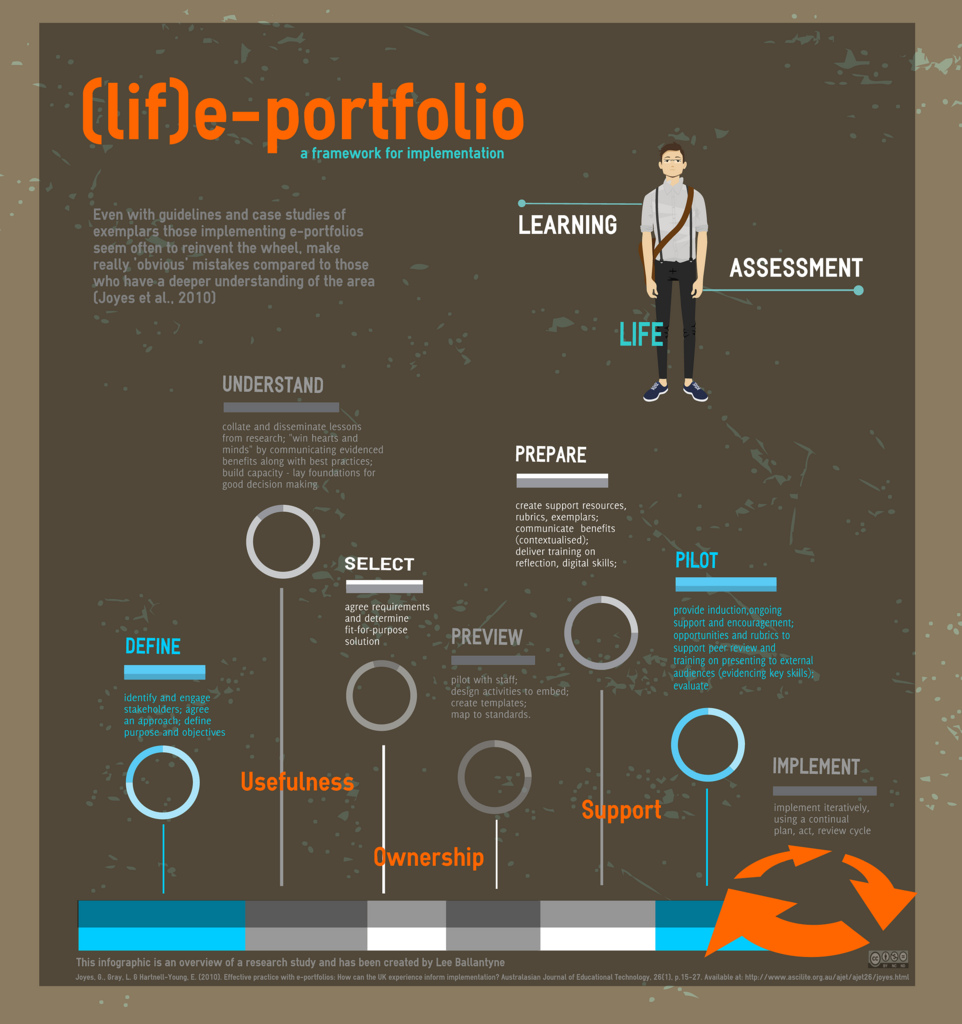
February 7th, 2013 by Graham Attwell

Diagramme: @lee74 (some rights reserved) http://www.flickr.com/photos/lee8/7164889790/

One of the issues driving the adoption of technology for learning in organisations – particularly in sectors and occupations such as teaching and the medial sector – is the need to show continuing professional development as a requirement for continuing registration.

Many organisations are looking to some form of e-Portfolio to meet this need. Yet there is a tension between the use of e-portfolios to record and reflect on learning, as a tools for learning itself and as a means to assessment.

A recently published study, (lif)e-Portfolio: a framework for implementation (PDF downlaod) by Lee D Ballantyne, from Cambridge International Examinations (CIE) and University of Cambridge ESOL Examinations (ESOL) , examines some of these issues.

Ballantyne says:

There has been much recent discussion (e.g. Barrett, 2009; JISC, 2012d) concerning the dichotomy of e-portfolios which have the primary purpose of learning versus those which have the primary purpose of assessment. E-portfolio systems developed specifically for assessment purposes often forgo key elements of the learner-centred e-portfolio: social tools, longevity, and personalisation. By contrast, e- portfolios primarily for learning often lack the award-specific structure and reporting tools required for assessment (see Appendix II). A suitable e-portfolio solution must take into consideration the backwash of assessment and that ―from the students‘ point of view assessment always defines the actual curriculum‖ (Ramsden, 1992, p 187), and when the purpose of an e-portfolio changes from a learning tool to summative assessment it becomes ―something that is done to them rather than something they WANT to maintain as a lifelong learning tool‖ (Barrett, 2004a). There is a clear link between an assessment purpose and lack of engagement (Tosh et al., 2005) and yet CIE and ESOL both have stakeholder groups (teachers and trainee teachers) who straddle both learner (professional development) and candidate (teaching awards). The main challenge is to convey the value of the whole e-portfolio to all stakeholders; to find the right balance between assessment-driven (institution-centric) requirements and learner-driven (user-centric) requirements; and to achieve a level of standardisation yet allow for personalisation and creativity (Barrett, 2009). This unprecedented link between teaching, learning and high stakes assessment is fundamentally disruptive: pedagogically, organisationally and technologically (Baume cited Taylor & Gill, 2006, p 4; Cambridge, 2012; Eynon cited Shada et al., 2011. p 75), and planning for successful implementation is critical (JISC, 2012e; Joyes et al., 2010; Meyer & Latham, 2008; Shada at el., 2011).

Tweetbacks/Trackbacks/Pingbacks

  1. [...] on http://www.pontydysgu.org Share this:Google +1TwitterFacebookTumblrPinterestLinkedInDiggEmailLike this:LikeBe the first to [...]

Leave a Reply

Spam Protection by WP-SpamFree Plugin

  • Search Pontydysgu.org

    News Bites

    MOOCs and beyond

    A special issue of the online journal eLearning Papers has been released entitled MOOCs and beyond. Editors Yishay Mor and Tapio Koshkinen say the issue brings together in-depth research and examples from the field to generate debate within this emerging research area.

    They continue: “Many of us seem to believe that MOOCs are finally delivering some of the technology-enabled change in education that we have been waiting nearly two decades for.

    This issue aims to shed light on the way MOOCs affect education institutions and learners. Which teaching and learning strategies can be used to improve the MOOC learning experience? How do MOOCs fit into today’s pedagogical landscape; and could they provide a viable model for developing countries?

    We must also look closely at their potential impact on education structures. With the expansion of xMOOC platforms connected to different university networks—like Coursera, Udacity, edX, or the newly launched European Futurelearn—a central question is: what is their role in the education system and especially in higher education?”


    The cost of austerity and privatisation

    There is growing concern over the consequences of the English (Scotland, Wales and Northern Ireland have different policies) government’s cutbacks and privatisation of  careers guidance for young people. The International Centre for Guidance Studies reports on a discussion paper called ‘Cost to the Economy of Government Policy on Career Guidance: A Business Case for Funding and Strengthening Career Guidance in Schools‘ from Lizzie Taylor who is an Careers England Affiliate Member. “The report claims that the economic consequence of current government policy on career education is an escalating annual cost to young people in reduced and lost earnings, reaching £676m p.a. in 2018 before dropping back slightly to £665 m p.a.2022. The total cost in reduced and lost earnings to young people in the period 2013 to 2022 is estimated as £3.2bn.”


    Open Education 2030

    The Institute for Prospective Technological Studies (IPTS) –part of the Joint Research Center of the European commission –  is calling upon experts and practitioners to come up with visionary papers and imaginative scenarios on how Open Education in 2030 in Europe might look with a major focus on Open Educational Resources and Practices, in different education sectors.

    The foresight scenarios submitted can be normative or descriptive, idealistic or provocative, critical or imaginary, reflective or polemic, imaginative or concrete, comprehensive or selective, general or specific. They should be both inspiring and scientifically sound.

    Submissions are free to choose any angle, subject, approach, but they say the future vision and/or scenario should address the key question of how Open Education in 2030 in Europe might look, and include the role of OER.

    More details from the EU Europa website.


    PLE Conference Update

    I wasn’t overoptimistic about the Personal Learning Environments Conference this year. Discussions about PLEs have been subsumed in the hype over MOOCs. And most conferences are struggling with the ongoing recession. But I am delighted that we have received 59 submissions including a number of great proposals for interactive workshops.

    The PLE Conference takes place on 10 and 12 July in Berlin.


    Twitter

    Follow Graham Attwell on Twitter Follow Cristina Costa on Twitter Follow Dirk Stieglitz on Twitter

    Other Pontydysgu Spaces

  • Sounds of the Bazaar AudioBoo

  • Recent Posts

  • Archives

  • Meta

  • Upcoming Events

      There are no events.
  • Categories