Graduates of arts, humanities and social sciences are just as resilient to economic upheaval as other graduates and are just as likely to remain employed as STEM graduates during downturns
Looking at the total UK workforce, arts, humanities and social science graduates are just as likely to be employed as their STEM counterparts; the 2017 Labour Force Survey shows that 88% of HSS graduates and 89% of STEM graduates were employed in that year
Of the ten fastest growing sectors in the UK economy, eight employ more graduates from the arts, humanities and social science than other disciplines. They include the well-paid information and communication industry and finance sector
HSS graduates are the backbone of the economy, with the majority working in the UK services sector. The service sector accounts for 81% of the UK’s total economic output and is second only to the US in export value globally
HSS graduates will be essential to fill in the workforce gaps of the future, particularly those studying fine arts, history and archaeology, philosophy and theology, geography, sociology and anthropology
While the health sector is the dominant destination for recent STEM graduates, HSS graduates choose to work in a wide range of sectors across the economy, including financial services, education, social work, the media and creative industries.
I have long been dubious of what I see as an overemphasis on STEM subjects from an employment perspective and this report would seem to support such scepticism. And I can well understand the advantages HSS graduates may have in their flexibility and employment resilience. However, one worry lies in that focus on jobs in the services sector. Obviously as a sector accounting for 81% of the UK’s total economic output, the sector is very broad and will include a spread of occupations. Many, I fear will be in lower paid and precarious employment.
Pontydysgu has recently been working with Deirdre Hughes from DH Associates in developing a serie sof Webinars around the use of technology, including AI, in career development
. The next webinar in the series – entitled Digital Innovations is on 6th May from 1630 – 1730 CEST (an hour earlier if you are in the UK time zone) and will include presentations from Rhys Herriott, NESTA CareerTech Challenge and Gareth Phillips, Head of Communications, Careers Wales.
This webinar explores digitial innovations in a career development context.
Nesta research suggests that more than six million people in the UK are currently employed in occupations that are likely to radically change or entirely disappear by 2030 due to Artificial Intelligence, automation, population aging, urbanisation and the rise of the green economy. In the nearer-term, the coronavirus crisis has intensified the importance of this problem. Recent warnings suggest that a prolonged lockdown could result in 6.5 million people losing their jobs. Of these workers, nearly 80% do not have a university degree.
Nesta is delivering the CareerTech Challenge in the UK, in partnership with the Department for Education, as part of their National Retraining Scheme. Solutions being funded through the CareerTech Challenge are designed to support people who will be hit the hardest by an insecure job market over the coming years.
Careers Wales is on a digital transformation journey from its award winning use of video, exciting new gaming developments and pioneering website and resources. In recent times the company has adapted its service delivery model in response to the Covid-19 outbreak. Key lessons are being learned in relation to the role of digital as they look ahead and plan for the new normal.
Note: DMH Associates and Pontydysgu are supported by DfE and Nesta through the CareerTech Challenge. You can find out more information about the programme here: https://www.nesta.org.uk/project/careertech-challenge/.
Been a while since I last posted here. It i s not that I have been inactive – far from it. It is just that either everyone else seemed to be saying what I wanted to say – and usually better and the strangely unsettling effect of the lockdown in Spain.
Any way I am back here writing again and with a lot of things to talk about.
One area of my work is the provision of Labour Market Information to support careers guidance, primarily in the UK. And just as in other areas of education careers guidance is fast moving online. However providing access to data about the jobs of the future is not an easy business. on the LMI for All database which I work with, only two months ago we published an update of our ‘Working Futures’ data, with projected employment up to 2030 in different jobs. Interestingly, it is the most popular of the ten or so different data sets we provide. But I seriously wonder how accurate that data is any longer.
I have been to a number of webinars about the future of employment and there is increasingly data and analysis coming out. I think one of the unknown factors (leaving aside the question of when a vaccine for Covid 19 might be available) is government policies and reactions to the deep recession sparked off by the pandemic. Policy not only includes direct support to industries, enterprises and individuals but also how the broader economy is regulated in the future (more on this in a future post).
Sales at non-grocery suppliers fell by around 45 per cent, compared to the same week of last year. Spending at grocery suppliers rose by 16 per cent, as people eat more at home.
Pretty university towns and cities have been hit twice – they have lost their students and their tourists. Oxford and Brighton saw massive spending falls – plummeting around 60 per cent compared to the same week last year;
The biggest falls have come in smaller tourist towns. Excluding grocery spending, Penrith in Cumbria has seen spending fall 82 per cent fall. Penzance, in Cornwall, has seen an 85 per cent drop;
The big cities have all suffered, but with significant variation. Leeds, Cardiff and Liverpool are down more than 30 per cent, but have done better so far than Sheffield and Nottingham – both down by around half;
London sales are down by 29 percent overall, but its figures are flattered by being a financial centre. Outside of the centre, spending is down by 40 per cent.
Areas with strong retail and wholesale industries, such as Peterborough, have also seen serious declines. Areas with lots of employment in coffee shops, restaurants and sports have also seen particular falls in sales – as have the areas around airports.
Local customers are critical. The strongest predictor of how well a neighbourhood’s businesses will do is what share of its old customer base lived nearby. Shops that rely on customers who travel more than a mile to get to them are doing worse.
The article draws particular attention to what they call the ‘localisation effect’. Quite simply how well or badly shops and businesses are doing depends on the percentage of their customers who live locally. Looking on from Spain, I wonder how much the move to out of twon shopping has effected the UK, where high streets were already in trouble before the lockdown. In Spanish cities the housing density is usually higher, with local shops and markets in easy reach for most purchases and probably more likely to survive. On the other hand the large numbers of small bars and terraces are being devastated by the crisis.
Anyway much more to come on this theme in next couple of weeks.
As part of the AI and vocational education and training project funded through the EU Erasmus plus project we are producing a series of case studies of the use of AI in VET in five European countries. Here is my first case study – the Ada chatbot developed at Bolton College.
About Bolton College
Bolton College is one of the leading vocational education and training providers in the North West of England, specialising in delivering training – locally, regionally and nationally – to school leavers, adults and employers. The college employs over 550 staff members who teach over 14,500 full and part time students across a range of centres around Bolton. The college’s Learning Technology Team has a proven reputation for the use of learning analytics, machine learning and adaptive learning to support students as they progress with their studies.
The Ada Chatbot
The Learning Technology Team has developed a digital assistant called Ada which went live in April 2017. Ada, which uses the IBM Watson AI engine, can respond to a wide range of student inquiries across multiple domains. The college’s Learning Technology Lead, Aftab Hussain, says “It transforms the way students get information and insights that support them with their studies.” He explains: “It can be hard to find information on the campus. We have an information overload. We have lots of data but it is hard to manage. We don’t have the tools to manage it – this includes teachers, managers and students.” Ada was first developed to overcome the complexity of accessing information and data.
Student questions
Ada is able to respond to student questions including:
General inquiries from students about the college (for example: semester dates, library opening hours, exam office locations, campus activities, deadline for applying for university and more);
Specific questions from students about their studies (for example: What lessons do I have today/this afternoon/tomorrow? Who are my teachers? What’s my attendance like? When is my next exam? When and where is my work placement? What qualifications do I have? What courses am I enrolled in? etc.)
Subject specific inquiries from students. Bolton College is teaching Ada to respond to questions relating to GCSE Maths, GCSE English and the employability curriculum.
Personalised and contextualised learning
Aftab Hussein explains: “We are connecting all campus data sets. Ada can reply to questions contextually. She recognises who you are and is personalised according to who you are and where you are in the student life cycle. The home page uses Natural Language Processing and the Watson AI engine. It can reply to 25000 questions around issues such as mental health or library opening times etc. It also includes subject specific enquiries including around English, Mathematics and business and employability. All teachers have been invited to submit the top 20 queries they receive. Machine learning can recognise the questions. The technical process is easy.” However, he acknowledges that inputting data into the system can be time consuming and they are looking at ways of automatically reading course documentation and presentations.
All the technical development has been undertaken in house. As well as being accessible through the web, Ada, has both IOS and Android apps and can also be queried though smart speakers.
The system also links to the college Moodle installation and can provide access to assignments, college information services and curriculum materials. The system is increasingly being used in online tutorials providing both questions for participants and access to learning materials for instance videos including for health and social care.
It is personalised for individuals and contextualised according to what they are doing or want to find out. Aftab says: “We are looking at the transactional distance – the system provides immediate feedback reducing the transactional distance. “
Digital assessment
Work is also being undertaken in developing the use of the bot for assessment. This is initially being used for the evaluation of work experience, where students need to provide short examples of how they are meeting objectives – for example in collaboration or problem solving. Answers can uploaded, evaluated by the AI and feedback returned instantly.
Nudging
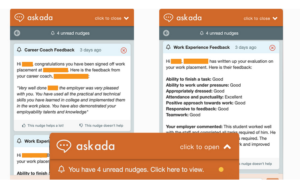
Since March 2019, the Ada service has provided nudges to students with timely and contextualised information, advice and guidance (IAG) to support their studies. The service nudges students about forthcoming exams, their work placement feedback and more. In the following example, a student receives feedback regarding his work placement from his career coach and employer.
The College is currently implementing ProMonitor, a service which will offer teachers and tutors with a scalable solution for managing and supporting the progress made by their students. Once ProMonitor is in place, Ada will be in a position to nudge students about forthcoming assignments and the grades awarded for those assignments. She will also offer students advice and guidance about staying on track with their studies. Likewise, Ada will nudge teachers and student support teams to inform them about student progress; allowing for timely support to be put in place for students across the College.
A personal lifelong learning companion
For Aftab Hussein the persona of the digital agent is important.
For Aftab Hussein the persona of the digital agent is important. He thinks that in the future that chatbot will morph into a personal cognitive assistant that supports students throughout their entire educational life, from nursery school to university and beyond.
“The personal assistant will learn from each student throughout their life and adapt according to what they like, while guiding them through studies. It could remind when homework is due, book appointments with tutors, and point towards services and events that might support studies, for example.”
The International Labour Organization (ILO) have launched a E-Discussion on Continuing online learning and skills development in times of the COVID-19 crisis. The discussion started on 27 March and runs to 9 April.
The ILO say “the virtual discussion provides an opportunity to explore the concept of “learning and training anywhere, anytime”, an idea central to the concept of lifelong learning. This, in turn, requires examination of a range of issues such as how technically prepared we are to support new ways of working in the face of disruptors like a pandemic, and how quickly we can organize digital education and training and mobilize teachers and trainers to maintain services to learners.”
You can join the discussion at the following addresses
Graham Attwell will be speaking at an online webinar – LiveCareerChat@Lockdown on 6 April. The webinar, organised by DMH Associates will focus on the future challenges for careers identities and careers advice and guidance
Deirdre Hughes says “During these turbulent times, we all have an opportunity for reflection, sharing ideas and offering practical advice on how best to manage career identity and changing work practices. This webinar is designed to bring people together and to listen and/or share experiences of careers support mechanisms at a time of crisis. ”
Graham Attwell will talk about the changing international labour markets and the challenges of new technologies, including AI and automation.
I have written before about the issues of interpreting sense making from Labour Market Data and the difference between Labour Market Information and labour Market Intelligence.
This is exposed dramatically in the article in Social Europe by German Bender entitled ‘The myth of job polarisation may fuel populism’. As German explains “It has become conventional wisdom since the turn of the century that labour markets are rapidly becoming polarised in many western countries. The share of medium-skilled jobs is said to be shrinking, while low- and high-skilled jobs are growing in proportion.” But as German points out: “In a research report published last May by the Stockholm-based think tank Arena Idé, Michael Tåhlin, professor of sociology at the Swedish Institute for Social Research, found no job polarisation—rather, a continuous upgrading of the labour market.”
German goes on to explain:
The main reason is that the research, as is to be expected from studies rooted in economics, has used wages as a proxy for skills: low-paying jobs are taken to be low-skilled jobs and so on. But there are direct ways of measuring skill demands in jobs, and Arena Idé’s report is based on a measure commonly used in sociology—educational requirements as classified by the International Labour Organization’s ISCO (International Standard Classification of Occupations) scheme. Using this methodology to analyse the change in skill composition yields strikingly different results for the middle of the skill distribution.
The study found that while jobs relatively low skill demands but relatively high wages—such as factory and warehouse workers, postal staff and truck drivers—have diminished, others with the same or slightly higher skill demands but lower wages—nursing assistants, personal-care workers, cooks and kindergarten teachers—have increased.
The reason is that the former jobs are male dominated whilst the jobs which have grown have a majority of female workers. Research in most countries has shown that women (and jobs in which women are the majority) are lower paid than jobs for men, regardless of skills levels.
“Put simply”, says German: “wages are a problematic way to measure skills, since they clearly reflect the discrimination toward women prevalent in most, if not all, labour markets across the world.”
A further review of two British studies from 2012 and 2013, showed a change in the composition, but not the volume, of intermediate-level jobs. “Perhaps the most important conclusion”, German says “was that ‘the evidence shows that intermediate-level jobs will remain, though they are changing in nature’.”
The implications of this interpretation of the data are profound. If lower and medium skilled jobs are declining there is little incentive to invest in vocational education and training for those occupations. Furthermore, young people may be put off entering such careers and similarly careers advisers may further mislead school leavers.
There has been a trend in many European countries towards higher level apprenticieships, rather than providing training with the skills need to enter such medium skilled jobs. But even a focus on skills, rather than wages, may also be misleading. It is interesting that jobs such as social care and teaching appear more resistant to automation and job replacement from technologies such as Artificial Intelligence. But those who are arguing that we should be teaching so called soft skills such as team building, empathy and communication are talking about the very skills increasingly demanded in the female dominated low and middle skilled occupations. It may be that we need not ony to relook at how we move away from wages as a proxy for skills, but also look at how we measure skills.
German references research by Daniel Oesch and Giorgio Piccitto, who studied occupational change in Germany, Spain, Sweden and the UK from 1992 to 2015, characterising good and bad jobs according to four alternative indicators: earnings, education, prestige and job satisfaction.
They concluded that occupations with high job quality showed by far the strongest job growth, whereas occupations with low job quality showed weak growth regardless of indicator used.
Much of my work at the moment is focused in two different areas – the training and professional development of teachers and trainers for the use of technology for teaching and learning and the use and understanding of labour market data for careers counseling, guidance and advice. However as data increasingly enters the world of education, the two areas are beginning to overlap.
This morning I received an email from the European Network on Regional Labour Market Monitoring. Although the title may seem a little obscure, the network, which has been active over some time, organises serious research at a pan European level. Each year it selects a theme for research, publications and for its annual conference. Over the last year it has focused on informal employment. Next year’s theme is Small and Medium Enterprises (SMEs) which they point out can be viewed as perhaps the most vibrant and innovative area of the European economy. However, when it comes to researching and understanding SMEs it is not so easy
A number of European or national statistics exist to analyse SMEs’ but they generally use the same categories as for large firms and are, in general, constructed from a large firm perspective or in any case not from a framework based on SME characteristics. Many academic papers focusing on SMEs show that they cannot fully be understood using the same categories as with large firms. The general idea is that firstly, SMEs are same as large ones, just smaller. Secondly, the assumption that they will grow up to become Midcaps, then large firms, is incorrect. Torres and Julien (2005) start their article explaining that “Most, if not all, researchers in small business have accepted the idea that small business is specific (the preponderant role of the owner-manager, low level of functional breakdown, intuitive strategy, etc.)”. A 2019 French publication directed by Bentabet and Gadille tackles the issue of SMEs focussing on their specific “social worlds”, their “action models and logics”, while elsewhere the influences of institutional logics and multi-rationalities of SMEs have been considered. The entry of social worlds highlights the great diversity of micro-enterprises and SMEs, which often makes it difficult to analyse them. As a counterpoint, specific knowledge of these companies is required because they are at the heart of the debates on flexibility, labour market dynamics, skilled labour shortage and disruptions in the vocational training system.
SMEs will be the focus for the next Annual Meeting of the Regional Labour Market Monitoring to be held in September 2020 in Sardinia
On Thursday, 10th October 2019 I am delighted to be speaking at the conference on ‘Career Development: Identity, Innovation and Impact’ in Birmingham UK
The conference will focus on career development policies, research and practice for young people and adults. It will explore practical ways of harnessing individuals’ talents, skills and learning experiences in fast changing and uncertain labour markets. Here is the abstract for my presentation:
Graham Attwell, technical lead for the UK ‘LMI for All’ project (funded by the Department of Education and led by the University of Warwick, IER) will explain latest labour market intelligence/information developments applied in career education, guidance and counselling settings. He will reflect on the changing world of work and examine the impact of technology on the future labour market and implications of Automation and Artificial Intelligence (AI) on employment and the jobs of the future. He will consider how can we best advise young people and adults on courses and employment.
The conference, organised by Deirdre Hughes for DMH Associates, will be exploring the changing nature of identities on a lifelong basis, innovative ways of working with young people and adults in education, training, employment and other community settings. In times of austerity and the impact on services users, there becomes an urgent need to provide evidence on the impact of careers work.
Participants will also get the chance to hear about a series of recent international policy and research events and your own ‘Resource Toolkit’. It is, the conference newsletter says, an opportunity to acknowledge and celebrate innovative and impactful careers work.
Deirdre Hughes will be announcing ambitious plans to help inspire others to engage in career development policies, research and practice and saying more about what they are doing with their partners on careers work in primary schools, post-primary schools and colleges (city-wide approaches), youth transitions, evidence and impact approaches and adult learning both within and outside of the workplace. To receive regular copies of their newsletter go to http://eepurl.com/glOP2f.
An article ‘Predicting Employment through Machine Learning‘ by Linsey S. Hugo on the National Association of Colleges and Employers web site,confirms some of my worries about the use of machine learning in education.
The article presents a scenario which it is said “illustrates the role that machine learning, a form of predictive analytics, can play in supporting student career outcomes.” It is based on a recent study at Ohio University (OHIO) which leveraged machine learning to forecast successful job offers before graduation with 87 percent accuracy. “The study used data from first-destination surveys and registrar reports for undergraduate business school graduates from the 2016-2017 and 2017-2018 academic years. The study included data from 846 students for which outcomes were known; these data were then used in predicting outcomes for 212 students.”
A key step in the project was “identifying employability signals” based on the idea that “it is well-recognized that employers desire particular skills from undergraduate students, such as a strong work ethic, critical thinking, adept communication, and teamwork.” These signals were adapted as proxies for the “well recognised”skills.
The data were used to develop numerous machine learning models, from commonly recognized methodologies, such as logistic regression, to advanced, non-linear models, such as a support-vector machine. Following the development of the models, new student data points were added to determine if the model could predict those students’ employment status at graduation. It correctly predicted that 107 students would be employed at graduation and 78 students would not be employed at graduation—185 correct predictions out of 212 student records, an 87 percent accuracy rate.
Additionally, this research assessed sensitivity, identifying which input variables were most predictive. In this study, internships were the most predictive variable, followed by specific majors and then co-curricular activities.
As in many learning analytics applications the data could then be used as a basis for intervention to support students employability on gradation. If they has not already undertaken a summer internship then they could be supported in this and so on.
Now on the one hand this is an impressive development of learning analytics to support over worked careers advisers and to improve the chances of graduates finding a job. Also the detailed testing of different machine learning and AI approaches is both exemplary and unusually well documented.
However I still find myself uneasy with the project. Firstly it reduces the purpose of degree level education to employment. Secondly it accepts that employers call the shots through proxies based on unquestioned and unchallenged “well recognised skills” demanded by employers. It may be “well recognised” that employers are biased against certain social groups or have a preference for upper class students. Should this be incorporated in the algorithm. Thirdly it places responsibility for employability on the individual students, rather than looking more closely at societal factors in employment. It is also noted that participation in unpaid interneships is also an increasing factor in employment in the UK: fairly obviously the financial ability to undertake such unpaid work is the preserve of the more wealthy. And suppose that all students are assisted in achieving the “predictive input variable”. Does that mean they would all achieve employment on graduation? Graduate unemployment is not only predicated on individual student achievement (whatever variables are taken into account) but also on the availability of graduate jobs. In teh UK many graduates are employed in what are classified as non graduate jobs (the classification system is something I will return to in another blog). But is this because they fail to develop their employability signals or simply because there simply are not enough jobs?
Having said all this, I remain optimistic about the role of learning analytics and AI in education and in careers guidance. But there are many issues to be discussed and pitfalls to overcome.
Forbes reports that Microsoft has obtained a patent for a “conversational chatbot of a specific person” created from images, recordings, participation in social networks, emails, letters, etc., coupled with the possible generation of a 2D or 3D model of the person.
This week, Twitter apologised for racial bias within its image-cropping algorithm. The feature is designed to automatically crop images to highlight focal points – including faces. But, Twitter users discovered that, in practice, white faces were focused on, and black faces were cropped out. And, Twitter isn’t the only platform struggling with its algorithm – YouTube has also announced plans to bring back higher levels of human moderation for removing content, after its AI-centred approach resulted in over-censorship, with videos being removed at far higher rates than with human moderators.
Gap between rich and poor university students widest for 12 years
The gap between poor students and their more affluent peers attending university has widened to its largest point for 12 years, according to data published by the Department for Education (DfE).
Better-off pupils are significantly more likely to go to university than their more disadvantaged peers. And the gap between the two groups – 18.8 percentage points – is the widest it’s been since 2006/07.
The latest statistics show that 26.3% of pupils eligible for FSMs went on to university in 2018/19, compared with 45.1% of those who did not receive free meals. Only 12.7% of white British males who were eligible for FSMs went to university by the age of 19. The progression rate has fallen slightly for the first time since 2011/12, according to the DfE analysis.
Quality Training
From Raconteur. A recent report by global learning consultancy Kineo examined the learning intentions of 8,000 employees across 13 different industries. It found a huge gap between the quality of training offered and the needs of employees. Of those surveyed, 85 per cent said they , with only 16 per cent of employees finding the learning programmes offered by their employers effective.
We will be at Online Educa Berlin 2015. See the info above. The stream URL to play in your application is Stream URL or go to our new stream webpage here SoB Stream Page.
This website uses cookies to improve your experience. We'll assume you're ok with this, but you can opt-out if you wish. Cookie settingsACCEPT
Privacy & Cookies Policy
Privacy Overview
This website uses cookies to improve your experience while you navigate through the website. Out of these cookies, the cookies that are categorized as necessary are stored on your browser as they are essential for the working of basic functionalities of the website. We also use third-party cookies that help us analyze and understand how you use this website. These cookies will be stored in your browser only with your consent. You also have the option to opt-out of these cookies. But opting out of some of these cookies may have an effect on your browsing experience.
Necessary cookies are absolutely essential for the website to function properly. This category only includes cookies that ensures basic functionalities and security features of the website. These cookies do not store any personal information.
Any cookies that may not be particularly necessary for the website to function and is used specifically to collect user personal data via analytics, ads, other embedded contents are termed as non-necessary cookies. It is mandatory to procure user consent prior to running these cookies on your website.


 The International Labour Organization (ILO) have launched a E-Discussion on Continuing online learning and skills development in times of the COVID-19 crisis. The discussion started on 27 March and runs to 9 April.
 Graham Attwell will be speaking at an online webinar – LiveCareerChat@Lockdown on 6 April. The webinar, organised by DMH Associates will focus on the future challenges for careers identities and careers advice and guidance
 I have written before about the issues of interpreting sense making from Labour Market Data and the difference between Labour Market Information and labour Market Intelligence.