Archive for the ‘e-learning 2.0’ Category

MOOCs at F-Alt

Thursday, September 4th, 2008

From Open Education News:

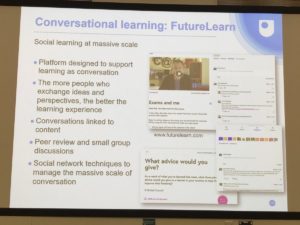
“There has been a lot of buzz about the free and open Connectivism and Connective Knowledge course to be facilitated by George Siemens and Stephen Downes in September. To date, over 1,200 people have signed up for the course prompting a new label, Massive Open Online Course (MOOC), to describe this super-sized open education course”. On a new blog about the course George says:

“As a group, we all share in the success (and failure) of MOOCs …We have to walk a line between innovating teaching and learning while still keeping things at a level that permits the ideas we’re presenting to translate into the realities of educators and administrators … While Stephen and I are facilitating this course, I think it’s critical that the larger community identifies with it and takes ownership of it. Our course isn’t happening in a vacuum - we’re building on our own previous work and the work of others. And once our course is done here, others will hopefully learn from our experience and build on it. Spiralling innovation. But I’m hoping we won’t only see people building on our work. I hope we’ll see others building with us … Research opportunities are enormous. MOOCs are uncharted, largely undocumented, territory. This course will produce a significant amount of data - both quantitative and qualitative.”

It is great that teh course is free and open. But is this real innovation. Are we not just reinventing mass rows of students sitting passively in tiered lecture tehares albeit on-line. Is thsi just another Tayloritic model of education. Cheap - yes! Efficent - yes! Effective - perhaps not. Particpation…learner support? Is the innovation technical or pedagogic?

These issues and more will be the subject of the F-Alt (the fringe conference at Alt C) warm up session in the bar at 9pm in the bar at Leeds Univeristy on Monday. It probably won’t be massive. Bit it is open and you are all invited.

Audio goodness - rhizomatic learning, Web 3.0 identities, PLEs and much, much more

Wednesday, September 3rd, 2008

OK - the summer break from the airwaves is over. Next week we will broadcast the first of the autumn series of Sound of the Bazaar LIVE - details tomorrow but put Tuesday 1820, CEST, 1720 BST in your diaries now. And here as a warm up is a new podcast produced by the wonderful Andreas Auwarter from the Bildung in Dialog site (English monoglots - don’t be put off by the the German language introduction - the discussion is in English. As Andeas says in this programme notes: “Steve Wheeler in an interview with Patrick Vetter and Christian Czarnowske. Finally Graham Attwell joins the dialog and this interview brings up to an interesting and short discussion about Web 2.0, Adult Education, Web 3.0 and their meanings of those terms.

Soundpainted with podsafe music from http://www.Jamendo.com.”

This was recorded on a beautiful summers day on the terrace of St Virgil’s conference centre in Salzburg at the EdMedia2008 Conference. To be honest, its chats like this outside the official programme which make conferences worth their while.

Once more my thanks to Andreas - and do join us on the terrace and try to imagine the sun.

Sadly I can’t seem to get the stream to play in my blog. But just head on over to Bildung in Dialog to hear this recording.

 
icon for podpress  Bildung in Dialog 40 [21:02m]: Play Now | Play in Popup | Download

PLEs - Designing for Change

Wednesday, August 13th, 2008

Yesterday I read “Designing for Change: Mash-Up Personal Learning Environments” by Fridolin Wild, Felix Mödritscher and Steinn Sigurdarson, who are working on the EU funded iCamp project. Thi is interesting stuff.
At the core of their arguement is the idea that “by establishing a learning environment, i.e. a network of people, artefacts, and tools (consciously or unconsciously) involved in learning activities, is part of the learning outcomes, not an instructional condition.”

They go on to look at AI and adaptive approaches to learning environments.

“Adaptive (educational) hypermedia technologies all differ”, they say, but “they share one characteristic: they deal primarily with the navigation through content, i.e. the represented domain specific knowledge. Information processing and knowledge construction activities are not in the focus of these approaches. Consequently, they do not treat environments as learning outcomes and they cannot support learning environment design.”

Their approach goes beyond personalisation.

“Considering the learning environment not only a condition for but also an outcome of learning, moves the learning environment further away from being a monolithic platform which is personalisable or customisable by learners (‘easy to use’) and heading towards providing an open set of learning tools, an unrestricted number of actors, and an open corpus of artefacts, either pre-existing or created by the learning process – freely combinable and utilisable by learners within their learning activities (‘easy to develop’). ”

They go on to explain a set of tools beng piloted by the iCamp project:

“In this section we describe the development of a technological framework enabling learners to build up their own personal learning environments by composing web-based tools into a single user experience, get involved in collaborative activities, share their designs with peers (for ‘best practice’ or ‘best of breed’ emergence), and adapt their designs to reflect their experience of the learning process. This framework is meant to be a generic platform for end-user development of personal learning environments taking into account the paradigm shift from expert-driven personalisation of learning to a design for emergence method for building a personal learning environment.”

The tools and platform they have developed are based on a learner interaction scripting language (LISL) leading to a Mash-UP Personal Learning Environment (MUPPLE). I do not fully understand how the platform works (does it require users to understand the scripting language?) but it appears to be based on users describing a set of activities they wish to undertake. These activities then allow them to access a set of tools to undertake those activities. The focus on activities rather than tasks seems to me interesting.

I very much like the idea that the learning platform is seen as an outcome of learning and think the approach has great potential. I woudl be interested to hear what others think of the approach. I hope to get a look at the platform and will report back.

OpenLearn - a step forward in PLE design

Friday, July 25th, 2008

I am greatly intrigued by Martin Weller’s presentation on SocialLearn yesterday. One of the advantages of Elluminate is it allows you to watch a recording of the presentation afterwards, although it is very frustrating not being able ot take part in the rolling chat channel. SocialLearn is a UK Open University project. According to the SocialLearn blog: “Some learners will be happy running 20 web apps [for their Personal Laerning Environment], while others will want to access this ecosystem via a coherent web interface. Currently one would do this via iGoogle, Netvibes, Facebook etc, if the apps have widgets in these different walled gardens.

In SocialLearn, we aim to move beyond web-feed based interoperability and visual clustering of apps on the webtop, with SL-aware apps communicating via the API, so that the learner’s profile can track and intelligently manage the flow of information and events to support their activity.”

This seems a great approach and I particularly liked Martin’s demo of their alpha software. two things stood out for me - the focus on people as a recommender for resources, thus allowing Open Educational Resouces to be accessed in context. Secondly the idea of supporting micro and episodic learning.

I do have concerns. The OU appears to be positioning the project as an experiment in exploring new business models in a world of competition by multiple learning providers. I am not sure that this is the ideal starting point but I suppose innovation is driven by many concerns and motivations!

When I watched the presentation last night I was also not happy with another of the core assumations behind the project - namely that “there is a major shift in society and education driven by the possibilities new technology create for creating and sharing content and social networking.” This seemed to me too technology centerd. But looking at it again in the cold light of a Friday morning the emphasis on the possibilities of new technology seems right. What then becomes interesting is that if such possibilities exist and if we assume that technology can be socially shaped, how do we use such possibilities in facilitating learning.

And in that respect, the SocialLearn project looks to be a very important initiative.

Coolness is culture : for universities it is part of the learning culture

Wednesday, July 23rd, 2008

My post ‘Universities get with it, wake up, be cool‘ has attracted some attention, both in comments on the blog and on twitter. Most people have agreed that the university degree ceremonies in the UK are outdated but some have not.

OK - it was a semi-humerous post. But there is a serieus point. How we celebrate achievement is part of our culture. And how universities celebrate student achievement is part of the learning culture of the institution. Degree cermonies such as the one in Aberystewth that I described - and I have no reason to believe there is any great difference in other UK universities - cannot be seen as anything other than a reflection of the learning culture of those institutions. What are the messages such events present. Firstly a veneer of the medieval univerity run by mysterious committees with inpenetrable ceremonies. Places where hierarchies are important - why else the different coloured gowns - or batman claoks as someone said on twitter. Secondly the lack of technology speaks for itself. And thirdly all this is overlaid with a crass commercialism. Vendor produced souvenirs, overpriced group hotos, hired gowns etc. University is a place you go to purchase your degree. This is not the learning culture I want to see. Universities should be serious fun. Universities should be democratic - a place of mutual leaning. And universities should be a part of continuing learning - not seperate from the rest of your life but part of a learning journey.

Universities get with it, wake up, be cool!

F-Alt Learning Goodness

Wednesday, July 23rd, 2008

It might be summer but it is certainly not quiet. And the slow revolution of self organised elearning is gathering pace (Twitter seems to be a major ‘organising’ technology but more on that in a later post). One initiative which looks interesting is F-Alt. Inaugurated by post punk playboy Scott Wilson, F-Alt is the Fringe for this years Advanced Laerning Technologies Conference, Alt C, to be held in Leeds.

As the wiki says planned (or not so planned) activities include “round-table brainstorms on some of the top topics (and non-topics). Its all up for debate.

Format: each session is a round-table brainstorm of problems, issues. Short quick quick fire format, say 20 to 30 minutes, with the aim of gathering of thoughts. Each topic identifies the questions that need to be answered to make some of these socio-technical educational interventions actually work.

Rules for participation
No long winded waffle. Participants must be short and sharp and to the point. More twitter than paper presentation.”

Sounds my kind of conference. If you are going to F-Alt and would like to be part of the loop just sign up on the wiki. And even if you are not planning to go I am sure we will have all kind sof technologies for distance communication.

Txtng is gd 4 lrng

Sunday, July 6th, 2008

Don’t miss this brilliant review - curiously filed by the Guardian newspaper under ‘Reference’ - by  linguistics Professor David Crystal on texting. David tells how langauge has always been changing and how the use of various forms of abbrieviations is not new.

“There are several distinctive features of the way texts are written that combine to give the impression of novelty, but none of them is, in fact, linguistically novel” he says. “Many of them were being used in chatroom interactions that predated the arrival of mobile phones. Some can be found in pre-computer informal writing, dating back a hundred years or more.”

He goes on to say that: “Although many texters enjoy breaking linguistic rules, they also know they need to be understood.”

He concludes: “An extraordinary number of doom-laden prophecies have been made about the supposed linguistic evils unleashed by texting. Sadly, its creative potential has been virtually ignored. But five years of research has at last begun to dispel the myths. The most important finding is that texting does not erode children’s ability to read and write. On the contrary, literacy improves. The latest studies (from a team at Coventry University) have found strong positive links between the use of text language and the skills underlying success in standard English in pre-teenage children. The more abbreviations in their messages, the higher they scored on tests of reading and vocabulary. The children who were better at spelling and writing used the most textisms. And the younger they received their first phone, the higher their scores.

Children could not be good at texting if they had not already developed considerable literacy awareness. Before you can write and play with abbreviated forms, you need to have a sense of how the sounds of your language relate to the letters. You need to know that there are such things as alternative spellings. If you are aware that your texting behaviour is different, you must have already intuited that there is such a thing as a standard. If you are using such abbreviations as lol and brb (”be right back”), you must have developed a sensitivity to the communicative needs of your textees.”

Talking about knowledge

Tuesday, July 1st, 2008

I think I might have posted this some time ago. But it is worth looking at agin in teh context of developing Personal Learning Environments. I would argue that a central tole for a PLE is for knowledge development and sharing and the knowledge development involves different processes. Jenny Hughes has produced an analysis of different forms of knowledge based on the Welsh language. Whilst English has few words to differentiate knowledge, in Welsh there are at least six different terms for knowledge processes and six different terms for different types of knowledge, each with their own distinct meaning.
The general word for knowledge in Welsh – the translation from the English word knowledge is Gwybodaeth. Even this is not an exact translation. Gwybodaeth means something like ‘knowing-ness’, rather than knowledge.

However, the word Gwybodaeth – or knowing-ness comes in different forms defining different types of knowledge:

  1. Cynnull (gwybodaeth) – to gather knowledge (as in acquisition) ‘along life’s way’
  2. Cynhaeaf (gwybodaeth) – to harvest (purposefully) knowledge– or set up systems for harnessing knowledge or organise knowledge
  3. Cymrodedd (gwybodaeth) - to compromise what you know to accommodate the unknown
  4. Cynnau (gwybodaeth) - to light or kindle knowledge (in someone else) – can also be used to ‘share knowledge’ but implicit is that it is an active process not simply an exchange of information, which is an entirely different concept.
  5. Cynllunplas (gwybodaeth) - to design (new) knowledge, paradigm shift
  6. Cynyddu (gwybodaeth) - to increase or grow (existing) knowledge

I would argue that a PLE should support in some ways all of these different forms of knowing-ness and that such a list represents a useful starting point in defining what we want a PLE to be able to do.

What do you want your PLE to be able to do?

Sunday, June 29th, 2008

I am working on a couple of new papers on Personal Learning Environments. And getting asked by developers what we want them to produce as a PLE. Nota n easy question - in fact I am not sure it is the right question! But here are a few things I think I want my PLE to be able to do.

Access / search

One of the major things we use computers for learning for is accessing and searching information and knowledge. Whilst Google has greatly improved searching it is far form perfect. We need to be able to search inside documents in a way we cannot at the moment. And of course we need to be able to access and search our own computers and possibly those of our peer network. We need to be able to search inside audio and video, which is as yet problematic. And perhaps most importantly we need to be able to find people. Accessing and searching poses many challenges for developers. At present at a relatively simple level of educational repositories we are uncertain as to whether federated search or harvesting offers the best approach.
Aggregate and scaffold
A second use of a Personal Learning Environment could be for aggregating the outcomes of our activity – be it searches for documents, or other media, be it people or be it our own work. Aggregation is more than simply producing a database or of ‘learning objects’. Aggregation should allow us to bring information and knowledge together in a meaningful way. At the same time such a process of aggregation should assist us in scaffolding our knowledge, both in terms of growing on existing knowledge but also in terms of compromising what we know to accommodate the new.

Manipulate
Another possible use of a Personal Learning Environment is to manipulate or rearrange knowledge artefacts. This could be at the simple level of editing text or adding a note or tag. However with the use of different forms of media it may involve more extensive repurposing of such objects. Such repurposing may be for use within a personal knowledge base or may be for (re) publishing or sharing with others.

Another reason for manipulating media artefacts may be to render them usable within different environments and contexts.
Analyse
A PLE should be a place to analyse knowledge. This might involve the use of different tools. Alternatively, or additionally, it might involve the functionality to render information, knowledge and data in forms to allow analysis. It might also include the functionality to share and collaborate in analyses and to compare the results of such analysis with the research of others.
Store
A simple and obvious function for a PLE is to store data and artefacts. However, that storage function may not be so easy as at first thought with an increasing use of different storage media including external drives and web storage. Whilst some data and artefacts may be stored in a personal repository it may be that others will be stored within shared areas.
Reflect
Reflection is a central activity in developing learning. Reflection is particularly critical in an information rich (or information overload) environment. Reflection involves questioning, challenging and seeking clarification and forming and defending opinions and supporting or challenging the opinions of others. A PLE could provide (micro) tools for supporting these processes.
Present
We all have a need to present our ideas, learning and knowledge in different ways and for different purposes. It may be that we merely wish to present some work in progress for feedback from others. We may also wish to present parts of our work for a seminar or for a job application. A PLE could offer the functionality to select and summarise ideas and learning and develop a presentation in different formats according to need. Some forms of presentation may be unique instances – for example a presentation at a conference, others may be more recursive e.g a C.V. Tool also need to take into account that presentation may involve different media.
Represent
The representation of learning and knowledge within a PLE may be seen as a more complex functionality of presentation. Whilst a presentation will draw directly on artefacts within the PLE, a representation will attempt to show the underpinning knowledge structures of such artefacts. A PLE could include tools for visualisation and tools which allow the structures of the knowledge to be shown in a dynamic way. They might also allow the dynamic re-rendering of such structures either through the interrelationship of the artefacts and the underpinning knowledge structures.   The representation of knowledge might be an individual activity but might also form part of a wider community activity

Share

That a personal Learning Environment should support individuals in sharing their learning and knowledge almost goes without saying. However, what is shared, when and with whom is far more complex. Tools could be developed, for example, which allow sharing to be the property of any particular artefact. A PLE might also include tools to facilitate collaborative work and collaborative work flows.
Network and people
Networks lie at the heart of a Personal Learning Environment. A PLE might be defined at a personal or individual node in a networked collaborative learning environment. It must be emphasised that a PE is not a document management system (although of course documents may be part of a PLE). PLE tools might allow social representation of networks and networking interchange. Such tools might also allow social association between people, knowledge and artefacts.

Old man gets lost in another world

Wednesday, June 25th, 2008

A brilliant guest post from my esteemed friend John Pallister.

“I dropped into a bar last night, well actually I listened in to some folks talking about where they were going to go and I decide to have a look there. I lurked around in a corner for a while, then sat down at the bar and watched. It was a bit strange, the bar did not have a barman, it looked to be a help-yourself establishment. People, who I have to admit did look a bit strange, were helping themselves to some strange things and seemed to enjoy jumping around a lot. They all appeared to know each other and were chatting about some music that was playing in the background. I attempted a bit of chit chat, although my natural reserved stopped me from dancing on the bar. As usual, I very quickly cleared the bar with everyone whizzing off with some feeble excuse about having to build a tower! I wandered a bit and got lost. I ended up in an adult area with a scantily clad Avatar jumping around in front of me and singing. Now that does not often happen to me often, was I dreaming? How could a grown man, who has a thousand and one real interests, find himself wandering around in a virtual world?

During the past two years I have been on quite a steep learning curve. The need, as a partner in the MOSEP project, to collaborate with colleagues from across Europe forced me to master Skype; Net-meeting; Eluminate Live; Media Wiki; blogging; social bookmarking and collaborative writing etc. I became engaged in a number of social networks and got into the habit of following people who had similar interests. I soon realised that it did not really matter if, having contributed something to a discussion, forum or a Blog, you did not receive a response. I realised that the vast majority of people were lurkers and that people were in fact reading what I was writing and occasionally, were using it to help them with their thinking. So there was a reason for me to participate and contribute. I also found that writing things down did in fact help to move my own thinking forward. I began to follow and contribute to communities, setting up a group and most recently experimenting with micro-blogging.

In the process of following the Jisc Emerge http://elgg.jiscemerge.org.uk/ community I ended up in Second Life last night. I teleported to a Bar on the Emerge Island. I had to apply all of my Functional ICT skills to master the Second Life interface, I did not really practice my Functional English skills but I did listen to others demonstrating their skills, with one person showing that she recognised her responsibility to move a discussion forward, attempting to engage me in the discussion by employing a range of techniques. The exploding Harveywallbanger was a new one to me! I listened to people agreeing how they would work as a team; reflecting on their own strengths; developing a shared understanding of what it was that they were going to work together to achieve; reflecting on their personal strengths and weaknesses and how they might contribute to the work of the team; etc. I was watching people, in a virtual world practising and developing their Functional and Personal Learning and Thinking skills. Had I managed to keep up with them, I am sure that I would have witnessed more as they built the Tower, although I suspect that they went on to a disco – ‘magic dance ball’?

I am beginning to see more and more potential in these environments for learning – but a bit like Twitter I am overcapacity!