Photos
October 30th, 2007I didn’t realise that this page was blank. But coming soon – a very fine set of photos taken by Jenny Hughes in Afganistan. I think you’re going to like then. So please come back soon.
I didn’t realise that this page was blank. But coming soon – a very fine set of photos taken by Jenny Hughes in Afganistan. I think you’re going to like then. So please come back soon.
As some of you may have seen from my twitter stream, this week I have been in Bucharest. The main reason for my visit was to speak at the launch event of a new European funded project on Lifelong Learning (more on that tomorrow).
But, on Monday, I was luck enough to be invited by my friend Magda Balica to the university who teaches a seminar based course on pedagogy.
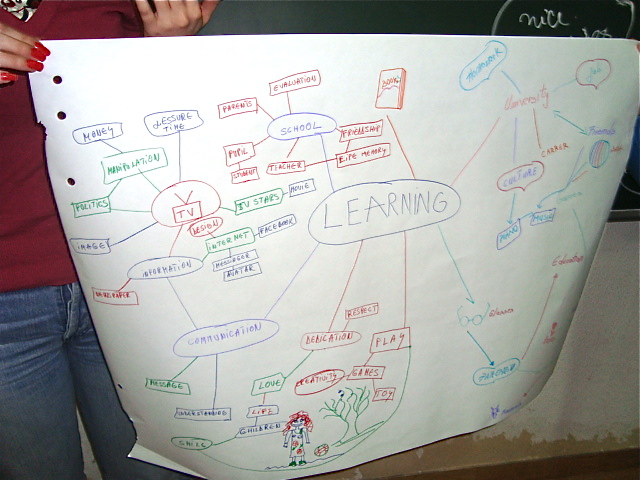
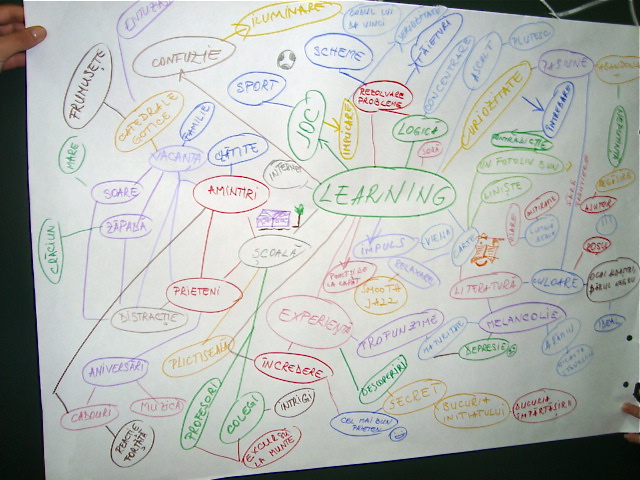
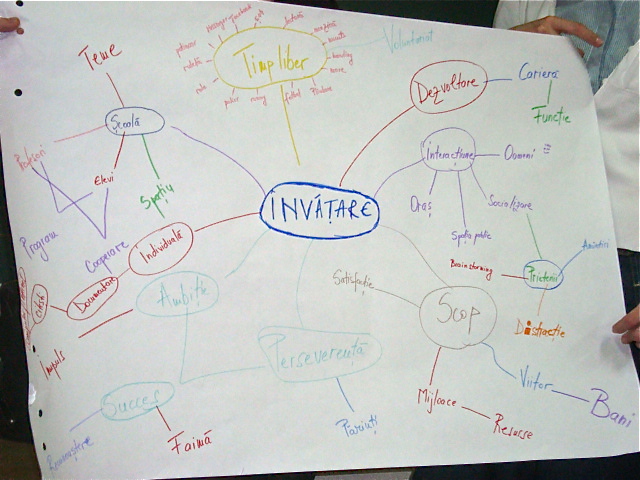
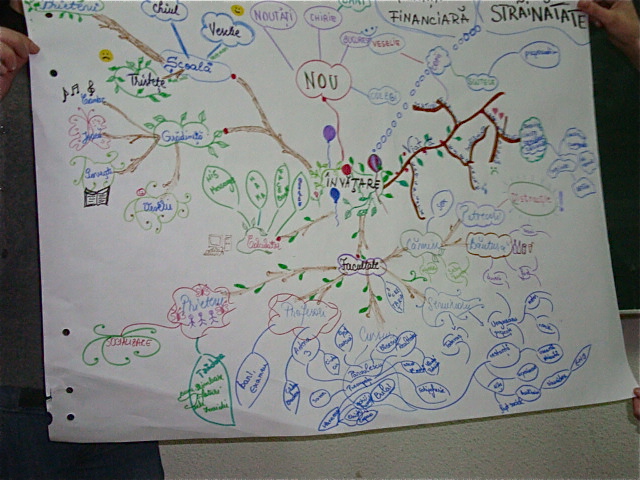
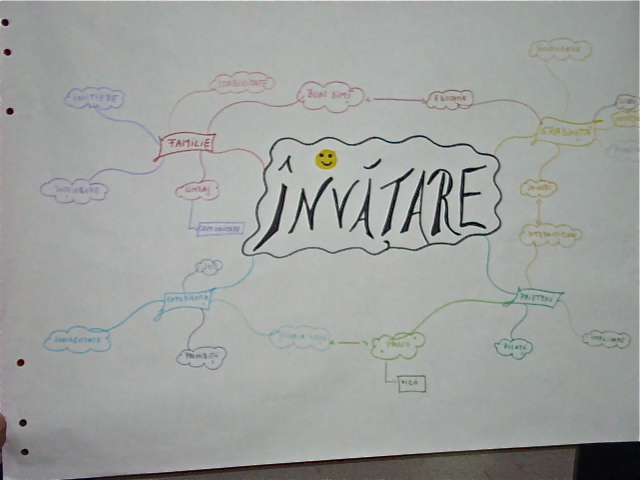
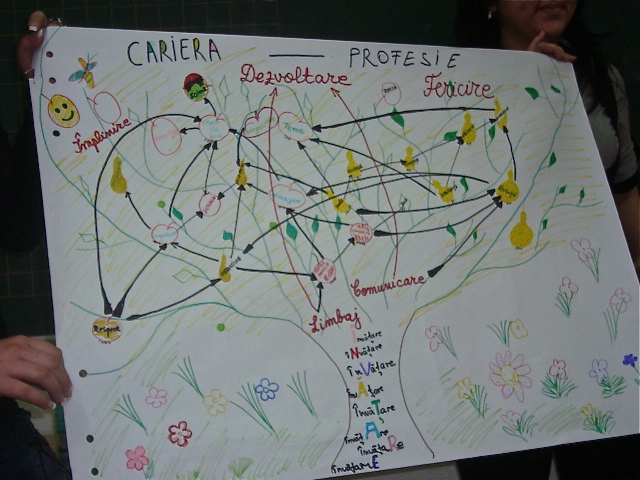
This week she was looking at the use of mindmaps and she set the students a groupwork task to draw a mindmap with ‘learning; at the centre. I was extremely impressed with the results, and als0 with the willingness of a number of the groups to produce the maps and report on them in English for my benefit.
It was interesting that most of the groups recognised the diverse sources of learning and the different contexts in which they learnt. Interesting too, and less encouraging, was how separated the different contexts appeared to be. If joined at all, learning from different sources and contexts was seen as mediated, for instance by friends or classmates. The students were in general fairly scathing about the quality of formal education in schools in Romania, although I am doubtful that the response of German or UK students would be much different.
These were some of the comments in their report backs, as recorded in twitter:
Although many of the students had Facebook accounts, none had seen Twitter before and there was general excitement about getting ‘real time’ feedback from people in different countries.
Anyway, I promised to post the mindmaps on this blog (click on any of the photos below for a larger version). Thanks to all who made my stay in Romania so interesting and enjoyable.

This Thursday sees the final session in our autumn series of open on-line seminars run jointly between the Evolve network and Educamp.
The seminar, which takes place on the Elluminate platform, is on Mobile learning and Augmented Reality, with presentations from Mark Kramer and Same Easterby Smith, both of whom are leading developments in the use of this technology for learning.
Mark says: “The application of computer-generated imagery in live-video streams on mobile devices, as a way to expand the real-world, is finally available for the masses on an affordable basis. Augmented and mixed-reality scenarios are now a common fixture of our technology arsenal of methods to acquire information about our surroundings. This emergence of augmented reality (AR) also has great potential to support individual and group learning. I will share thoughts and experiences on how AR will change the way we view and experience learning in a situated context.”
The seminar takes place at 19.00 (UK time) / 20.00 (CEST) (check your local time).
Link to Venue: Elluminate
Link for more information: Seminars
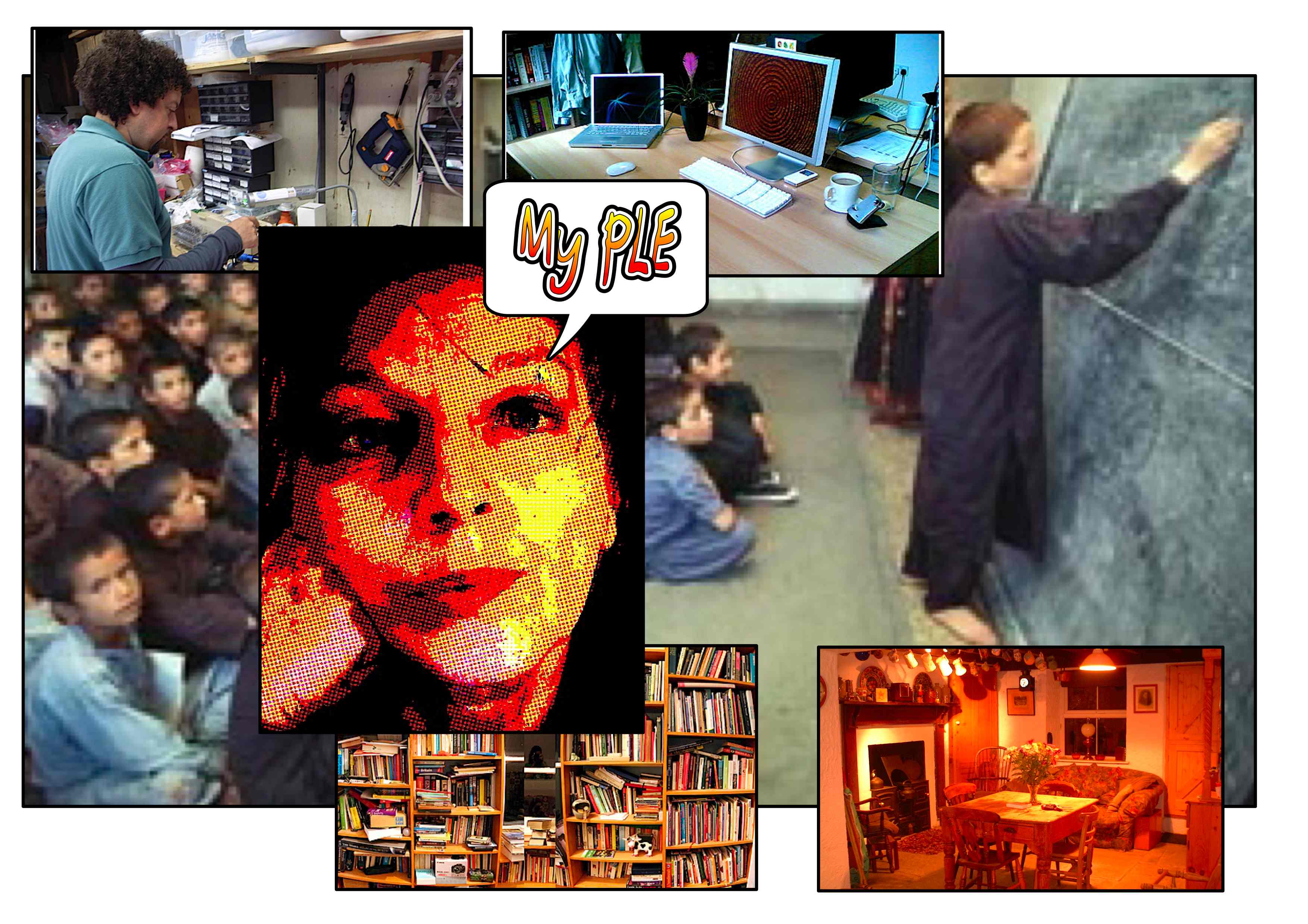
I’m doing two presentations on Personal Learning Environments this week – one in Braga in Portugal and one on line at Bar Camp Berlin. Regular readers will know these are not my first presentations on PLEs. And lately I have been concerned that the debate has been stalling a little. We have been very good at saying what a PLE is not – it is not an instititional learning system etc. but rather hazy on just what it is. So that is the theme of the all brand new – new words, new pictures presentation. I will release the slides in Friday and try to get an audio version out in next two weeks. One of the points which I am at pains to make is that a PLE is not just a technical infrastruture – indeed it is possible to imanagine a PLE which involves not computers what so ever. Anyway here is a picture Jenny Hughes drew for me of her PLE>
This beautiful and thought provoking set of photos were taken by Jenny Hughes in 2006 whilst working on an evaluation contract for the United Nations Development Programme.


Cyborg patented?
Forbes reports that Microsoft has obtained a patent for a “conversational chatbot of a specific person” created from images, recordings, participation in social networks, emails, letters, etc., coupled with the possible generation of a 2D or 3D model of the person.
Racial bias in algorithms
From the UK Open Data Institute’s Week in Data newsletter
This week, Twitter apologised for racial bias within its image-cropping algorithm. The feature is designed to automatically crop images to highlight focal points – including faces. But, Twitter users discovered that, in practice, white faces were focused on, and black faces were cropped out. And, Twitter isn’t the only platform struggling with its algorithm – YouTube has also announced plans to bring back higher levels of human moderation for removing content, after its AI-centred approach resulted in over-censorship, with videos being removed at far higher rates than with human moderators.
Gap between rich and poor university students widest for 12 years
Via The Canary.
The gap between poor students and their more affluent peers attending university has widened to its largest point for 12 years, according to data published by the Department for Education (DfE).
Better-off pupils are significantly more likely to go to university than their more disadvantaged peers. And the gap between the two groups – 18.8 percentage points – is the widest it’s been since 2006/07.
The latest statistics show that 26.3% of pupils eligible for FSMs went on to university in 2018/19, compared with 45.1% of those who did not receive free meals. Only 12.7% of white British males who were eligible for FSMs went to university by the age of 19. The progression rate has fallen slightly for the first time since 2011/12, according to the DfE analysis.
Quality Training
From Raconteur. A recent report by global learning consultancy Kineo examined the learning intentions of 8,000 employees across 13 different industries. It found a huge gap between the quality of training offered and the needs of employees. Of those surveyed, 85 per cent said they , with only 16 per cent of employees finding the learning programmes offered by their employers effective.

Our Wikispace for teaching and learning

Join our Sounds of the Bazaar Facebook goup. Just click on the logo above.
We will be at Online Educa Berlin 2015. See the info above. The stream URL to play in your application is Stream URL or go to our new stream webpage here SoB Stream Page.