Last year I evaluated the ICT in education projects and programmes for UNESCO. In particular I looked at UNESCOs work in sub Saharan Africa. In a ‘Landscape Review’ of the use of ICT in education I wrote:
“UNESCO has a humanistic vision of education and of the role of ICT in education linked to its mission of providing inclusive and quality education that is transforming lives and at the heart of UNESCO’s mission to build peace, eradicate poverty and drive sustainable development.
UNESCO believes that education is a human right (so it cannot be a market good) for all throughout life and that access must be matched by quality. It has a mandate to cover all aspects and all levels of education and to lead and contribute to the Global Education 2030 Agenda through Sustainable Development Goal 4. UNESCO believes information and communication technology (ICT) can complement, enrich and transform education for the better. As the lead United Nations Organization for education, UNESCO shares knowledge about the many ways technology can facilitate universal access to education, bridge learning divides, support the development of teachers, enhance the quality and relevance of learning, strengthen inclusion, and improve education administration and governance.”
I am very pleased to see UNECO is opening up a global discussion on the futures of education.
UNESCO is now inviting organisations and networks to mobilize their stakeholders and partners to engage in the global debate on the futures of education and provide inputs to the International Commission on the Futures of Education.
They have prepared guidelines for running stakeholder focus groups so that a broad range of unique perspectives can be brought into the global discussion. The insights gained through focus group discussions, they say, will be synthesized by UNESCO and presented to the International Commission as an input into the development of a global report on the futures of education.
UNESCO is also inviting its partners and organizations broadly interested in the futures of education to organize seminars or work groups that result in a written report for the UNESCO International Commission on the Futures of Education. Input is sought on identifying and addressing key challenges and opportunities foreseen for the future.
Yes, the new year 2020 has started already some weeks ago – I hope you all have had a good start of the year.
For me this year will be different from all of what I have experienced so far. I have returned to Bremen as has been the case for so many years before. So far I have always started working further from what I had left behind when going on the holiday break. This time it is not the case.
Concerning my employment status, I am waiting for the decision that settles my terms of retirement starting from the 1st of January 2020. Once I have got the related paperwork settled I will leave Bremen and move back to Finland. However, there are several matters of private nature that keep me moving around before I settle back to the home grounds.
In addition to the above I still have a minor contract for finishing the final duties with the EU-funded project TACCLE4 CPD. This contract will come to end at the end of August this year. However, as I have already delivered my reports for the project, I have a limited number of duties to take care of. So, I am preparing myself to go on retirement via a transitional period. I will be around in Bremen in the beginning of the year and then return for some working periods.
Concerning this blog, I will not be writing that frequently as I have used to. I am no longer in the middle of an active project that keeps me busy with working issues and with lessons learned. Right now I need to give more attention to all kinds of practicalities that need not be discussed on the blog. But, every now and then I will come up with some new issues or with memories. There is still time to reflect on working and learning.
“Ich habe noch einen Koffer in Berlin” (I still have a piece of luggage in Berlin) – this is the way that old Berliners express their longing for getting back to the home town they have left behind. The first one (if remember correctly) to record the song was Marlene Dietrich, and many others have done it after her. I am not a singer but I share this feeling although my time in Berlin was relatively short – from June 1994 to September 1995. But that was long enough to get familiar with the mega-city consisting of different kinds of districts (Bezirken) that had once been independent municipalities. And the history of Berlin (East and West) has left its traces, as well as the unification and the rebuilding and remodelling of the capital of the unified Germany. So, now that I had a chance to spend three days in Berlin, I got back to my luggage of memories just like Marlene Dietrich in her song.
Walking in Berlin – the sights “um de Ecke” (round ‘e corner) in East Berlin
To me, walking in Berlin was an endless series of expeditions in different parts of Berlin in the years 1994 – 1995. At that time I was working as a national seconded expert at Cedefop (European centre for the development of vocational training) – during that last year and a half before the centre was relocated to Thessaloniki, Greece. But this is not a story of my work but of my memories of Berlin. So, I kept visiting firstly the centres of West Berlin and East Berlin – the divide into two was still there and the construction sites in the border zones were only taking shape. And with the tube (U-Bahn) I travelled to all surrounding districts and collected impressions. So, I learned to love the city and felt bad about the thought that we had to move elsewhere. (But that, again, is another story – not for this blog entry.)
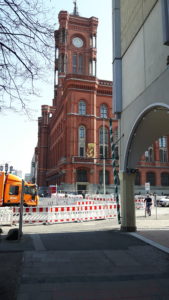
So, now that I had quite some spare time, I was there again, walking in Berlin and visiting the sights of the centres. I started from East Berlin, since my hotel was there (for reasons to be told later). And the obvious point to start was the Alexanderplatz (‘Alex’, as the locals call it). During my years in Berlin it remained pretty much the same as it was after the unification, but major changes were to come in the near future. So, the central buildings of the DDR-regime were to be demolished and completely new buildings were to be built, in particular due to the move of the capital city (Hauptstadtumzug) that was still on its way. Now, most of that rebuilding work had been done, but yet there was quite a lot of construction work going on around the Alex. This can be seen from the photos that I took there.
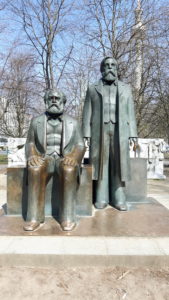
What we don’t see any longer in these pictures, is the former parliament of DDR, Palast der Republik, also called by some locals as “Erichs Lampenladen” (Erich’s lamp boutique) due its luxurious lighting from inside and outside. But, as we see it, the respectable fellows Karl Marx and Friedrich Engels are still there and observing, what all is going on.
Demonstrating in Berlin – “Berlin brennt” (Berlin is burning)
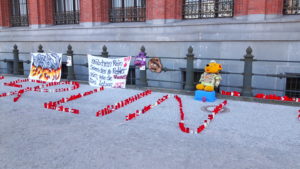
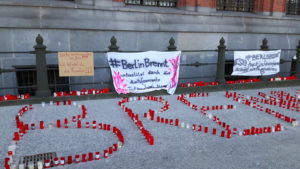
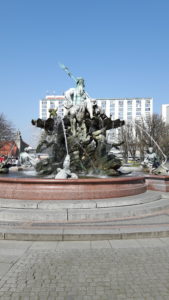
During my years in Berlin in the 1990s I experienced a lot of demonstrations – including the techno event Love parade that was officially a demonstration. This time the overarching trade union of employees in (public and private) service occupations – ver.di – had strikes (that didn’t have an impact on my travels or stay in the city). I didn’t see any great mass demonstration BUT I saw a very special demonstration of the fire fighters in front of the city hall of Berlin (Rote Rathaus). The fire fighters raised issues on health and safety, working hours, retirement arrangements, outdated equipment … . And they had found effective ways to present their message as we see it from the photos. I was happy to support them by signing their petition and by giving a statement that was recorded on a video. I hope that the authorities will count on the fire fighters when something starts burning – rather than on the old pal Poseidon, who was placed near them. (BTW, the red building in the final picture is not from Alex, it is the headquarters of ver.di close to my hotel on the other side of the river Spree.)
Berliner Dom – Unter den Linden – Brandenburger Tor – Reichstag
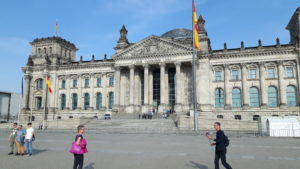
Probably the best way to get a feeling for the history of Berlin and for the critical moments is to proceed from Alex via the Berliner Dom to the main street Unter den Linden up to Brandenburger Tor (the Brandenburg gate) and to the old parliament building Reichstag. When moving between the gate and the old parliament building one cannot help thinking, how deeply the years of separation and the wall between the two parts had torn the people apart from each other. Here some photos of the Dom, Brandenburger Tor and the Reichstag.
Bahnhof Zoo – Gedächtniskirche – Ku’damm
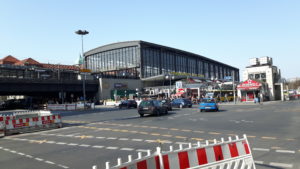
But, to be honest, at the time when I was working in Berlin, most of us (me and my colleagues) still perceived the centre of West Berlin as the real and living centre of Berlin. And accordingly, the Kurfürstendamm (or shortened as Ku’damm) counted as the main street for business and tourists. The centre of East Berlin (Mitte) was perceived more like the historical centre that was a bit out – or to some colleagues very much out (as the phrase ‘jott-wee-dee’ meaning ‘janz weit draussen’). Now, visiting shortly the central places of West-Berlin, I got the impression that that part is now being squeezed by the new buildings and the ongoing construction work. Obviously, the railway station Bahnhof Zoo and the ruin church (Gedächtniskirche) with its memorial building remain as clear landmarks. But the legendary Kranzler-Ecke – and the cafeteria that gave the name for that corner – have been squeezed into minor diminutives. Well, times – they are a-changing – as we know it from the old song.
—
Ach weh! So many memories are creeping to my mind just when writing this and adding the photos. But I guess this is enough for this blog post. In my next post I will give insights into the meetings with friends of old and how we refreshed our memories when having lunch or dinner together.
Digital literacies is a very “hot” topic right now, and one that deserves our attention given the influence of the web on our working and social lives. And worthy of note is that the web is not only influencing the way we work nor solely the way we use it to socialise. The separation between formal and informal, public and private spaces has never been less straight forward and, as many would argue, the boundaries are blurry(ing) (See here, here, and here, for instance).
In its Developing Digital Literacies briefing paper, JISC state that digital literacies define those who exhibit a critical understanding and capability for living, learning, and working in the digital society.
I think this is a good definition. It goes beyond the initial concerns regarding the searching and retrieving of information online – as important as they are – to reflect the participatory culture that the social web supports because of its very interactive nature.
Yet, not everyone perceives the web in this way nor does everyone value it for its social(lisation) potential. The web as a field of participation and socialisation is not deprived of tensions, and it is far from being evenly distributed in the current global and network society [just to throw a couple of more ready made phrases in there!]. Consequently, different practices, and agendas, co-exist in a space that aggregates a wide variety of groups of people with a multitude of approaches on how the web can be appropriated to serve their needs.
This takes me to consider the Digital Visitors and Digital Residents debate initiated by White and Cornu. In wanting to take the digital native discussion to a new level, the authors devised a topology that looks at the frequency of use and explores the needs and motivations of individuals when using the web. This is translated into two different types of users: those who have embedded the web in their day-to-day practice (the residents) and those who use it sporadically for specific purposes (the visitors). Attached to this dichotomy between intense and occasional use of the web is a feeling of belonging, with the former feeling more attached to the “online world” than the latter. Although the Digital Visitors and Digital Residents metaphor provides us with an understanding on how individuals are taking to the Social and Participatory Web, it still offers, in my opinion, a binary interpretation of a more complex reality; one that educational institutions are struggling to get to terms with. And that has as much to do with how learners are using the web as it has to do with why some learners are more predisposed to do so than others, not to mention those who may be excluded of this topology altogether because of other factors that may preclude them from having access to technology or perceiving it as a useful tool for learning.
This makes me wonder what role individuals’ social, cultural and economic background play in prompting them to engage with the web for living, learning and working.
And more important even, it leads me to question as to the role (or duty) of educational institutions in cultivating and enhancing learners‘ cultural capital in a world mediated by technology.
Providing access to technology and wifi is necessary, but it’s effects will only be felt if the implementation of such technological infrastructures are accompanied by practices that promote its effective use.
The University of Southampton has recognised that and launched a module on Living and Working on the Web in an attempt to equip their students with relevant skills for the changing job market that the so called digital economy is bringing about. In our preliminary study we realised that the student population participating in the module was very diverse, not only in terms of their digital literacies but also, and above all, in terms of their attitudes with regard to digital forms of working and learning. This might be related to the way students have been socialised into learning and how they are predisposed to engage with digital practices. In this sense, I wonder how different these students are from staff who also feel less keen in changing their practices and attitudes to accommodate digital practices.
With learning technologies (and implicitly digital literacies) starting to feature heavily in Educational Institutions’s policies, what does it really mean to (and in) practice?
The last few weeks have been extremely hectic but also rather exciting with participation in some EC projects, the writing of a new module for our Masters in Education and participation in events both in and outside my institution. I promise to translate those experiences in blogpost during the weekend [There you go. I’ve declared my intentions in writing, now I have to do it!]
Meanwhile I want to share the diagram below from mentoringminds.com because I think it’s a very useful one to have in mind for my future courses.
This week someone told me you cannot teach young children Critical Thinking. I disagree. I think everyone is capable of it … even if the degree of depth might vary according to the knowledge and experiences we manage to accumulate. All it takes is to create the appropriate learning context for it to happen and allow learners to engage with it. Having said that, sometimes that accumulated experience can also get into the way we think… critically! I think the use of digital technologies in education is a good example of that.
I am yet to develop a convincing message for those who see technology as a threat [and me as a lunatic]. Technology, or the Web for that matter, as a form of accessing information or allowing teachers to create sleek content seems to be popular amongst teachers. Everyone likes that feature. But when it comes to use the web as a form of participation, networking and co-creation of knowledge people’s opinions seems to change… almost radically, because apparently children and teenagers might not be ready for it!! …that is for me when that critical thinking vanishes, minds are no longer open to new ideas and new experiences do not materialise because people refuse to accept that using the features of the current web implies to re-think their approaches to practice.
I participated in several events in the past weeks where technology in education was discussed. For me all of those events were marked by one single sentence: “I’m useless with technology”. I have heard variants of this sentence time and time again in the last few weeks. It’s a popular statement. One that is culturally accepted between many educators too. I was puzzled that it seems to work as a perfect excuse not to look further into how technology can add something to the teaching and learning experience. Would we allow our pupils and students to say they were rubbish at maths or spelling and let them get away with it? … the answer is “certainly not”. So why can we?
As you can note from this post, I’m frustrated with such attitude, but I am even more frustrated with myself for not being able to convey the message in an effective way. But I will not give up. I’ll keep working and refining my message…
As explained in my previous post, last week I visited the Hub Westminster in central London. The Hub is located on the first floor of New Zealand house, the New Zealand embassy near Piccadily.
The hub website explains
We believe there is no shortage of good ideas to solve the issues of our time. But there is an acute lack of collaboration and support structures to help make them happen. The HUB was founded to address this need.
We set out to create spaces that combine the best of a trusted community, innovation lab, business incubator and the comforts of home. Spaces with all the tools and trimmings needed to grow and develop innovative ventures for the world. But above all, spaces for meaningful encounters, exchange and inspiration, full of diverse people doing amazing things.
The idea has been spreading like wildfire and resulted in the emergence of a global movement. To date, there are 25+ open HUBs and many more in the making, from London to San Francisco, Johannesburg, Melbourne, Sao Paulo and Milan.
Not withstanding the hype, the Hub was impressive. It consists of a large open working space, with different small work areas, and different meeting areas. there must have been some 60 or 70 people there last Friday. some spaces seemed to be for particular teams, others were hot desking areas.
True, the tech area is very different to more traditional industrial and craft sectors. But it illustrated to me how work is changing. And although European Commission policy recognises the centrality of small enterprises for future employment and economic growth, I think they have been slower to think through the implications of this in social and education policy terms.
Probably the biggest problem for micro and small businesses remains access to capital. and for micro businesses without fixed assets, and with a business plan that is yet to show profits, banks may be even more unwilling to lend that to start ups in more traditional areas of the economy.
Equally such start up businesses are heavily reliant of skills and knowledge. yet the traditional education and training systems seem slow to adapt to new and growing areas of the economy and to the needs for higher level continuing learning than traditional qualifications structures provide.
If SMEs are to play such a key role they are going to need state support. The present EU policy seems to be based on reducing legislation and providing targeted help. Yet the ‘system for targeted help may be to inflexible and slow to meet real needs on the ground. I am also unconvinced that merely exempting SMEs from employment legislation is the right answer. Germany has some of the toughest employment legislation in Europe, yet has a record of thriving SMEs.
One of the issues may be the level of decision making and the forms that decision making takes. More transparency and social involvement in decision making processes could improve the quality of support for SMEs. equally there is a need for more localised economic planning. This, in turn, means better access to data and ideas for those responsible for such planning.
I am not arguing against private sector initiatives to support SMEs and job creation. But I would argue that the public sector has a key role to play and that we need more democratic and open processes if that support is to be effective.
Similarly, we need to re-look at social systems to see how they can be adapted to changing patterns fo work including access to food and recreation systems, transport, nursery provision and education and training.
This years meme at ed-tech conferences is disruption. There seems to be two opposing discourses. One says that education is not in a period of disruption – rather that the system is evolving to take account of the possibilities that technology offers for teaching and learning.
The other says we are entering a period of disruption with the existing system fundamentally unable to respond to needs and that the take up of technology will lead to fundamental change. The rush to deliver and accredit MOOCs is seen as the tipping point.
I think both sides are wrong. Firstly there are massive differences in different countries. Whilst there is little doubt of the speed of change, uncertainty and even disruption in the US and UK higher education sectors, in Germany and the Netherlands, for example, life seems to be going on as before.
What this suggest to me is that it is not technology as such that is the major factor in disruption. Rather it is social and ideological drivers which are leading to the more apocalyptic scenarios. We probably have reached a tipping point in that the use of technology for learning is becoming mainstream. And the availability of high quality learning opportunities outside the classroom means that educational institutions can know longer claim a monopoly on learning or knowledge. Equally the power of smart phones is opening up new contexts for learning. Of course these developments will lead to changes – particularly in pedagogy – within institutions.
But the promise of such developments is to extend education to all who wish to learn, rather t5han the present minority who are able to access higher education.
But this i9s a political and social decision. Technology can be used in many different ways – for good and for bad, In the US and in the UK the technology argument is being used as part of an ideological drive to extend the remit of capital to include education – in other words to privatise education. And of course the new private institutions will be driven primarily by the need to make a profit – rather than by pedagogical imperatives.
Lets look again at MOOCs. the early MOOCs – now known as c-MOOCs – were developed by people like Stephen Downes, George Siemens, Dave Cormier and Jim Groom. The idea of massive open online courses was not to make money. Quite the reverse : they were struggling to find models to sustain the programmes. They were motivated by the idea of new pedagogical approaches to using technology for learning.
Now MOOCs have been picked up by the mainstream system. Coursera is an international consortium of elite universities using a proprietary platform to deliver free online courses. Apart from their use of video these courses are somewhat traditional in their pedagogic approach. At last weeks EFQUEL conference, Jeff Haywood, Vice Principal of Knowledge Management at Edinburgh university, a founder member of the Coursera consortium, was quite explicit about their interest in MOOCs. We are there to make money, he said. And if we do not make money within four years we will close the MOOCs down (it is worth reading Audrey Watters extremely amusing account of the education session at the TECHCrunch Disrupt conference in San Francisco earlier this week).
Same technology – but very different pedagogic approach and motivation. So it is not technology per se which is the driving force behind the great disruption. Rather it is the economic crisis and political and ideological responses to that crisis. As a society should we be retaining free education and investing in education as a response to the fall in productivity and high levels of unemployment. Or should be be seeking to cut back by privatising education? That is the real debate.
The first blog of the new year looks at what I see as something of a contradiction for those of us wanting to change and hopefully improve education. Lets look at two trends from 2010.
In terms of the use of technology for teaching and learning we saw limited technical innovation. OK, the UK saw an increasing trend towards providing Virtual Learning environments (mainly Moodle) in primary schools. Applications like Google docs and Dropbox allowed enhanced facilities for collaborative work and file sharing. However neither of these was designed specifically for educational use. Indeed the main technical trend may have been on the one hand the increased use of social software and cloud computing apps for learning and on the other hand a movement away from free social software towards various premium business models. Of course mobile devices are fast evolving and are making an increasing impact on teaching and learning.
But probably the main innovation was in terms of pedagogy and in wider approaches to ideas around learning. and here the major development is around open learning. Of course we do not have a precise or agreed definition of what open education or open learning means. But the movement around Open Educational Resources appears to be becoming a part of the mainstream development in the provision of resources for tecahing and learning, despite significant barriers still to be overcome. And there is increasing open and free tecahing provision be it through online ‘buddy’ systems, say for language learning, various free courses available through online VLEs and the proliferation of programmes offered as Massive Open Online Courses (MOOCs) using a variety of both educational and social software. Whilst we are still struggling to develop new financial models for such programmes, perhaps the major barrier is recognition. This issue can be viewed at three different levels.
The first level is a more societal issue of how we recognise learning (or attainment). at the moment this tends to be through the possession of accreditation or certification from accredited institutions. Recognition takes the form of entry into a profession or job, promotion to a higher level or increased pay.
The second level is that of accreditation. Who should be able to provide such accreditation and perhaps more importantly what should it be for (this raises the question of curriculum).
The third is the issue of assessment. Although traditional forms of individual assessment can be seen as holding back more innovative and group based forms of teaching and learning there are signs of movement in this direction – see, for example the Jisc Effective Assessment in a Digital Age, featured as his post of the year by Stephen Downes.
These issues can be overcome and I think there are significant moves towards recognising broader forms of learning in different contexts. In this respect, the development of Personal Learning Environments and Personal Learning Networks are an important step forward in allowing access to both technology and sources of learning to those not enrolled in an institution.
However, such ‘progress’ is not without contradiction. One of the main gains of social democratic and workers movements over the last century has been to win free access to education and training for all based on nee4d rather than class or income. OK, there are provisos. Such gains were for those in rich industrialised countries – in many areas of the world children still have no access to secondary education – let alone university. Even in those rich countries, there are still big differences in terms of opportunities based on class. And it should not be forgotten that whilst workers movements have fought for free and universal access to education, it has been the needs of industry and the economic systems which have tended to prevail in extending access (and particularly in moulding the forms of provision (witness the widely different forms of the education systems in northern Europe).
Now those gains are under attack. With pressures on econo0mies due of the collapse of the world banking system, governments are trying to roll back on the provision of free education. In countries like the UK, the government is to privatise education – both through developing a market driven system and through transferring the cost of education from the state to the individual or family.
Students have led an impressive (and largely unexpected) fightback in the UK and the outcome of this struggle is by no means clear. Inevitably they have begun to reflect on the relation between their learning and the activities they are undertaking in fighting the increases in fees and cutbacks in finances, thus raising the issue of the wider societal purposes and forms of education.
And that also poses issues for those of us who have viewed the adoption of technology for learning as an opportunity for innovation and change in pedagogy and for extending learning (through Open Education) to those outside schools and universities. How can we defend traditional access to institutional learning, whilst at the same time attacking it for its intrinsic limitations.
At their best, both the movements around Open Education and the student movement against cuts have begun to pose wider issues of pedagogy and the purpose and form of education as will as the issues of how we recognise learning. One of the most encouraging developments in the student movement in the UK has been the appropriation of both online and physical spaces to discuss these wider issues (interestingly in opposition to the police who have in contrast attempted to close access to spaces and movement through he so-called kettling tactic).
I wonder now, if it is possibel to bring together the two different movements to develop new visions of education together with a manifesto or rather manifestos for aschieveing such visions.
I am still in Porto, at the Faculty of Engineering , in the University of Porto. Yesterday I did a short presentation about the use of Social Media in Higher Education for the eLearning @FEUP workshop. I mainly focused on some projects I have been developing at the University Salford, but everything went so quickly […]
Forbes reports that Microsoft has obtained a patent for a “conversational chatbot of a specific person” created from images, recordings, participation in social networks, emails, letters, etc., coupled with the possible generation of a 2D or 3D model of the person.
This week, Twitter apologised for racial bias within its image-cropping algorithm. The feature is designed to automatically crop images to highlight focal points – including faces. But, Twitter users discovered that, in practice, white faces were focused on, and black faces were cropped out. And, Twitter isn’t the only platform struggling with its algorithm – YouTube has also announced plans to bring back higher levels of human moderation for removing content, after its AI-centred approach resulted in over-censorship, with videos being removed at far higher rates than with human moderators.
Gap between rich and poor university students widest for 12 years
The gap between poor students and their more affluent peers attending university has widened to its largest point for 12 years, according to data published by the Department for Education (DfE).
Better-off pupils are significantly more likely to go to university than their more disadvantaged peers. And the gap between the two groups – 18.8 percentage points – is the widest it’s been since 2006/07.
The latest statistics show that 26.3% of pupils eligible for FSMs went on to university in 2018/19, compared with 45.1% of those who did not receive free meals. Only 12.7% of white British males who were eligible for FSMs went to university by the age of 19. The progression rate has fallen slightly for the first time since 2011/12, according to the DfE analysis.
Quality Training
From Raconteur. A recent report by global learning consultancy Kineo examined the learning intentions of 8,000 employees across 13 different industries. It found a huge gap between the quality of training offered and the needs of employees. Of those surveyed, 85 per cent said they , with only 16 per cent of employees finding the learning programmes offered by their employers effective.
We will be at Online Educa Berlin 2015. See the info above. The stream URL to play in your application is Stream URL or go to our new stream webpage here SoB Stream Page.
This website uses cookies to improve your experience. We'll assume you're ok with this, but you can opt-out if you wish. Cookie settingsACCEPT
Privacy & Cookies Policy
Privacy Overview
This website uses cookies to improve your experience while you navigate through the website. Out of these cookies, the cookies that are categorized as necessary are stored on your browser as they are essential for the working of basic functionalities of the website. We also use third-party cookies that help us analyze and understand how you use this website. These cookies will be stored in your browser only with your consent. You also have the option to opt-out of these cookies. But opting out of some of these cookies may have an effect on your browsing experience.
Necessary cookies are absolutely essential for the website to function properly. This category only includes cookies that ensures basic functionalities and security features of the website. These cookies do not store any personal information.
Any cookies that may not be particularly necessary for the website to function and is used specifically to collect user personal data via analytics, ads, other embedded contents are termed as non-necessary cookies. It is mandatory to procure user consent prior to running these cookies on your website.
 Last year I evaluated the ICT in education projects and programmes for UNESCO. In particular I looked at UNESCOs work in sub Saharan Africa. In a ‘Landscape Review’ of the use of ICT in education I wrote: