Archive for the ‘socialmedia’ Category

Linkedin Endorsements

October 15th, 2012 by Graham Attwell

There have been many discussions in the educational technology community about recommender systems. And there have been a number of projects attempting to develop systems to allow people to recommend or verify the skills and competences of other people.

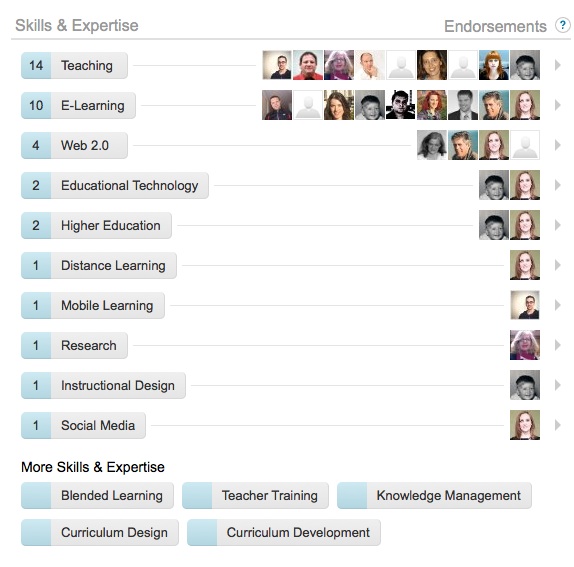
Now Linkedin has jumped big time into this area. In fact Linkedin has long had a system for allowing people to provide a reference or recommendation for others. I wrote a recommendation for Josie Fraser for her work for Jisc as a ‘community architect’. But whilst some people – like Josie – have been fairly diligent in seeking recommendations, I suspect most people have never bothered. And the old recommendation system required some effort on the part of the person writing the reference. Writing more than 148 characters has long gone out of fashion in the days of Twitter and the Facebook like button.

So Linkedin have launched a new system to allow you to ‘endorse’ people. As far as I know, they have not published how it works. But it seems to be based on matching your self claimed skills and competences to others in your network and then asking them to endorse you.

It is an interesting development but I have serious doubts about its credibility. Will employers take such a one click system seriously, especially given that there is no requirement for you to actually know the prso0n you are endorsi9ng or to have any real expertise for whatever you are endorsing them? Or will we all end up trying to game the system to make our endorsements look more impressive?

Some years ago, the UK government decided that one way to increase peoples’ employability was to send unemployed people on a CV writing course and to help them produce a professional looking CV. The result of course was CV inflation with everyone havi8ng a great CV regardless of their real abilities to do a job. And I suspect that is what will happen with Linkedin endorsements. We will all end up endorsing each other and end up where we started.

Anyway I’m off now to endorse some of my friends.

The great music license mess is stifling creativity

August 1st, 2012 by Graham Attwell

RadioActive Europe project which will work with different groups of young people and adults to develop internet radio and set up a European Internet Radio hub kicks off in November. But we are already working on a RadioActive project in London, funded by the Nominet Trust and I am in contact with a number of projects and initiatives around Europe using using radio and video channels with young people and adults.

One of the biggest problems for these project is music. Well it isn’t music as such that is the problem. Access to music has never been easier. I am nostalgic  for those long hours I spent browsing in record shops, and taking hard choices as to which album to spend my hard earned pennies on. Now my phone has more music than was ever contained in my much loved collection of LPs.

The problem is the licensing of commercial music for streaming over the radio or for use in downloads of radio programmes. And of course many young people want to play their favourite music. It is a form of curation and self expression. From talking to many musicians, they too want their music to be played on internet radio. It is a way of reaching new audiences who might buy their music.

But the licensing, controlled essentially by the music industry (and certainly not the musicians) is a total mess. I ploughed through the UK licensing documents last week to try to make some sense out of what we can and can’t do through RadioActive. And this is what I came up with.

“1. For broadcasts that include non Creative Commons licensed material

a) requires a sign off by whoever owns the music – e.g. a friends band

OR

b) A PRS For Music licence and a PPL licence.

In the case of (b)

1. We cannot offer the download of programmes or files containing any part of any Sound Recordings. This includes Podcasting.

2. We cannot loop the (streamed) replay within a 3 hour time period.

3. No more than

- 3 Sound Recordings from a particular album

-  2 Sound Recordings from a particular album

- 4 Sound Recordings by one particular artist

- 3 Sound Recordings by one particular artist consecutively

Assuming – reasonably I think – that we do not go over 270000 performances per year the 2012 licence fee for PPL’s Small Webcaster Licence is £189.41 (plus VAT).

If we played say 8 recordings per hour this would provide us with 649 listener hours per week.

We would have to provide quarterly a Webcasting Report detailing the total number of Listener Hours (i.e. the aggregate duration that all users have streamed the service), and the average number of Sound Recordings played per hour for the quarter and (if they ask for it) -  a Programme Report detailing all of the Sound Recordings used during a given day’s programming.
We also need to know which countries listeners come  from (via web analytics).

The PRS license is far less restrictive costing £118  for 118000 streams. it also allows downloading.

How could that work? For instance cover versions of copyrighted music can be downloaded but commercial recordings cannot.

So in summary (assuming we purchase both licenses) broadcasters have three options

a) To play friends original music with permissions (obtained on paper or by electronic media)

b) To play cover versions of versions by friends with permission

c) To play music covered by a creative commons license

In these three cases we can offer unlimited streaming and downloads

2. To include commercial music in which case we cannot offer for download but can offer on looped streaming subject to conditions detailed above

I think we should purchase the licenses and then explain conditions to broadcasters to make their decision.”

It is all a bit of a nightmare. Jamendo.com is an increasingly rich source of Creative Commons licensed music (although I am told even this is contested in Portugal). And I hope through the RadioActive projects that we can start recording original music. But themess of licensing is stigling creativity and preventing many musicians from getting their music held. All this in the name of an industry which has spectacularly failed to keep pace with changing technologies and changes in the social ways in which we listen to and share music.

Innovation not adverts

May 16th, 2012 by Graham Attwell

A geeky article in GeekWire notes that Facebook has downplayed the possibilities of future income from their mobile app. the reason being suggested in that users don’t like mobile apps. I think they are right. I have installed several apps because of the advertising.

And although I have pop ups blocked, I use search engines everyday on my desktop computer which provide advertising. The truth is I never see it. But on a mobile it is pretty hard to avoid. This has some pretty big implications, considering that the whole Web 2 and social software thing has been largely been financed by advertising.

A move back to paid for software and services could be a good thing. It is near to impossible for start up companies or small enterprises with a smart idea to develop a business plan. Indeed, most developers I have talked to just hope that their idea will catch on and one of the big companions will buy them. This doesn’t do much for innovation. Indeed big companies have a generally poor record when it comes to taking over innovatory start ups. Yahoo have managed somehow to run Flickr, perhaps the first really social application, into the ground. Google ended up closing down microblogging service Jaiku and I don’t hold any great hopes for the future of Posterous under Google stewardship.

Not only would a return to paid for applications and services allow a better chance for innovative start-ups to compete and to develop business models which allowed them to remain independent but it could allow the development of better privacy controls and quality. The argument that because a service if free, users have no rights is insidious, but without proper regulation is hard to counter.

And finally, it might get rid of all the advertising spam which pollutes the web.

Learning not brands

December 13th, 2011 by Graham Attwell

Amy Gahran has written an interesting article on the slow take off of QR codes. She quotes research by Archrival, a research group that focuses on youth marketing, which surveyed 500 students at 24 colleges and universities across the United States who “found that although about 80% of students owned a smartphone and had previously seen a QR code, only about 20% were able to successfully scan the example QR code they were shown.

Furthermore, about 75% said they were unlikely to scan a QR code in the future.”

One of the reasons advanced for the findings was that the process of accessing QR codes is too clunky and time consuming. So far I agree. Firing up the app and getting it to scan can be a pain.

But I would disagree with another of their conclusions. Archival suggest that QR codes need to provide “content that engenders a more meaningful connection to the brand or product.”

On the contrary I suspect it is just because QR codes are becoming associated with brands and products that we are reluctant to use them. In this respect context is critical. I will not use a QR code just to access some random brand or product web site. On the other hand if the code does something useful (and I know it is going to do something useful) like tell me the time of the next rain or bus or allow me to check in for my flight then I will and do use QR codes. And even if QR codes are thought to be an interim technology towards augmented reality and near field communication the same issues arise.

These findings reflect a growing tension between the development of social networks and services designed for us (the 99 per cent) and those for the one per cent or less of companies wanting to use social networks and advanced technologies for selling brands and products. The problem is that social network and service providers are more concerned with the one per cent than the 99. This has led to Facebook’s constant attempts to erode privacy in order to provide more data for advertisers. Even Twitter, which has perhaps been the most brand free of the networks has launched a re-design which seems primarily intended to facilitate brand advertising.

Such tensions will not go away. Web 2.0 was launched on the back of free service paid for by real (or hoped for) advertising revenue. Yet such revenues are finite. Ultimately we need to develop new and more robust business models which better reflect the nature and purpose of the services provided.

This does not mean there is no future for QR codes and other augmented mobile applications. There are a number of very convincing experiments of their use in education. But where they do work, in a social sense, the context and purpose is clear. And that is for learning, for interaction for creativity, not for pushing brands and products we do not want.

Amplifing ECER 2011

September 19th, 2011 by Graham Attwell

Last week the Pontydysgu crew were at the Freie Universitat, Berlin for the European Conference on Educational Research. As last year we were working with ECER on amplifying the conference. This included video streaming the three keynote sessions, filming interviews with 11 of the ECER network conveners and broadcasting three live radio shows. The radio hows are already online on this site and will soon be available on the ECER web pages. We will also be updating the programme information to provide more transparent access to the contents! The videos will take a little longer for editing and post processing.

We also experimented this year with using AudioBoo as a semi live audio stream. I have to admit this was inspired by AltC who had announced a live video station from their 2011 co0nference. i was jealous but also aware that we did not have the resources to emulate this. But AudioBoo requires little in the way of resources, other than an iPod, an internet connecti9on, some imagination and of course, great people to talk to. And we found plenty of people at ECER. There were something like 2300 participants enrolled at the conference from all over the world. And although we only managed to talk to a very few of the delegates, I think the AudiBoos work well in conveying the atmosphere and feel of the conference to a remote audience.

However where the Boos work best is where delegates are explaining their research interests, the things that they are passionate about. Listen for example to Benedicte Gendron from Montpelier University in France talking about emotional capital. In the past we have often seemed to have a split between papers and books being seen as media for serious research with audio being reserved for more popularist versions fo the same. I am not sure this divide is necessary. Indeed it could be fun to try using audio for the hard stuff, with easier electronic versions of papers being provided alongside. Video can be an intrusive media and to do it well needs some considerable resources. Audio is not in any way so intrusive and can be recorded on mobile devices. And I think in future conferences, it could be interesting just to arrange turn up at the end of a session and interview one of the presenters about their ideas.

Anyway thanks to all of our crew – to Jo, Jake, Judith, Klaus, Raymond and Dirk. many thanks also to Angelika, to Herr Goldenbaum and the ECER staff who were so helpful to us and of course to everyone who participated in our media fest.

Another blogpost coming up about content and ideas from the conference.

The future of social media

July 31st, 2011 by Graham Attwell

Although Google+ has been generally welcomed the advent of yet another social networking site has given rise to some thoughts on just exactly what value such sites are.

In a perceptive blog post George Siemens writes:

I’ve concluded that most of the hype around social media is nonsense and that people, particularly the self-proclaimed social media elite are clothing-less……What has social media actually done? Very, very little. The reason? Social media is about flow, not substance…….Twitter/Facebook/G+ are secondary media. They are a means to connect in crisis situations and to quickly disseminate rapidly evolving information. They are also great for staying connected with others on similar interests (Stanley Cup, Olympics). Social media is good for event-based activities. But terrible when people try to make it do more – such as, for example, nonsensically proclaiming that a hashtag is a movement. The substance needs to exist somewhere else (an academic profile, journal articles, blogs, online courses).

It is difficult not to agree. Even on twitter – to date my preferred social network – the ratio of conversation to proclamation – or information sharing – seems to be decreasing. Or is this a reverse power  effect – is it that the more people you follow the less the social interactions?

I think the problem is context. Social media work well in a particular context – be it talking with close friends and family – keeping people up to date on your movement or planning holidays – or around conferences and events, planning projects or seeking jobs. However social media is far less strong in the context of everyday life flows. Indeed the only aspect of context that social media seems good at is geo-awareness with all the privacy issues that brings.

It may be important though to distinguish between social media ‘in the wild’ – Facebook, Twitter and Google+ web sites – and the integration of social media within more specific and contextually defined web tools to support activities, learning or communities. Twitters success may be down to its relatively open development environment making it easy to embed twitter flows into blogs or community web sites.

Not withstanding the debate over the use of real names in Google+ and acknowledging the interest in the playful use of alternative identities, the issue of linking real life worlds and social media worlds seems an important one. As George says “substance needs to exist somewhere else”. But whilst George is posting that substance in the academic world, such substance may lie in different facets of our lives – within work, play or the community.

Yet I suspect those corporations developing social media applications have little interest in such substance. The substance for them is in the advertising and commercial world which produces them profit, the ultimate arbiter of success for social media companies. I have written before that the future of social media may lie in more focused and niche networks and communities – communities which can link our online and off line activities and enrich both. But such communities will have to be developed from  the bottom up. And in this context the issue of design will involve much more than cool tools and applications – or indeed encouraging us to follow ever more ‘friends’.

Measuring impact

June 17th, 2011 by Graham Attwell

This toolkit from Jisc has been released for measuring the impact of resources. However it could also be very useful for those seeking to measure project impact, an increasing demand from funding bodies.

The Jisc press release says “Measuring the impact of a resource you’ve put online can be difficult – but a newly updated JISC toolkit will help content creators, publishers and other information professionals understand the reach of their digital assets.

They can use the kit to help guide them through different aspects of measuring impact, both qualitative, such as focus groups, and quantitative, such as web metrics.”

The toolkit can be accessed here.

Serious Social Networking

January 24th, 2011 by Graham Attwell

The Guardian newspaper points to a so called ‘backlash’ against social networking, expressed in a number of recent academic studies and books. And to an extent, I agree. I suspect the novelty factor has worn off. That does not mean social networking is dead, far from it. But it does mean we are slowly evolving an ecosystem of social networking and I am not sure that the Facebook model, driven by the desire to monetarise a huge user base will survive in the long term.

Instead I see two trends. With applications like Facebook, or whatever succeeds it, friends will return to being friends. People we know, people we want to socialise with, be it family and friends we see regularly face to face or friends in distributed networks.

The second will be the growth of social networks based on shared interests and shared practice. Of course this is nothing new. The early days of the web spawned many wonderful bulletin boards with graphics being based on the imaginative use of different text and fonts. Ning led to the explosion of community sites whilst it remained free. But now we are seeing the evolution of free and open source software providing powerful tools for supporting interest and practice based communities.

Cloudworks, developed by the UK Open University has now released an installable version of their platform. Buddypress seems to have developed a vibrant open source community of developers.And I am greatly impressed by QSDA, the Open Source Question and Answer System. Quora is all the hype now. But like so many of these systems, it will be overrun not so much by machine driven spam, but by the lack of a  shared community and purpose.

According to Ettiene Wenger, a community of practice defines itself along three dimensions:

  • What it is about – its joint enterprise as understood and continually renegotiated by its members.
  • How it functions – mutual engagement that bind members together into a social entity.
  • What capability it has produced – the shared repertoire of communal resources (routines, sensibilities, artefacts, vocabulary, styles, etc.) that members have developed over time.

Open Source networking tools can allow us to support that shared repertoire of communal resources. I am working on the development of open and linked data for careers guidance and counselling. it is a fairly steep learning curve for me in terms of understanding data. And one of the bests sites I have found is Tony Hirst’s Get the Data site, only launched a week ago and based on the QSDA software, but already providing a wealth if freely contributed ideas and knowledge.

it is this sort of development that seems to me to be the future for social networking.

Gry społecznościowe – nowy paradygmat?

January 22nd, 2011 by Ilona Buchem

Ostanio dużo uwagi z perspektywy pedagogiczno-technologicznej poświęcałam tak zwanym grom poważnym (ang. Serious Games). Szczególnie zainteresowały mnie nowsze formy gier poważnych, tzw. gry społecznościowym (ang. Social Games), takie jak CityVille, FarmVille czy FrontierVille firmy Zynga.

W związku z tym, że to mój pierwszy wpis na Paradygmacie 2.0 w nowym roku, pokuszę się o małą prognozę na rok 2011. Zacznę od gier społecznościowych produkowanych przez Zynga, jako dobry przykład na to, jak można wciągnąć  do zabawy miliony ludzi.  Zynga to firma, która stała się popularna przede wszystkim przez gry na Facebooka. Hitem stały się jej gry FarmVille, potem CityVille i FrontierVille. Gra FarmVille Druga polega na prowadzeniu gospodarstwa rolnego wraz z innymi graczami. Aby uzyskać dochody gracze wspólnie uprawiają pola, hodują zwierząta i zbierają plony. CityVille polega na planistycznym i biznesowym budowaniu miasta. Najważniejszym “surowcem” jakiego potrzebują gracze są znajomi – im więcej współgraczy, tym szybciej można rozwinąć miasto. W styczniu 2011 w grze CityVille bierze udział ponad 100 milionów graczy z całgo Świata! Czym tłumaczy się tak wielki sukces tych gier? Chociaż gry takie jak CityVille czy FarmVille przypominają m.in. Sim City, są one o wiele łatwiejsze i nastawione przede wszystkim na społeczność. Gry te nie polegają na interakcji człowiek-komputer, ale na interakcji człowiek-grupa przy pomocy techniki. To znacząca zmiana w dziedzinie gier poważnych.

Innym typem gier społecznościowych to gry z celem edukacyjnym, Gry te nie są ukierunkowane na rozrywkę, co nie oznacza, że nauka nie może być przyjemnością. Wręcz przeciwnie, gry społecznościowe z celem edukacyjnym wykorzystują aspekt rozrywki to przekazywania specyficznych treści, stymulowania podejmowania wyborów i decyzji, rozwiązywanie problemów, zmiany perspektyw lub nastawień.  Do takich gier należą gry ukierunkowane na ważne problemy społeczne takie jak m.in. prawa człowieka, zmiany środowiska, polityka, globalne konflikty czy zdrowie publiczne. Dobrym przykładem producentów takich gier jest organizacja non-profit “Games for Change” . Fundacja ta zaprojektowała nie tylko serię gier (np. 3rd World Farmer, At-Risk czy The Cost of Life, ale też i publiczny zestaw narzędzi (toolkit) do wspierania tworzenia własnych gier.  Również te gry grane są w grupie. O „Games for Change“ pisano ostatnio w Mashable.

Innym ciekawym przykładem jest gra EVOKE, wystartowana przez organizację World Bank, której celem jest walka z biedą, szczególnie w krajach rozwijających się. Gra EVOKE została zaprojektowana z myślą o tym, aby zachęcić młodych ludzi, szczególnie w Afryce, do wspólnego rozwiązywania kluczowych problemów, takich jak głód, bieda, choroby, konflikty, opieka medyczna, szkolnictwo i prawa człowieka. W grze wzięło udział około 20 tysięcy osób z około 150 krajów. Gracze stworzyli  ponad 23 tysiące wpisów na blogi, około 5 tys. zdjęć i ponad 1,500 filmów video.

Te fenomenalne wyniki skłaniają mnie do prognozy na 2011: W grach społecznościowych tkwi potencjał edukacyjny. Gry społecznościowe mogą stać się jednym z najciekawszych trendów w tym roku.

Co o tym sądzicie?

Thye social web – a huge shopping mall?

January 18th, 2011 by Graham Attwell

The Facebook privacy arguments won’t go away. In part this is because as a society we are having to rethink what we mean by personal privacy and how much we are prepared to live our lives openly on the net.

And it is also in part because Facebook are keepi9ng the pressure on for ever more disclosure of data. last weekend Facebook announced that it had expanded the information users are able to share with external websites and applications, to include home addresses and mobile phone numbers. True, this had to be authorised but as is often the case the interfaces for doing this were less than clear. In the event Facebook backed off and on Monday announced they were rethinking this feature. But they will be back.

In one of a series of articles she has written on Facebook in the Guardian newspaper, Jemina Kiss explains Facebook’s motivation:

Facebook’s future – if it is to meet the increasingly inflated aspirations of its “incentivised” investors – is to use a combination of its scale and the acres of intimate information it holds about all of us to find the real money in targeted advertising. The strategy is to gradually open our personal data more and more, making open information the norm, desensitising us to any uncomfortable feelings we might have had about our personal data being released into the wild.

And in turn Facebook’s incentivised investors are driven by the aspirations of Facebook to control the social web and eat into Google’s search driven advertising revenue.

This raises a big question. If ‘social’ is indeed the future of the web, do we necessarily have to give over control to a bunch of investors. Is the web just to become one big shopping mall. Or indeed, is that what it is becoming already?

  • Search Pontydysgu.org

    News Bites

    MOOCs and beyond

    A special issue of the online journal eLearning Papers has been released entitled MOOCs and beyond. Editors Yishay Mor and Tapio Koshkinen say the issue brings together in-depth research and examples from the field to generate debate within this emerging research area.

    They continue: “Many of us seem to believe that MOOCs are finally delivering some of the technology-enabled change in education that we have been waiting nearly two decades for.

    This issue aims to shed light on the way MOOCs affect education institutions and learners. Which teaching and learning strategies can be used to improve the MOOC learning experience? How do MOOCs fit into today’s pedagogical landscape; and could they provide a viable model for developing countries?

    We must also look closely at their potential impact on education structures. With the expansion of xMOOC platforms connected to different university networks—like Coursera, Udacity, edX, or the newly launched European Futurelearn—a central question is: what is their role in the education system and especially in higher education?”


    The cost of austerity and privatisation

    There is growing concern over the consequences of the English (Scotland, Wales and Northern Ireland have different policies) government’s cutbacks and privatisation of  careers guidance for young people. The International Centre for Guidance Studies reports on a discussion paper called ‘Cost to the Economy of Government Policy on Career Guidance: A Business Case for Funding and Strengthening Career Guidance in Schools‘ from Lizzie Taylor who is an Careers England Affiliate Member. “The report claims that the economic consequence of current government policy on career education is an escalating annual cost to young people in reduced and lost earnings, reaching £676m p.a. in 2018 before dropping back slightly to £665 m p.a.2022. The total cost in reduced and lost earnings to young people in the period 2013 to 2022 is estimated as £3.2bn.”


    Open Education 2030

    The Institute for Prospective Technological Studies (IPTS) –part of the Joint Research Center of the European commission –  is calling upon experts and practitioners to come up with visionary papers and imaginative scenarios on how Open Education in 2030 in Europe might look with a major focus on Open Educational Resources and Practices, in different education sectors.

    The foresight scenarios submitted can be normative or descriptive, idealistic or provocative, critical or imaginary, reflective or polemic, imaginative or concrete, comprehensive or selective, general or specific. They should be both inspiring and scientifically sound.

    Submissions are free to choose any angle, subject, approach, but they say the future vision and/or scenario should address the key question of how Open Education in 2030 in Europe might look, and include the role of OER.

    More details from the EU Europa website.


    PLE Conference Update

    I wasn’t overoptimistic about the Personal Learning Environments Conference this year. Discussions about PLEs have been subsumed in the hype over MOOCs. And most conferences are struggling with the ongoing recession. But I am delighted that we have received 59 submissions including a number of great proposals for interactive workshops.

    The PLE Conference takes place on 10 and 12 July in Berlin.


    Twitter

    Follow Graham Attwell on Twitter Follow Cristina Costa on Twitter Follow Dirk Stieglitz on Twitter

    Other Pontydysgu Spaces

  • Sounds of the Bazaar AudioBoo

  • Recent Posts

  • Archives

  • Meta

  • Upcoming Events

      There are no events.
  • Categories