Archive for the ‘transitions’ Category

New website launched

October 3rd, 2011 by Graham Attwell

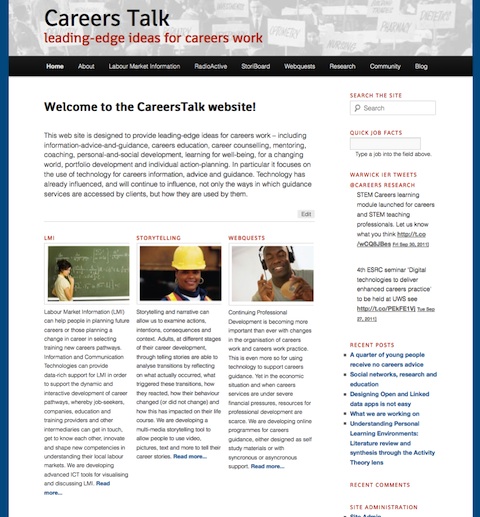
We are happy to announce the launch of a new webs site, CareersTalk. The site, developed jointly between Pontydysgu and the Institute for Employment Research, Warwick University, provides access to the ongoing research and development we are undertaking into careers guidance and in particular, the use of new technology to support careers guidance. Much of this work has been undertaken with support from the EU Mature-IP and G8WAY projects.

The introduction says: “The web site is designed to provide leading-edge ideas for careers work – including information-advice-and-guidance, careers education, career counselling, mentoring, coaching, personal-and-social development, learning for well-being, for a changing world, portfolio development and individual action-planning. In particular it focuses on the use of technology for careers information, advice and guidance. Technology has already influenced, and will continue to influence, not only the ways in which guidance services are accessed by clients, but how they are used by them.”

The web site also provides links to working versions of our data visualisation tools.

Educational transitions and career adaptability

August 19th, 2011 by Graham Attwell

I have spent much of the afternoon reading the UK Commission for Employment and Skills report on The role of career adaptability in skills supply. The report was written by my colleagues Jenny Bimrose, Alan Brown, Sally Anne Barnes and Deirdre Hughes from the Institute for Employment Research at Warwick University. It is particularly pertinent to our ongoing work on career transitions and Web2.0 and this post forms the first of two looking at some of the central ideas in the report.

Research in careers is limited yet careers choice and careers guidance are increasingly important with fast changing technologies and the world financial crisis rendering many occupations and jobs increasingly insecure. Few young people today will spend their entire working life in one occupation. The report based on empirical research undertaken in the UK and Norway looks at how people adapt to such a situation and how we can better support people through career transitions.

The term career adaptability, the authors say

describes the conscious and continuous exploration of both the self and the environment, where the eventual aim is to achieve synergy between the individual, their identity and an occupational environment. Developing career adaptability has a focus on supporting and encouraging individuals to be autonomous, by taking responsibility for their own career development. The operational definition of career adaptability used for this study was: ‘The capability of an individual to make a series of successful transitions where the labour market, organisation of work and underlying occupational and organisational knowledge bases may all be subject to considerable change’.

Central to the ideas of the report – and paqrazelling the development of Personal Learning Environments – is the aim of  supporting autonomy and recognising that

‘career’ belongs to the individual, not to the employing organisation (Duarte, 2004).

The report identifies a set of five career adaptive competencies:

  • control emphasises the need for individuals to exert a degree of influence on their situations;
  • curiosity emphasises the value in broadening horizons by exploring social opportunities and possibilities;
  • commitment stresses how individuals should experiment with new and different activities and projects, rather than being focused narrowly on getting into a particular job, so that new possibilities can be generated;
  • confidence relates to believing in yourself and your ability to achieve what is necessary to achieve your career goal;
  • concern refers to stimulating or developing a positive and optimistic attitude to the future. (Savickas et al., 2009, p.245).

Learning is obviously important in developing career adaptive competences, particularly learning through work.

The role of learning in developing career adaptability at work has four dimensions. The first involves learning through challenging work: mastering the practical, cognitive and communicative demands linked with particular work roles and work processes. The second has a primary cognitive focus and involves updating a substantive knowledge base (or mastering a new additional substantive knowledge base). Knowledge updating may play an important role in extending adaptability beyond a focus on the current work role. The third dimension has a primary communicative focus and comprises learning through (and beyond) interactions at work. Finally, the fourth dimension focuses upon how career adaptability is facilitated by individuals becoming more self-directed and self-reflexive in their learning and development.

One special aspect of being self-directed, illustrated by the quotes above, relates to being self-reflexive, able to identify your current skill set and how this might be enhanced and extended. Those who made successful transitions all seemed to be self-directed in either or both their learning and development and their career more generally. The link between being self-directed in your own learning and development and making successful transitions is transparent: if you can learn to adapt and continue to develop in your current job, even in less than ideal circumstances, then this provides a basis for making successful transitions in future. Several participants also pointed to the psychological dimension of how being self-directed and successful in making a major transition reinforced your confidence that you would be able to do this again in future, if required.

Those individuals who see that their skills can be transferred to other contexts have significant advantages in changing career direction over those who define themselves almost exclusively by their occupational and organisational attachments (Bimrose et al., 2008). This advantage stems from the former having a dynamic sense of themselves as being able to navigate their own route through the labour market, whereas the latter are dependent upon the pathways linked to a particular organisation or occupation.

However, the research based on a psychological-social approach, also recognised the importance of opportunity in careers transitions and the multiple-disadvantages many face in the labour market, especially in the UK, as opposed to Norway where class plays a lesser role. It also recognises the role that different labour market and education structures (and regulation) can play with regard to opportunity.

The term ‘opportunity structures’ itself contains the tension between openness and flexibility on the one hand and structured pathways on the other. Both are valuable and it is finding an accommodation which works well for most members of a society and also provides opportunities for those who do not fit initially. This should be the goal of a Continuing Vocational Training policy, informed by concerns for individual career developmen

The research approach was particularly interesting. In the EU funded G8WAY project we have been looking at the potential of storytelling, both as a research methodology or tool., and for helping young people reflect on education transitions. The career adaptability study also adopted a story telling approach.

The research study reported here adopted a retrospective and reflective approach – asking adults to reflect on their experiences of labour market transition, comment on the strategies they deployed and what, with the benefit of hindsight, they might have done differently. This approach has analytical power in that it enables individuals to ‘tell their career stories’, who invariably respond well to being given an opportunity to do so. Most individuals in our sample constructed coherent career narratives that had a current value in offering perspectives on where they were now, had been, and were going in their work lives. It could be argued that the career stories of some individuals may have been partly based on past events that have been reinterpreted from how they felt at the time they occurred. However, this misses an essential point about career adaptability: it is how the past is interpreted and reinterpreted which can act as a trigger to positive engagement with education and training when faced with labour market transitions. Hence, it is the stories in which we are interested, rather than searching for an unobtainable ‘truth’ about their attitudes and behaviours in the past.

This reflective approach has provided deep insights into dominant features that characterise an individual’s career adaptability profile, namely: individual (personality) characteristics; context and opportunities (opportunity structures); learning and development; and career orientation. These features are in constant and dynamic interaction, one with another.

One final aspect of being self-directed surfaced in many of our participants’ replies – people can learn from their lives through the stories they tell about them. Many of our participants recounted powerful narratives of where they had been, where they were and where they might be going. They were in charge of their own stories and such a perspective itself is an important component of adaptability.

The Determined, the Meanderer and the Stagnant

November 30th, 2010 by Graham Attwell

The European Commission funded G8WAY project is researching educational transitions with he aim of using social software and web 2.0 to assist young people in transitions.

As part of the methodology the project has undertaken some 50 interviews in five countries looking at how young people move from school to university or work, and from university to work.

These provide a rich, of somewhat disturbing, picture of uncertainty in an increasingly complex world. But, in terms of designing social software 50 case studies are hard to handle. The project has developed three personas or archetypes to help in this process. I proudly present to you the determined, the meanderer and the stagnant.

Persona Type 1 – “The Determined”

Key Attributes;

  • Rich resources
  • Passionate
  • Motivated
  • Congruent steps
  • Independent
  • Confident
  • Clear aims
  • No plan B
  • Ambitious

Typical Case Studies: Sara, Eleonora, Störte, Ronny

Motto – “Choose a job you love, and you will never have to work a day in your life.”  (Confucius)

Demographic and biographical Characteristics
The determined person tends to have a very supportive family or peer group who are able to provide encouragement and emotional security to the individual. With this in place the Determined person is able to make bold and confident decisions in their choice of career. These decisions are often made early in the individuals lives allowing them to follow a clearly defined progression towards their objective. The determined person knows where he/she is heading and rarely ventures far from the path.

The truly Determined will always find a way to balance their families’ expectations with their own needs without compromising their goals.

Transitions

Educational and transitional pathways:

Pathways are predetermined and clear. The determined person knows what to do in order to get to the next stage. Career paths are well researched and often, little time is wasted, these are the most efficient of transitions.

Motivations and Strategies:

The Determined are passionate people, they are intrinsically motivated and confident in their own abilities. They have strong friendship groups and take advantage of networking opportunities. They use their initiative and they think things through carefully rather than acting on impulse.

Support Services used

Determined people use support services well, they make use of the internet, social networking, careers guidance services and mentors. They are likely to seek out and take advice from those with more experience.

Information and Communication Technologies

Determineds make good use of the internet by surfing web sites to search for information, using email, participating in online forums and using social networks to keep in touch with friends.

Ways in which Determineds would like G8way to help:

  • at a glance regional and national Job profiles
  • comparison of vocational and e-learning courses throughout Europe
  • blog or forum to exchange experiences and advice

Persona Type 2  – “Meandering”

Key Attributes:

  • Extended/multiple transitions
  • Following a complex pathway
  • Many distractions
  • Aware of the desired outcome but unsure of how to get there
  • Deal with problems as and when they occur
  • Look for appropriate help
  • Motivated
  • Open to suggestions
  • Active, experimenting with different strategies
  • Have less resources than the Determined type

Typical Case Studies – Amleto, Michelle, Marco, Mariaangela

Motto – “I was making good progress” (Anon – in response to a traffic cop)

Demographic and biographical Characteristics

Meanderers tend to have very wide social networks making friends easily with contacts from diverse sections of society. They receive a good level of support from family and peers but lack clear guidance. Family ideals can often be a barrier to their progress. Meanderers may have multiple goals, never being entirely sure which one to pursue, or they may have one fixed goal but be unsure which path to take in order to achieve it. Some meanderers think that their dream is beyond their reach.

Transitions

Educational and transitional pathways:

The direction is uncertain and several different pathways are attempted. There are indirections and distractions along the way such as social or financial pressures. The meanderer tends to eventually reach a satisfying position but often takes the “scenic route”.

Motivations and Strategies:

The meanderer collects qualifications and enjoys learning even though the process may not directly benefit their cause. They tend to have plenty of work experience mostly around their area of interest and may have tried their hand at a number of related jobs.

Support Services used
If meanderers use support services, they make use of the internet, social networking, careers guidance services and mentors but do so without a clearly defined pathway. They have difficulty with filtering out the useful information or deciding what to do when given conflicting advice.

Information and Communication Technologies

ICT is used by this group but more for pleasure, social networking and games than for careers guidance. In the interviews, the young people typical of the group often describe themselves as not being ICT experts suggesting a lack of confidence.

Ways in which Meanderers would like G8way to help;

  • provide a sharing platform for people in transition.
  • report the different experiences for different age groups.
  • reflect the diversity of individual transitions

Persona Type 3 – Stagnant

Key Attributes:

  • Few personal resources
  • Multiple family, social or financial issues
  • Need of support in different life areas
  • Lack of enthusiasm
  • Late decisions for a field of interest
  • Difficulties to prioritise effectively
  • Low self esteem

Typical Case Studies – Sambucca, Daniele and Tillmann

Motto – “We will always tend to fulfill our own expectation of ourselves.” (Brian Tracy)

Demographic and biographical Characteristics

The Stagnant group representatives have low levels of support from family and peers. They have no fixed direction and are often too caught up in the challenges of the here and now to contemplate the future.

Transitions

Educational and transitional pathways:

By definition this group is rather unmoving or moving at pressure (financial, social). They may have some academic background but tend to be early school leavers with little desire to undergo further education.

Motivations and Strategies:

The Stagnant group are not usually actively following a clear path towards a desirable position but are happy to have reach any professional status. If further education is attempted, it is used as an interim solution. Steps taken are by chance rather than design. External proposals are taken up readily. Social and financial pressure is often the motivator to get active. Own professional plans often lack sound reflection against the own abilities and resources. Learning takes place rather accidental and informal.

Support Services used

Individuals typical of this group may attend youth groups or be involved with other community programmes. They also call on known professional services but often struggle to find specific services appropriate to their needs.

Information and Communication Technologies

The group members tend to be familiar with search engines, email and some social web2.0 tools.

Ways in which the Meandering group would like G8way to help:

  • signposting to basic skills qualifications and other training and learning opportunities
  • clear, short job profiles that fit their resources
  • competency assessment
  • way of interacting with more experienced people
  • support in discussing transition issues with parents

Multiple, extended and indirect transitions that are described to be distinct features of the Meandering persona are becoming increasingly characteristic for modern transition pathways. In our case samples, they showed throughout all transition types.

Open Research?

September 12th, 2010 by Graham Attwell

I am still interested in experimenting with different formats for conference presentations. Of course the call for contributions and formats for different conferences will limit the possibilities (as often does the design of the conference environment). The European Conference on Educational Research offers the possibility for workshops but, in may experience, there are very few workshops and all too often it is difficult to tell the difference between a paper sessions and a workshop sessions.

This year I submitted a proposal for a workshop around the G8WAY project on educational transitions. This was the proposal:

” A major characteristic of European societies is the rapidly growing differentiation of educational pathways, opportunities and biographies. This increase in complexity  requires great effort from learners into initiative taking, creativity, problem solving, risk assessment and decision taking. Through the past years various structures have been developed in order to support students in mastering educational transition. However they have been often formulated in an institutional perspective, discounting learners’ experience and creativity skills as well as new opportunities of technology enhanced learning.

The research workshop is based on the European Commission funded G8WAY project. G8WAY is based on the idea, that the growing availability of web 2.0 tools allows for bridging this gap through learner centred and connective approaches, with a chance to more effectively manage educational transition. Thus, G8WAY is developing web 2.0 enhanced learning environments, which will enable learners to reflect and develop creativity potentials and transitional skills in the light of self and others’ learning experience, made visible through a variety of media sets and PLE tools, each of them designed to meet the requirements of transition envisaged, and all of which are mapped into one single pedagogy framework.

G8WAY is producing 3 transition scenarios:

  1. school to work and
  2. general to higher education.
  3. Higher education to work

For each of the scenarios a problem oriented concept and case based reasoning method will be developed and embedded into a web 2.0 learning environment to facilitate reflection, case based reasoning and experimental learning on self and other’s learning experience across different educational contexts and towards the development of transitional skills. To this purpose G8WAY will develop web 2.0 learning environments combining a variety of media sets and ICT enhanced learning tools, which are connected through a single pedagogy framework.

The research workshop is intended to form an active part of the G8WAY project, allowing connection and input from the wider educational research community to the projects work and outcomes.

This will involve collaborative exploration of a series of interlinked issues:

  • What are the issues in transitions between education institutions and between education and work
  • What competences are required to deal with transitions
  • How can these competences be acquired
  • How can informal learning be facilitated to bridge scaffold transition processes
  • How can thinking & reflection, conversation & interaction, experience & activity or evidence & demonstration be supported in transition scenarios
  • How can we use Web 2.0 and social software to support transition processes
  • Where do learners gain support from teachers, trainers or peers in managing their own learning for transition
  • What roles could Personal Learning Networks or Personal Learning Environments play in transition processes”

It all sounded very fine when I wrote the proposal last January. But the proposal didn’t require me to say HOW i was going to design and run the workshop. I only had one and a quarter hours and to make it worse the workshop was scheduled for the final confernce session – after lunch on a Friday afternoon. What I wanted to do was to go beyind brainstrorming or group work around teh main ideas of the project and inclove particpants in the ongoing research of the project.

The G8WAY project has been undertaking a series of ‘case studies’ of transitions, based on a  story telling approach. To date we have gathered stories from 60 people, in six different countries. We have published the stories on the G8WAY project web site.  At the present time we have two working groups who are looking at the school to university transition case studies and the university to work case studies with the aim of deriving a limited number of persona. These persona are intended to provide a basis for developing social software to assist young people in educational transitions.

We had about 20 particpants in the workshop. I asked them to work in pairs. each pair was given one of the transition stories and asked to analyse it with respect to:

a) Foregrounded and backgrounding of issues in transition, as told in the case study

b) Possible spaces for intervention to support the transition

And, somewhat to my surprise, everyone not only dived into the work but seemed to enjoy it. Indeed, the only regret was that the time was too short. Backgorund issues and potential rooms for interventionf romt he different case studies included:

  • Family pressure – need spaces for empowerment and rethinking of options
  • Cultural integration – need for spaces / approaches allowing exploration of intergenerational issues
  • Lack of support from colleagues in temporary employment – need for more support in finding appropriate job vacancies
  • Instability – need for signposting to professional support
  • Unsure of identity = need for peer group contact and communication

Of course, without the original case studies this feedback makes little sense. But there was a genuine enthusiasm and interest form participants both in our work and in the process. This has led me to think if we should not extend the exercise,through our project web site, allowing those who are interested but not a project partner to contribute to the project research. Of course that raises the question of why anyone would want to participate voluntarily in ‘Open Research’? The answer I think lies in the relation between research and learning. Participation in a research project can be a powerful form of learning or professional development.

I am constantly being asked to fill in questionnaires and surveys to support different projects. But seldom does the opportunity for involvement go beyond that. It will require some creativity and imagination, but I see no reason why we shouldn’t start opening up our research to all those interested. And that is not just the obligatory bulletin board for visitors to ask questions or add a comment. It means redesigning the research methodologies and processes to allow others to participate. More to come in a future post….

Free workshop on educational transitions

September 3rd, 2010 by Graham Attwell

The autumn conference season is in full swing. One  of my favourites is Online Educa Berlin - this year being held on 2 and 3 December. If nothing else Online Educa is a great social event – a chance to catch up with friends from round the world. Online Educa also organises a series of pre conference workshops on 1 December. and this year we are organising a workshop for the European funded G8WAY project on educational transitions. Whilst there is a fee for many of the workshops, the G8WAY event is sponsored by the project and is free to participants.

The workshop will focus on the issue of how educational transitions can be made easier for young people through Internet-based services (e.g. career advice, information and guidance).

According to the workshop website the importance of helping young people in their quest to find employment is widely recognised and there is growing interest in the potential of technology-assisted learning when it comes to helping young people make the transition from education to employment. However, this area of learning remains in its infancy and throws up a series of issues for policymakers, researchers and practitioners alike.

The European project G8WAY: Enhanced Gateway to Educational Transition is investigating how social software and Web 2.0 applications can be used to help young people in make transitions.

The following key issues will be explored in the workshop:

  • What are the challenges of educational transitions – how can young people start a career in recession-hit European societies?
  • What is the potential of social software and Web 2.0 tools in the context of transitions?
  • What role can careers guidance and support play in this process?
  • What is the future of technology-based learning regarding career education?

The active involvement of participants, exchange of expertise and creation and further development of ideas will be the key elements of this pre-conference workshop.

whilst the workshop is free places are limited and pre registration is necessary. If you are going to be in Berlin, don’t miss our workshop.

  • Search Pontydysgu.org

    News Bites

    Free digital content

    From a Jisc press release:

    Over 14,000 items of archived TV footage from 17 European countries are now available via the EUscreen online portal for teaching, research and general interest.

    EUscreen – the result of a collaboration between 36 partners across Europe – provides a rich insight into Europe’s television heritage with content dating from the 1920s to the present day.

    The portal includes rare footage and commentary on key events in history, including a 1962 interview with Martin Luther King about racial discrimination in the US.

    John Ellis, Professor of Media Arts at Royal Holloway and principal investigator on the EUscreen project, said: “This is a valuable resource for anyone interested in social history or indeed TV history, as it brings together tens of thousands of clips from across Europe. The portal is available to anyone (not only academics) and it is very easy to get absorbed and spend hours browsing all of the footage.”

    The expansive footage has also proved popular as a learning aid for foreign language students, with clips available in 14 languages.

    By the end of September 2012, there will be around 30,000 items of digital content freely available on the portal as the European providers continue to add carefully selected material.

    Explore the EUscreen footage


    Open online seminar

    Jisc are hosting an open, online seminar on ‘Making Assessment Count (MAC)’ on Friday 3rd Feb – 1-2pm. The presenters are Professor Peter Chatterton (Daedalus e-World Ltd) and Professor Gunter Saunders (University of Westminster).

    The mailing for the seminar says” “The objective of Making Assessment Count is primarily to help students engage more closely with the assessment process, either at the stage where they are addressing an assignment or at the stage when they receive feedback on a completed assignment. In addition an underlying theme of MAC is to use technology to help connect student reflections on their assessment with their tutors. To facilitate the reflection aspect of MAC a web based tool called e-Reflect is often used. This tool enables the authoring of self-review questionnaires by tutors for students. On completion of an e-Reflect questionnaire a report is generated for the student containing responses that are linked to the options the student selected on the questionnaire.”

    You can find out more ans sign up for the seminar at  http://jiscmac.eventbrite.co.uk/


    EC-TEL 2012

    The EC-TEL 2012: Seventh European Conference on Technology Enhanced Learning 21st Century Learning for 21st Century Skills takes place on 18-21 September 2012 at Saarbrücken in Germany.

    The focus for the conference includes:

    - How can schools prepare young people for the technology-rich workplace of the future?
    - How can we use technology to promote informal and independent learning outside traditional educational settings?
    - How can we use next generation social and mobile technologies to promote informal and responsive learning?

    The deadline for proposals is April 2.


    Visitors and Residents

    David White (University of Oxford) and Dr. Lynn Silipigni Connaway (OCLC) have been attracting quite a stir with their JISC-funded work on Visitors and Residents: What Motivates Engagement with the Digital Information Environment?, being undertaken as part of the Developing Digital Literacies programme webinar series.

    Slides, audio and a recording of the Blackboard Collaborate session where they presented some of the findings of their work can be found at http://bit.ly/jiscdiglitvr.


    ECER 2010

    The keynotes, videos, radio shows and interviews from the ECER 2010 Conference in Helsinki:

    On the ECER 2010 website.

    Taccle handbook for teachers order form

    Here you find the Taccle handbook for teachers order form.

    Twitter

    Follow Graham Attwell on Twitter Follow Cristina Costa on Twitter Follow Dirk Stieglitz on Twitter

    Other Pontydysgu Spaces

    • Pontydysgu on the Web

      blip.tv
      Watch the Pontydysgu Videos
      pbwiki
      Our Wikispace for teaching and learning
      Sounds of the Bazaar Radio LIVE
      Join our Sounds of the Bazaar Facebook goup. Just click on the logo above.

      Our next programmes will be live from the German Moodlemoot in Emsden. Full details coming soon

  • Sounds of the Bazaar AudioBoo

  • Recent Posts

  • Archives

  • Meta

  • Upcoming Events

      There are no events.
  • Categories