Archive for the ‘e-portfolios’ Category

More notes on e-Portfolios, PLEs, Web 20 and social software

March 16th, 2010 by Graham Attwell

Some more very quick notes on teaching and learning, e-portfolios and Personal Learning Environments.

Lets start with the old problems of Virtual Learning Environments – yes one problem is that they are not learning environments (in the sense of an active learning process taking place – but rather learning management systems. VLEs are great for enrolling and managing learners, tracking progress and completion and for providing access to learning materials. But the learning most often takes place outside the VLE with the VLE acting as a place to access activities to be undertaken and to report on the results. In terms of social learning, groups are usually organised around classes or assignments.

The idea of Personal Learning environments recognised three significant changes:

  • The first was that of a Personal Learning Network which could be distributed and was not limited by institutional groups
  • The second was the idea that learning could take place in multiple environments and that a PLE could reflect and build on all learning, regardless of whether it contributed to a course the user was enrolled on
  • The third is that learners could use their own tools for learning and indeed those tools, be they online journals and repositries, networks or authoring tools, might also be distributed.

Then lest throw social software and Web 2.0 into the mix. This led to accordances for not just consuming learning through the internet, but for active construction and sharing.

This leads to a series of questions in developing both pedagogies and tools to support (social) learning (in no particular order):

  • How to support students in selecting appropriate tools to support their learning?
  • How to support students in finding resources and people to support their learning?
  • How to support students in reporting or representing their learning?
  • How to support students in identifying and exploring a body of knowledge?
  • How to motivate and support students in progressing their learning?
  • How can informal learning be facilitated and used within formal course outcomes?

How can we reconcile learning through communities of practice (and distributed personal learning networks) with the requirements of formal courses?

I am not convinced those of us who advocate the development of Personal Learning Environments have adequately answered those questions. It is easy to say we need changes in the education systems (and of course we do).

In one sense I think we have failed to recognise the critical role that teachers play in the learning process. Letsg o back to to Vykotsky. Vykotsky called those teachers – or peers – who supported learning in a Zone of Proximal Development as the More Knowledgeable Other. “The MKO is anyone who has a better understanding or a higher ability level than the leaner particularly in regards to a specific task, concept or process. Traditionally the MKO is thought of as a teacher, an older adult or a peer” (Dahms et al, 2007).

But the MKO can also be viewed as a learning object or social software which embodies and mediates learning at higher levels of knowledge about the topic being learned than the learner presently possesses.

Of course learners operate within constraints provided in part by the more capable participants (be it a teacher peer, or software), but an essential aspect of this process is that they must be able to use words and other artefacts in ways that extend beyond their current understanding of them, thereby coordinating with possible future forms of action.

Thus teachers or peers as well as technology play a role in mediating learning.

In terms of developing technology, we need to develop applications which facilitate that process of mediation. Some social software works well for this. If I get stuck on a problem I can skype a friend or shout out on Twitter, There is plenty of evidenced use of Facebook study groups. Yet I am not sure the pedagogic processes and the technology are sufficiently joined up. If I learn from a friend or peer, and use that learning in my practice, how does the process become transparent – both to myself and to others. How can I represent by changing knowledge base (through DIIGO bookmarks, through this blog?). And how can others understand the ideas I am working on and become involved in a social learning process.

I guess the answer lies in the further development of semantic applications which are able to make those links and make such processes transparent. But this requires far greater sophistication than we have yet achieved in developing and understanding Personal Learning Environments,

Rethinking e-Portfolios

March 14th, 2010 by Graham Attwell

The second in my ‘Rethinking’ series of blog posts. This one – Rethinking e-portfolios’ is the notes for a forthcoming book chapter which I will post on the Wales wide Web when completed..

Several years ago, e-portfolios were the vogue in e-learning research and development circles. Yet today little is heard of them. Why? This is not an unimportant question. One of the failures of the e-learnng community is our tendency to move from one fad to the next, without ever properly examining what worked, what did not, and the reasons for it.

First of all it is important to note that  there was never a single understanding or approach to the development and purpose of an e-Portfolio. This can largely due be ascribed to different didactic and pedagogic approaches to e-Portfolio development and use. Some time ago I wrote that “it is possible to distinguish between three broad approaches: the use of e-Portfolios as an assessment tool, the use of e-Portfolios as a tool for professional or career development planning (CDP), and a wider understanding of e-Portfolios as a tool for active learning.”

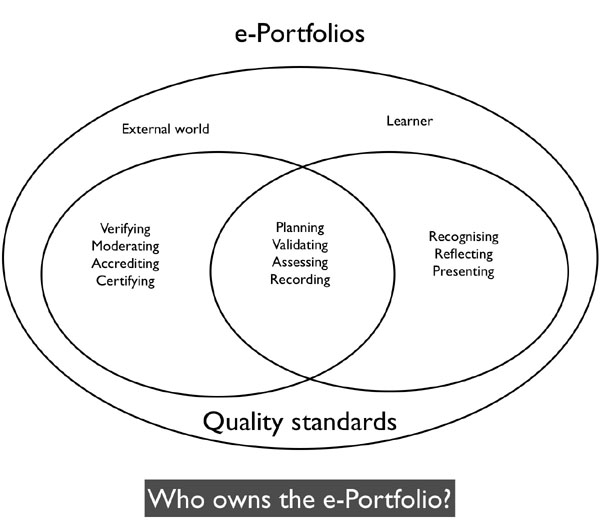
In a paper presented at the e-Portfolio conference in Cambridge in 2005 (Attwell, 2005), I attempted to distinguish between the different process in e-Portfolio development and then examined the issue of ownership for each of these processes.
eport

The diagramme reveals not only ownership issues, but possibly contradictory purposes for an e-Portfolio. Is an e-Portfolio intended as a space for learners to record all their learning – that which takes place in the home or in the workplace as well as in a course environment or is it a place or responding to prescribed outcomes for a course or learning programme? How much should a e-Portfolio be considered a tool for assessment and how much for reflection on learning? Can tone environment encompass all of these functions?

These are essentially pedagogic issues. But, as always, they are reflected in e-learning technologies and applications. I worked for a whole on a project aiming to ‘repurpose the OSPI e-portfolio (later merged into Sakai) for use in adult education in the UK. It was almost impossible. The pedagogic use of the e-Portfolio, essentially o report against course outcomes – was hard coded into the software.

Lets look at another, and contrasting, e-Portfolio application, ELGG. Although now used as a social networking platform, in its original incarnation ELGG stared out as a social e-portfolio, originating in research undertaken by Dave Tosh on an e-portfolio project. ELGG essentially provided for students to blog within a social network with fine grained and easy to use access controls. All well and good: students were not restricted to course outcomes in their learning focus. But when it came to report on learning as part of any assessment process, ELGG could do little. There was an attempt to develop a ‘reporting’ plug in tool but that offered little more than the ability to favourite selected posts and accumulate them in one view.

Mahara is another popular open source ePortfolio tool. I have not actively played with Maraha for two years. Although still built around a blogging platform, Mahara incorporated a series of reporting tools, to allow students to present achievements. But it also was predicated on a (university) course and subject structure.

Early thinking around e-Portfolios failed to take into account the importance of feedback – or rather saw feedback as predominately as coming from teachers. The advent of social networking applications showed the power of the internet for what are now being called personal Learning networks, in other words to develop personal networks to share learning and share feedback. An application which merely allowed e-learners to develop their own records of learning, even if they could generate presentations, was clearly not enough.

But even if e-portfolios could be developed with social networking functionality, the tendency for institutionally based learning to regard the class group as the natural network, limited their use in practice. Furthermore the tendency, at least in the school sector, of limited network access in the mistaken name of e-safety once more limited the wider development of ‘social e-Portfolios.”

But perhaps the biggest problem has been around the issue of reflection. Champions have lauded e-portfolios as a natural tools to facilitate reflection on learning. Helen Barrett (2004) says an “electronic portfolio is a reflective tool that demonstrates growth over time.” Yet  are e-Portfolios effective in promoting reflection? And is it possible to introduce a reflective tool in an educations system that values the passing of exams through individual assessment over all else? Merely providing spaces for learners to record their learning, albeit in a discursive style does not automatically guarantee reflection. It may be that reflection involves discourse and tools for recording outcomes offer little in this regard.

I have been working for the last three years on developing a reflective e-Portfolio for a careers service based din the UK. The idea is to provide students an opportunity to research different career options and reflect on their preferences, desired choices and outcomes.

We looked very hard at existing opens source e-portfolios as the basis for the project, nut could not find any that met our needs. We eventually decided to develop an e-Portfolio based on WordPress – which we named Freefolio.

At a technical level Freefolio was part hack and part the development of a plug in. Technical developments included:

  • The ability to aggregate summaries of entries on a group basis
  • The ability add custom profiles to see profiles of peers
  • Enhanced group management
  • The ability to add blog entries based on predefined xml templates
  • More fine grained access controls
  • An enhanced workspace view

Much of this has been overtaken by subsequent releases of WordPress multi user and more recently Buddypress. But at the time Freefolio was good. However it did  not work in practice. Why? There were two reasons I think. Firstly, the e-Portfolio was only being used for careers lessons in school and that forms too little a part of the curriculum to build a critical mass of familiarity with users. And secondly, it was just too complex for many users. The split between the front end and the back end of WordPress confused users. The pedagogic purpose, as opposed to the functional use was too far apart. Why press on something called ‘new post’ to write about your career choices.

And, despite our attempts to allow users to select different templates, we had constant feedback that there was not enough ease of customisation in the appearance of the e-Portfolio.

In phase two of the project we developed a completely different approach. Rather than produce an overarching e-portfolip, we have developed a series of careers ‘games; to be accessed through the Careers company web site. Each of the six or so games, or mini applications we have developed so far encourages users to reflect on different aspects of their careers choices. Users are encouraged to rate different careers and to return later to review their choices. The site is yet to be rolled out but initial evaluations are promising.

I think there are lessons to be learnt from this. Small applications that encourage users to think are far better than comprehensive e-portfolios applications which try to do everything.

Interestingly, this view seems to have concur with that of CETIS. Simon Grant points out: “The concept of the personal learning environment could helpfully be more related to the e-portfolio (e-p), as both can help informal learning of skills, competence, etc., whether these abilities are formally defined or not.”

I would agree: I have previously seen both as related on a continuum, with differing foci but similar underpinning ideas. However I have always tended to view Personal Learning Environments as a pedagogic capproach, rather than an application. Despite this, there have been attempts to ‘build a PLE’. In that respect (and in relation to rethinking e-Portfolios) Scott Wilson’s views are interesting. Simon Grant says: “As Scott Wilson pointed out, it may be that the PLE concept overreached itself. Even to conceive of “a” system that supports personal learning in general is hazardous, as it invites people to design a “big” system in their own mind. Inevitably, such a “big” system is impractical, and the work on PLEs that was done between, say, 2000 and 2005 has now been taken forward in different ways — Scott’s work on widgets is a good example of enabling tools with a more limited scope, but which can be joined together as needed.”

Simon Grant goes on to say the ““thin portfolio” concept (borrowing from the prior “personal information aggregation and distribution service” concept) represents the idea that you don’t need that portfolio information in one server; but that it is very helpful to have one place where one can access all “your” information, and set permissions for others to view it. This concept is only beginning to be implemented.”

This is similar to the Mash Up Personal Learning Environment, being promoted in a number of European projects. Indeed a forthcoming paper by Fridolin Wild reports on research looking at the value of light weight widgets for promoting reflection that can be embedded in existing e-learning programmes. This is an interesting idea in suggesting that tools for developing an e-Portfolio )or for that matter, a PLE can be embedded in learning activities. This approach does not need to be restricted to formal school or university based learning courses. Widgets could easily be embedded in work based software (and work flow software) and our initial investigations of Work Oriented Personal Learning Environments (WOMBLES) has shown the potential of mobile devices for capturing informal and work based learning.

Of course, one of the big developments in software since the early e-Portfolio days has been the rise of web 2.0, social software and more recently cloud computing. There seems little point in us spending time and effort developing applications for students to share powerpoint presentations when we already have the admirable slideshare application. And for bookmarks, little can compete with Diigo. Most of these applications allow embedding so all work can be displayed in one place. Of course there is an issue as to the longevity of data on such sites (but then, we have the same issue with institutional e-Portfolios and I would always recommend that students retain a local copy of their work). Of course, not all students are confident in the use of such tools: a series of recent studies have blown apart the Digital Native (see for example Hargittai, E. (2010). Digital Na(t)ives? Variation in Internet Skills and Uses among Members of the “Net Generation”. Sociological Inquiry. 80(1):92-113).  And some commercial services may be more suitable than other for developing an e-Portfolio: Facebook has in my view limitations! But, somewhat ironically, cloud computing may be moving us nearer to Helen Barrett’s idea of an e-Portfolio. John Morrison recently gave a presentation (downloadable here) based on his study of ‘what aspects of identity as learners and understandings of ways to learn are shown by students who have been through a program using course-based networked learning?’ In discussing technology he looked at University as opposed to personally acquired, standalone as opposed to networked and Explored as opposed to ongoing use.

He found that students:

Did not rush to use new technology

Used face-to-face rather than technology, particularly in early brainstorming phases of a project

Tried out software and rejected that which was not meeting a need

Used a piece of software until another emerged which was better

Restrained the amount of software they used regularly to relatively few programs

Certain technologies were ignored and don’t appear to have been tried out by the students

Students used a piece of software until another emerged which was better  which John equates with change. Students restrained the amount of software they used regularly to relatively few programs  which he equates with conservatism

Whilst students were previously heavy users of Facebook, they were now abandoning it. And whilst there was little previous use of Google docs, his latest survey suggested that this cloud application was now being heavily used. This is important in that one of the more strange aspects of previous e0Portolio development has been the requirement for most students to upload attached files, produced in an off line work processor, to the e-Portfolio and present as a file attachment. But if students (no doubt partly driven by costs savings) are using online software for their written work, this may make it much easier to develop online e-portfolios.

John concluded that :this cohort lived through substantial technological change. They simplified and rationalized their learning tools. They rejected what was not functional, university technology and some self-acquired tools. They operate from an Acquisition model of learning.” He concluded that “Students can pick up and understand new ways to learn from networks. BUT… they generally don’t. They pick up what is intended.” (It is also well worth reading the discussion board around John’s presentation – - although you will need to be logged in to the Elesig Ning  site).

So – the e-Portfolio may have a new life. But what particularly interests me us the interplay between pedagogic ideas and applications and software opportunities and developments in providing that new potential life. And of course, we still have to solve that issue of control and ownership. And as John says, students pick up what is intended. If we continue to adhere to an acquisition model of learning, it will be hard to persuade students to develop reflective e-Portfolios. We should continue to rethink e-Portfolios through a widget based approach. But we have also to continue to rethink our models of education and learning.

Developing mobile applications to support My Learning Journey

January 25th, 2010 by Graham Attwell

A quick post about mobile devices and work based learning – which I know I have been going on about a lot lately.

So far most of the work on mobile learning at a practical level seems to me to fit into four categories:

  • applications designed to provide information for students – about their courses, lecture times, venues, transport information, buildings etc.
  • what might be called learning objects – small apps designed to support learning about a particular topic or issue – often using multi media
  • apps or projects aiming to improve communication between learners or between learners and teachers
  • information – revision guides etc. designing to promote mobile access to resources

There is nothing wrong about any of these and they all may be useful in pushing mobile learning forward. But I think they may fail to really extend forward ideas about tecahing and learning 0 they are all essentially repackaging existing elearning applications for mobile devices.

The big potential I see for mobile devices is in their affordances of being always on – or almost always on, in the fact that we already accept the idea of the frequent but sporadic use of the devices for all kinds of activities such as taking photos and messaging – as well as making telephone calls – and that they are portable.

in other words – taking learning support to areas it has not been taken to before. And prime amongst these is teh workplace. It is little coincidence that many of the main take-up areas for elearning are for those occupations which involve regular use of computers e.g in ICT occupations, in marketing and management etc. Ans one of the main issues in developing elearning for vocational or occupational learning is the contextual nature of such learning and the high cost of producing specific learnng materials for relatively low numbers of learners. Vocational students often wish for learning materials to be in their own language, thus exacerbating the problem of small numbers of users for specific occupations.

It is also interesting to note that despite many researchers pointing to the importance of reflection as a key pedagogic tool, there has been limited pedagogic and technical development to facilitate such an approach.

The use of mobile devices can overcome this. They can be used in specific contexts of location, tasks, experince, colleagues and allow ready means of reflection through the use of photographs, video, text and audio.

If linked up to a server based ‘portfolio’ this could form an essential part of a Personal Learning Environment. Furthermore the learning materials become the entire work environment, rather than custom built applications. And tools such as Google Goggles could easily be incorporated (although I have to say it seems more alphe than beta ot me – I havent managed to get it to recognise a single object so far!).

I am mush taken with a free Android Ap called Ontheroad. It doesn’t do much. It is designed its ays for you to share your adventures on the road You have to set up a free account on a web site. You can publish active trips (I am going to try to make one this week). You can add articles including your position by GPS, you can add text, multimedia, dates and choose which trip to publish it to though the telephone network or by SMS. You can browse existing articles and look at comments. You can add media including photos already on your gallery. Or you can record a video (audio support seems limited).

And it is all synced through a server. It would not take much to refocus this app to a Learning Journey, rather than a road trip. And it could be incredibly powerful in terms of work based learning.

So I do not see a great technical challenge. the bigger challenge is in developing a pedagogic approach which incorporates informal learning in the workplace and such a portfolio based on practice within formal approaches ot education and training.

If you are interested in working with me to develop these technologies and ideas please get in touch.

Personal Learning Environments in the Cloud?

January 24th, 2010 by Graham Attwell

I am surprised that there has not been more discussion of the UK Open University’s decison to sign up to Google Education for cloud computing services.

On his blog Niall Sclater says:

“In our first foray into cloud computing, Google will be hosting for our students:

  • email (gmail)
  • contacts
  • instant messaging and presence
  • calendar
  • document creation, storage and sharing
  • websites”

Interestingly, The OU, the UK’s largest univeristy, will not at the moment be giving staff access ot the system, presumably becuase of concerns over security and confidentiality.

Niall explains the reasons for the decision :

“Growing numbers of institutions are now adopting cloud-based systems such as Google Apps for Education, particularly in the US. The arguments for hosting your own student email are becoming increasingly weak when it can be done externally for free, or at least much more cheaply. Google will provide a service level agreement with higher levels of availability than we could achieve ourselves. In addition there are other services included such as instant messaging that we don’t currently provide to students but could help them to connect more with each other.”

However the decision has interesting implications for pedgogic approaches. Niall says:

“These systems will increasingly start to compete with some of the features of learning management systems / virtual learning environments such as Moodle and Blackboard. They provide a higher level of individual control for students and potentially remove some of the administrative burden from the university. …

Another area for investigation is the use of Google Apps as an eportfolio system. Our initial research has shown that it would work for some of the key aspects of eportfolio provision such as the storage of documents under the control of the user, the exporting of these so they can be taken with them through life, and the creation of templates for the collection of structured data for a variety of purposes. We still need to work out how we can freeze or export eportfolio content where it is being for formal assessment.”

In a comment on the blog, Tim Hunt, also from the Open University, says:

“The VLE is the University’s space where it publishes its courses, and students come to study that material and perform some course-specific activities.

Google tools / ePortfolio / PLE / student’s own laptop are the student’s spaces for keeping and managing their learning.

In a traditional bricks a and mortar, chalk and talk setting, the VLE is the lecture room and labs; and Google tools are the student’s room in the hall of residence, or possibly their leaver-arch file.

I think it is clear that you need both types of space, and that they complement each other. However, there are some activities that could take place in either space.”

Manish Malik from Portsmouth University, which is already giving access to Google cloud services to all students, tries to distinguish between PLEs, VLEs, loosely coupled applications and what he calls a “CLE or Cloud Learning Environment”

The cloud can be seen as one big autonomous system not owned by any educational institution. Let the Academics or Learners be the users, of some cloud based services, who all equally share the privelages like control, choice, sharing of content etc on these services. Then this is different from a PLE, a VLE and a PTE. For example Google Apps for universities is hosted on the cloud, not fully controlled by any educational institution and certainly not owned by one. The tools on it are to a great extent academic or learner controlled. Each “Google Site”, for example, can be owned by an academic or a Learner and both users be given the same rights/control by one another (depending on who creates first). Likewise Google Docs can be owned and shared between learners themselves or learners and academics under their own control.

This gives all parties the same rights on same set of tools. This clearly has potential to enable and facilitate both formal and informal learning for the learner. Both the academic and the learner are free to use the tools the way they wanted and share and collaborate with anyone they wanted.”

I think Malik is wrong is distinguishing between PLEs and CLEs (and to be honest, we really need just to advance our understandings of PLEs, rather than invent yet more acrobyms and terminology). If we go back to the blog entry which strated it all – Scott Wilson’s “The Future VLE?”, it was always clear that a PLE would include different third party services  (even though cloud computing was not a term invented then as far as I know).

However, there are a number of interesting issues raised by the move towards cloud services for students.

Firstly, the services provided by Google make it very easy for s student to develop their own PLE. One of the long running concerns about PLEs has been whether or not all students have the knowledge and skills with technology to develop their PLE. This may overcome such concerns. Furthermore, in a podcast interview with Niall I made three years ago, he expressed the concern that university computer services had a duty to provide support for all applications a university was using for tecahing and learning. If PLEs were to be introduced he argued, this would be impossible due to the very diversity of different platforms and applications. Presumably, the deal with Google overcomes that issue.

Of course it is all to easy to see Google as the new evil empire, taking over education. But unless the nature of the deal between universities totally ties down systems, it should be relatively easy to integrate third party services with the Google apps, at least for someone with reasonable digital skills. And although Niall Sclater refers to ePortoflios, I see little difference in the way this is developing to a PLE.

Of course, there are worries about trusting a PLE to third party commercial companies. But data is not locked down on Google in the way it is on platforms like Facebook. it should be relatively simple for a learner to keep copies of important work and data on their own computers (and indeed to update those copies when they change computers).

Interesting, from my present interests, it  should be relatively simple to integrate Google apps with the Android platform, this making mobile learning much cimpler (ignoring of course the problems with cross paltform use).

Of course the proof will be in the use. Will teachers start moving to Google apps rather than use the Open Univeristiy’s Moodle platform? Will learners develop their own PLEs? How will the Google apps integrate with univeristy services and applications. Will data be secure and will Google continue to support student PLEs even after they have left university: Is this just a new form of lockin? And how reliable are Google services? Do the moves by Portsmouth and the Open University herald a large scale shift by educational institutions to cloud services?

Most of all – will the use of these services provide new pedagogic affordances which will lead to changing practices in teaching and learning? Tims will tell.

Open Educational Resources and the future of institutions

December 28th, 2009 by Graham Attwell

One of the most positive developments in technology Enhanced Learning over the past year has been the ‘mainstreaming’ of Open educational resources’ (OERs). What do I mean by ‘mainstreaming’? Instead of being confined to the fringes in funded projects the creation and distribution of OERs are increasingly being seen as a strategic approach ro institutional educational strategies. At the same time there has been an increase in fundfing avaiable for the creation, distribution and discovery of OERs together with added awareness of what OERs are and how they might be used.

That is not to say every issue has been resolved. The resourcing of OER creation is till an issue, although some institutions seem to be absorbing the cost into the overall budgets. There remain issues over how to develop OERs, given that materials often include artefacts that are covered by copyright. Discovery – finding suitable OERs – is still not always easy. Academic practices (and terms of service) are not always aligned with the idea of open publishing. And of course we still do not as a community have a single agreed understanding of what constitutes an OER. But all thes eissues can be resolved given a little time.

However, the movement towards OERs conceals bigger issues. Firstly what do we mean by an Open Educational Resource. I am not  talking here about definitional squabbles. More important for me is who the resources are aimed at. many of the early OER repositres have comprised of materials for teaching and not for learning. these are not the same. Of course lecture notes and overhead presentations may be helpful to support learning (and certainly helpful for teachers). But, I am not sure that reading and watching course materials constitutes a learning programme in itself. Neither have many of the institutions providing OERS intended it to be. Why make free courses available online of it would compete with courses offered by an institution.

Yet, at the same time, organisations such as the BBC, are publishing increasing amounts of  learning (not teaching) materials aimed at a wide range of age groups and a wide ability range. YouTube contains hundreds of videos providing help in how to do almost anything. Web tutorial sites abound. And the growing power of mobile devices and if rumour is to be believed, the immanent arrival of smart tablet readers, allows integration of learning into everyday work and leisure activities. In other words, learning is moving outside teh institution at an ever increasing rate. It is these materials which will be of most profound influence on the future of our education systems

My prediction of trends for 1010 is that the crisis over the future role of institutional education will continue to deepen. The crisis, engendered largely by technological and social change, can only be exacerbated by the financial cutbacks facing higher education in many countries. At the moment education institutions can fall back of their function in providing recognised qualifications. Although the degree of regulation regarding qualifications and the weight such qualifications carry for employment varies between sectors and countries, in general we might expect that increasingly employers will look to a person’s digital identity and digital record of learning, rather than accepting qualifications as the basis for employment.

So do educational institutions have a future? I think they do but this will require profound change. Already a few pioneers like Dave Wiley, George Siemens and Stephen Downes have tested new models for online courses including both participants registered for a course credit and those not registered. But more fundamentally institutions may have a role in motivating and supporting the learning of students at particular phases in their (lifelong) learning. But this requires far more flexibility than our present (higher) education systems provide. Although I do not agree with his motives the Prince of Darkness, UK Business Minister Peter Mandelson, may be right when he talks of more flexible degree offerings including both full time two year degrees and more work based degrees. And we may even have to question the degree structures. Why not start recognising the learning that takes place whilst following a course in an institution, rather than referring to the course which frames that possible learning?

And of course such (personal learning) programmes will have to start from the point of where learners are at – recognising their previous learning and their learning needs (and desires). Much of that learning will have come from engaging with OERs in a workplace or social setting. That doesn’t mean there is no place for the seminar, workshop or even lecture. But it does mean that the regimentation of courses may become a thing of the past. Different learners will have different prior experiences and different learning needs. Why not conceive of university as an university such as an extended bar camp or unconference. Students could opt to follow particular elements and could themselves support the learning of others. Support would still be needed to help learners get from where they are now to where they potentiality could be. Universities could become an intense learning experience, unlike the present exam factories, often marketed on the basis of the social life around the institution.

If course I might have been reading too many science fiction novels over Christmas. But the times are a changing, however slowly and the increasing availability of Open Education Resources or Open Learning materials are part of that change.

Cartoon Planet – A Pedagogy of Change

October 6th, 2009 by Graham Attwell

Reflection is a big buzz word these days. But there sometimes seems a inverse relation between researchers talking about reflection and examples of how reflection can be facilitated in practice. For this reason I very much like the work I have been doing together with Cristina Costa and Helen Keegan from the University of Salford in the European Commission funded ICONET project. We have written a paper called ‘Cartoon Planet: Micro-reflection Through digital Cartoons – a Case Study on Teaching and Learning with Young People’. Just to make sure praise goes where it is due: Cristina designed and ran the workshops.

NB Scroll to the bottom of the paper for a downloadable PDF version.

INTRODUCTION

When considering formal and informal learning, we can see that the way young people today play, interact with others and take part in the surrounding world also represents the way they learn (Brown, 2002). Whist young learners in the 21st century are seen as being increasingly independent, simultaneously group skills are more important than ever before. Flexibility and adaptability are key to lifelong learning in a networked society, as are personalised learning opportunities (Green, Facer, et al 2005). However, such approaches may be missing from formal education where the focus on standard content, in a drive to measure and assess learning, means that sometimes there is little scope for learners to participate in school life in an engaging and relevant way. This becomes even more challenging when working with ‘disadvantaged’ young people, who often lack the confidence as well as the opportunities and supporting environment to develop a stronger self-awareness (i.e. awareness of their personal skills and abilities). Educational activities, which promote self-reflection and encourage young learners to engage in a learning journey by mixing fun with pedagogy through web technologies, can provide a powerful recipe in the classroom (Passey, Rogers et al, 2004). It not only increases the level of enthusiasm, it can also boost the pupil’s motivation and help create new ways of fostering learning and social engagement, in addition to new forms of teaching (John, 2005).

This paper focuses on the development of innovative learning activities and teaching and mentoring methodologies as part of the European ICONET Project, which is piloting a range of approaches to the recognition of informal learning in different countries and for different target groups. In this paper, the authors will consider the recognition of informal learning in the school setting, encouraging personal and joint reflection on formal and informal competencies with the use of web cartoons and micro activities supported by a hands-on, exploratory learning approach. We describe how young people were encouraged to use computers as an effective, hands-on, creative medium to develop self-awareness and engage in reflection on their own skills and competences. We also explore the advantages of giving learners access to the web and the issues to be addressed when working with them, and report on how this experience helped the researchers realize the potential of web-based activities to promote active engagement and reflection by young people. The importance of the presence of the teacher/tutor as a mentor to provide personalized support will also be considered as a key factor for the success of this experience. We conclude with suggestions for future research in the area of web 2.0 technologies, new educational trends and innovative practices as a contribution to creative learning experiences.

TRANSFORMING THE CLASSROOM

Education should aim to provide a transformative experience (Torosyan, 2001). With the spread of digital media and social computing this ideal may be seen as easier to achieve. In a society where new technological innovations are released daily, creative innovation in today’s education is to be expected. Yet, the panorama is somewhat different from optimistic predictions by educational theorists. According to the latest IPTS report (Ala-Mutka, Punie and Redecker, 2008), despite the wider availability of technology and the Internet, most classroom practices still fail to provide learners with innovative, creative and social approaches to augment and motivate learning. The ‘educational shift’, grounded on social and personalised pedagogies, as advocated by most of the literature, is still in progress (Williamson and Payto, 2009). Nevertheless, in the last decade there have been numerous policy initiatives, programmes and projects to adapt educational systems and institutions to the digital age (PLTS, 2009). Web based interactive environments can contribute to a shift in pedagogy and learning approaches. Such approaches are not new (the debate on educational change has been long running), but access to social computing offers new opportunities for radical pedagogic approaches to teaching and learning (UNESCO, 2004).

Even so, the transformation of the classroom does not rely so much on the technology as on the instigation of strategic approaches to modernising education and the willingness of the practitioners to adopt such approaches (Travers and Decker, 1999).

A Pedagogy of Change

A pedagogy of change does not mean that teachers become irrelevant. On the contrary, they become more important than ever (Redecker, 2009), in providing and mentoring learning experiences. The construction of new knowledge through collaborative and cooperative activities, which are personally meaningful to the learners, are core to a pedagogy of change (Learning and Teaching Scotland, 2007). However it is often argued that learning, as a dynamic process, is dependent on the learner’s willingness to interrelate with his/her learning in order to develop understanding (Barr and Tagg, 1995), it is equally contended that an effective learning experience is also influenced by those who help foster learning through active methodologies and personalised support.

Modern pedagogy, based on social processes, is not new. The idea that learning develops through dialogue and active processes has been much discussed, although not always practiced (Alexander, 2005). Learning relies both on granting the individual an active voice and creating an environment for collective listening and mutual support (UNESCO, 2002). That is probably one of the most radical changes the contemporaneous pedagogical approach is seeking to encourage. However, education systems are still based on an industrial age with the purpose of delivering mass-education (McLuhan and Leonard, 1967). The use of digital technologies is playing an important role in promoting change in education (Anderson, 2007). Participatory media has focused attention on the idea that teaching and learning practices have a strong social component, and that learning is a dynamic activity and naturally embedded in daily life (Bull, Thompson, et al, 2008). The interactive web not only enables collective understanding; it can also facilitate personal development and reflection through social engagement. Nevertheless, the effectiveness of learning environments is dependent more on human interaction than on technology. A pedagogy of change relies strongly on the actions of practitioners to promote such change, and also on the institutional support that is given to it. (Pritchard and McDiarmid, 2006) Equally it is dependent on the engagement of learners. Effective practices in teaching and learning rely on the commitment of both parties.

Formal education remains important. Whilst there is still a need for learning centres, these centres have to be become less formal, and provide different learning contexts, to remain relevant to those seeking meaningful learning opportunities (Du Bois-Reymond, 2004). This is especially true when working with ‘disadvantaged’ learners who may not relate to a programmatic and standardised education, but who are able to show, and most importantly, realize their potential, when engaged in different and less formal approaches to learning. A pedagogy of change could be rooted in the development of innovative learning activities, focusing on the learners’ personal and collective experience, with tutors/teachers acting as guides and mentors in the construction of knowledge and the understanding of experiences in the communities and networks in which learners participate. The school of life is a good teacher, but the learning from daily activities still needs to be recognized and capitalized as part of a formal education. Social computing can help in this as it can link the school setting with other environments where students learn in a more informal manner.

Innovative Learning Activities – Using the web to bridge learning (formal and informal)

In the recent years there has been a growing acknowledgment of the importance of informal learning (Cross, 2007; Attwell 2007). Life experience is recognised as relevant to personal and professional development, with lifelong learning taking place in a variety of scenarios and settings. Competences and skills are developed through experience and social interactions although frequently are not formally accredited as they remain outside the formal curriculum (Burley, 1990). This can demoralize and alienate those who fail to achieve formal academic qualifications but still possess skills and competences achieved in other contexts. As Cross (2007) points out, most of the skills and knowledge acquired are developed through informal learning. How we capitalize on that acquired knowledge and recognize learners’ skills is something that needs to be addressed, as recent debates in this area suggest[1].

The development of Internet and web environments is providing increasing access to free and informal learning opportunities and communities. Although learning has never been restricted to a classroom, it has met with boundaries, however internet has pushed these boundaries wider than before(Lindsay and Davis, 2007), and now even within the classroom, learning no longer is bound to a single place.

However there remain a number of outstanding issues: how to capitalize on those ‘marginal’ learning experiences, and valorise the competences and skills acquired through daily life, while assisting still learners in reflecting and realizing their full potential. The social web may assist in the development of learning activities which enable the engagement of students with their own learning. However, as pointed out before, the panoply of web applications currently available is not a solution per se. A pedagogical strategy focusing on effective engagement of students and promoting reflection on their learning is fundamental in leveraging the relevance of the technology. The ‘distractive’ side of the Web can hence be converted into a powerful learning and reflective tool. That is partly what the ICONET- Cartoon Planet project approach, described in this paper, tried to achieve. Through the development of a learning strategy ‘camouflaged’ by elements of ‘excitement’, ‘fun’ and ‘play’ with the use of interactive learning activities and digital cartoons for micro-reflection about personal skills and competences, we were able to engage learners in a way that activities with the same purpose, but with different strategies, might have not.

THE ICONET PROJECT

“There’s something wrong when a person is able to do something really very well, but is not considered smart if those things are not connected with school success” (Howard Garden)

The University of Salford is a partner in the European Commission funded ICONET project. This builds on the previous ICOVET project focused on developing and testing validation procedures for vocational skills gained by young people outside the framework of institutional education. The ICONET mission is to build on those experiences and develop new approaches and pedagogical tools for the validation of informally acquired competencies by disadvantaged young people. The main goal is to develop a space within the education system to introduce informal learning methods and pedagogical approaches targeted at engaging the learners with their own learning through active reflection.

The ICONET approach was incorporated into both Year 8 and Year 10 of the Salford Young People’s University (SYPU), a Summer School Programme for 11-16 year olds, providing a first-hand experience of life at the University with an opportunity to meet current students and lecturers. SYPU is a community outreach initiative aimed at young people who traditionally would not tend to go to University. The Year 8 SYPU Summer School is sponsored by AimHigher Greater Manchester, ‘a Government’s initiative to widen participation in higher education in England through activities that raise the aspirations of young people’.

The ICONET intervention was developed in conjunction with the SYPU. The curriculum criteria were based on three broad aspects of teaching and learning:

  • an interactive approach;
  • a focus on informal learning and skills;
  • attractive, diverse strategies for class engagement.

The approach focused on the use of interactive web and game-based reflection to involve learners from the Salford Young People’s University with their own learning in a fun, meaningful and personalised way.

The pupils taking part in this programme were between 11 and 16 years old. Classes were usually comprised of pupils from different backgrounds. However, most of them came from disadvantaged social environments and educational backgrounds, and were considered to be at risk of not pursing further education as it is not part of their family culture. This can often cause them to unconsciously discard Further and Higher Education as a possibility to progress their formal education.

ICONET – Cartoon Planet – Approach

The University of Salford’s ICONET approach was based on engaging the young learners from SYPU in interactive situations that would stimulate reflection about their own skills in a familiar environment, and thus help them realize their own potential. Hence, two-hour face to face workshops were planned and offered by the researchers/tutors. The workshops, entitled ‘Cartoon Planet’, aimed to promote the idea that learning can be exciting. The sessions were organized around activities that were supposed to be fun and stimulate active participation. The aim of the workshops was:

I. To stimulate guided reflection about the learners’ strengths and skills with different peer groups through group activities.

II. To utilise Information and Communication Technologies (ICT) to empower students to communicate their skills and competences in an interactive and personally meaningful way.

To fulfil the workshop’s main goals, two different sections were planned and developed as part of the workshop. During the first part of the workshop, the pupils were invited to take part in a set of activities which aimed at introducing them progressively to the topic under focus: the recognition of their skills and competences. These activities were not only designed to prepare them for the second phase of the workshop, but also to involve the learners in discussions and guided reflection around the areas ‘they were good at’. The role of the tutors was to mentor the learners in their discussions and to help them understand and describe their skills in a more CV orientated language, and most importantly to facilitate reflection and self learning.

The second part of the workshop required the use of computers and took place in a computer laboratory where learners were asked to (re)create themselves online, as avatars (a digital representation of oneself), and describe their skills using voice and text. The avatars were later published and presented to the rest of the class at the end of the workshop.

THE WORKSHOPS IN PRACTICE

Preparing the ICONET workshop

The researchers worked closely with the SYPU team to diagnose the needs and requirements of the participants. They also attended the training session offered by the SYPU coordinating team for the tutors who would be working with the young people during the summer school. This was useful in providing an understanding of the SYPU coordinating team’s epistemological approach to teaching and learning with disadvantaged young people and an exploration of innovative strategies to reach out to learners through the use of active learning approaches. Ideas from the training session were incorporated in the ICONET – Cartoon Planet approach.

As a result, the workshop sought to create a learning environment focused on personal and group engagement and support, where there would be scope for personalization, and where the learning activities were designed to be flexible and adaptable for the different groups of students that would participate in the sessions. Furthermore, the ICONET – Cartoon Planet design was based on the Mind Friendly Learning Framework (Greenhalg, 2001), which is based on a process of stimulating learning through a series of pedagogical steps developed to enhance learning with ‘more inclusive and powerful experiences which develop learning to learn skills’. The eight steps of the Mind-friendly learning framework are:

1. To create a friendly and positive learning environment through engaging ice-break activities that will pose exciting challenges to the learner;

2. To connect learner’s previous knowledge with new learning experiences;

3. To provide a general perspective on what the learning activity entails;

4. To negotiate the learning process and outcomes to achieve

5. To develop a diverse teaching strategy to enable multi-sensory learning

6. To engage learners actively with their own learning through an exploratory approach

7. To show provide opportunities for learners to share their learning with others

8. To encourage reflection and inquiry throughout the learning process

The workshop was planned and designed to accommodate the eight principles of the framework presented above, offering a variety of learning activities which aimed at creating a lively, engaging learning experience for the SYPU participants.

Cartoon Planet Sessions during SYPU 2008

The Cartoon Planet sessions took place in July 2008 as part of the SYPU 2008 programme[2]. An average of 12 students, both male and female, took part in the daily sessions.

The sessions started with a brief introduction about the aims of the workshop and were followed by an “Introduce Yourself” activity. Pupils were asked to share aspects of their experience that they were proud of and that they would like to share with their peers. This helped to create an environment of trust and provided pupils with the confidence to communicate with one another and the tutor.

Afterwards, the facilitator of the session introduced the idea that people have skills and competences which might not solely relate to their formal school learning activity, but which are all the same relevant to be included in their CV. This was explained in a language that was familiar to them (no educational jargon was used) and learners were prompted to reflect about “things” they were good at and proud of while using their own words. The facilitator explained this would help them later to ‘translate’ the knowledge of their skills into a more academic language, which they could include in their future résumé. The workshop activities proceeded with learners being asked to work in pairs and to take part in an interview role play – playing both the interviewer and interviewee – where they had a chance to ask and answer questions that would lead them to reflect about the topic they were exploring. This activity gave learners a sense of achievement and as the learners progressed in their activities, the tutors could notice the learners’ own excitement and interest in exploring their own skills and sharing their abilities with their peers. A mix of amazement and enthusiasm is probably what best describes the ICONET – Cartoon Planet workshop. As noted down in the researcher’s field notes, ‘the learners were delighted to find about themselves through themselves, and also through the eyes of their classmates’. For example, one of the pupils approached the tutor to ask question about one of her peer’s skills. She asked if ‘being good at doing people’s makeup’ was a skill. Her classmate had reported about such activity and she thought it could be added to that pupil’s skill list. The tutor prompted both pupils to think about what it meant ‘to be good at doing people’s makeup’ and how that could be articulated with one’s competences. Together they concluded that those were relevant artistic and social skills. As the researcher wrote down in her notes, a sense of realisation of that pupil’s potential had been understood by the pupil herself and that shone through the light of achievement in her eyes. Such small anecdotes as this may seem irrelevant, yet are important in developing confidence and recognition about skills and competences developed outside the traditional school curriculum.

This was followed by a group activity. The entire class was asked to form a round table. The facilitator introduced learners to the formal skills concept, explaining what was meant by the terminology used in the EUROPASS CV regarding skills and competences. Afterwards, the interviewers were asked to present the findings of their interviews. At this stage all students were prompted to help their colleagues verbalise their skills. The entire class participated in this joint reflection, contributing to the collective knowledge of the class.

To introduce the second part of the workshop students were given a card where they were asked to write down a sentence which would summarize their skills including interests, hobbies, sports, and social activities. This would be their “passport” to the next phase of the workshop which was the key to the “Cartoon Planet’. The game component added some vibrancy to the activity and learners were still enthusiastic about being in class. Once the cards were completed they were granted access to the Computer Lab and asked to explore the use of cartoons to express what they had learnt about themselves. They were asked to create an Avatar (an interactive, digital cartoon) to symbolize their ‘selves’ and their learning too. [At this stage it is important to note that secure access to the internet was provided through an application called NETSUPPORT limiting student access to the web application used for the avatars. To enable this, special software called NETSUPPORT was used.]

The creation of the speaking cartoons aimed at introducing a fun element to the session. It also aimed at analyzing how these tools can motivate learners’ and their engagement.

The learners remained focused and did not attempt to browse other sites [this had been one of the main concerns of the SYPU tutors, moderators and coordinator, when considering the Internet as a learning tool].

The understanding of the use of online learning tools appeared quite straightforward The participants were enthusiastic and most were proficient in working with computers. Even those with less experience were fast at mastering it.

However there were no assumptions about learners’ digital proficiency and support was provided through brief demonstration of the use of the tool. Nevertheless, participants were quick to understand the concept, although it was the first time they had used that specific application.

Although students were quite fast in reflecting on their strengths, they required help in expressing their competences in the formal or academic language of a CV. They also required support and personal guidance to focus on the task. Reflection was an exercise they didn’t seem to be used to.

In summary, the ICONET – Cartoon Planet approach supports learners in recognising their own skills and competences and thus realizing their potential outside the formal school setting. By providing tools to support reflection, the ICONET approach encourages young learners to tell their own stories in a more confident and exciting way. Furthermore, the reflective component, which can be problematic in a school setting (Reference), seemed to work well. This is probably due to the fact that the concept of ‘reflection’ was not evoked throughout the workshop. The tutors rather embedded this component in the activities in a way so that they were ‘disguised’ by the environment and the different tasks. It is almost the case that the learners were learning without thinking they were doing so. In day to day life learning happens naturally and reflection is integral to that process. It is only when we try to ‘make’ people learn that it often goes wrong.

CONCLUSIONS AND RECOMMENDATIONS

From the verbal feedback we received from the learners themselves, and the mentors and coordinators who spent more time with the learners, the Cartoon Planet sessions seemed to have been popular. The young participants’ informal feedback indicates this was a successful approach in terms of applying ICONET methodology. Feedback included “this is fun” and “now I can use these skills in my CV”. Learners were reported to have enjoyed the way the topic was presented to them and the way they were asked to explore their skills. The micro activities helped motivate the learners’ involvement in the workshop, whilst also allowing students to learn more about themselves while they engaged in this micro-reflection exercises.

A longitudinal study would be needed to fully analyse the impact of the ICONET tool in recognising informal learning. Unfortunately the workshop was offered only once and the regulations of the SYPU did not permit follow up contact. It was therefore not possible to identity the longer term effect of the ICONET – Cartoon Planet approach. However we believe that this approach can help foster deeper and ongoing reflection about informal skills in an appealing way to learners.

It is our impression that the two different sections of the workshop played a vital role in the success of the session. The personalised mentoring and constant support provided by the tutor to the small group of young people, as well as the freedom they were granted to collaborate with each other while exploring their skills seem to have enhanced motivation and active involvement in the workshop.

The fact that learners were allowed to use computers to create their own avatars appealed to their creativity and reinforced learning from the first part of the session.

In short, we would like to argue that there are a number of key elements that can enable the engagement of young people in this area:

  • Face to face contact – as a strong (initial) component of the learner activity (young people need personalised guidance);
  • The creation of a friendly, flexible and interactive learning atmosphere by the tutor;
  • Tutor’s constant and personalised support to facilitate learners’ engagement with the activities (small groups of students are advisable);
  • The use of ICT to help keep the learners’ interest and motivation;
  • The development of activities based on social learning approaches;
  • The inclusion of a fun component as an integral part of the learning activity.

The approach also raises issues around internet safety. The aim of the workshop was not to focus on digital literacy, but rather to use an interactive web application to enable self and group reflection about informal skills. Hence, net safety was not a focus for the workshop. The workshop provided only restricted access to the internet in line with concerns expressed by the organisers of SYPU. However, if this workshop was to be developed as part of a longitudinal study, with more sessions behind offered over a longer period of time, it would be interesting to develop a parallel strategy on e-safety and digital literacy to build on learners’ computing skills and thus empower them deeper understanding and know-how about both the benefits and pitfalls of social computing.

PDF Version

You can download a PDF version of this paper here.

References

[1] Anderson, P. (2007). What is Web 2.0? Ideas, technologies, implications for education. JISC Technology and Standards Watch. Retrieved from, from http://www.jisc.ac.uk/media/documents/techwatch/tsw0701b.pdf Last accessed 29/04/2009

[2] Ala-Mutka, Punie and Redecker, (2008): ICT for Learning, Innovation and Creativity – Policy Brief, European Commission , Joint Research Centre , Institute for Prospective Technological Studies . Retrieved from http://74.125.77.132/search?q=cache:7cZ04SNLIucJ:ftp.jrc.es/EURdoc/JRC48707.TN.pdf+Ala-Mutka,+Punie+and+Redecker,+(2008&hl=en&ct=clnk&cd=1&gl=uk&client=firefox-a Last accessed 29/01/2009

[3] Alexander, R. (2005), Education, Culture and Cognition: intervening for growth International Association for Cognitive Education and Psychology (IACEP), 10th International Conference, University of Durham, UK.

[4] Attwell G., (2007): Personal Learning Environments - the future of eLearning? 1. Vol 2, Nº 1 January 2007 ISSN 1887-1542. Retrieved from http://www.elearningeuropa.info/files/media/media11561.pdf . Last accessed 26/01/2009

[5] Barr, R. B., & Tagg. J. (1995). From teaching to learning. Change, 27(6), 13-25.

[6] Bull, G., Thompson, A., Searson, M., Garofalo, J., Park, J., Young, C., & Lee, J (2008). Connecting informal and formal learning: Experiences in the age of participatory media. Contemporary Issues in Technology and Teacher Education, 8(2), 100-107

[7] Burley, D. (1990) ‘Informal education – a place in the new school curriculum?’ in T. Jeffs and M. Smith (eds.) Using Informal Education, Buckingham: Open University Press.

[8] Brown, J. S., (2002). Growing Up Digital: How the Web Changes Work, Education, and the Ways People Learn. United States Distance Learning Association. Retrieve from http://www.usdla.org/html/journal/FEB02_Issue/article01.html Last accessed 29/03/2009

[9] Cross, J., (2007), Informal Learning, Rediscovering the Natural Pathways That Inspire Innovation and Performance, Pfeiffer, an imprint of WILEY, San Franscisco, CA

[10]Du Bois-Reymond, M (2004) Youth – learning – Europe, YOUNG, Vol. 12, Issue 3, pp. 184-203.

[11]Green, Facer , Rudd, Dillon and Humphreys, (2005), Personalisation and digital technologies, FutureLab Report, Retrieved from http://www.futurelab.org.uk/resources/publications-reports-articles/opening-education-reports/Opening-Education-Report201/ Last accessed 19/05/2009

[12]Greenhalgh, P. (2001) Reaching Out to all Learners. Stafford: Network Educational Press. (A useful aide memoire produced at a very low cost to enable organisations to buy multiple copies. Provides an overview of mind friendly learning.)

[13]John, P., (2005), Teaching and Learning with ICT: New Technology, New Pedagogy?, Education, Communication and Information, Vol. 4, No. 1., 101.

[14]Learning and Teaching Scotland, (2007), Teaching for Effective Learning – Learning Together, Retrieved from http://www.ltscotland.org.uk/learningaboutlearning/collaborativelearning/research/learningtogether.asp Last accessed 29/04/2009

[15] Lindsay, J., and Davis, V, (2007), Flat Classrooms, Learning & Leading with Technology, ISTE (International Society for Technology in Education)

[16]McLuhan, M., & Leonard, G. B. (1967). The future of education: The class of 1989. Look, February 21, 23-24.

[17]Passey, D., Rogers, C., Machel, J., and McHugh, G., (2004), The Motivational Effect of ICT on Pupils, DfES Publications.

[18]Pritchard, R., & McDiarmid, F. (2006). Promoting change in teacher practices: Investigating factors which contribute to sustainability. In Conference Proceedings Dunedin 2006: Teacher Education Forum of Aotearoa New Zealand.

[19]PLTS Framework, Retrieved from http://curriculum.qca.org.uk/key-stages-3-and-4/skills/plts/index.aspx?return=/key-stages-3-and-4/skills/index.aspx Last accessed 20/05/2009

[20]Redecker, C., 2009, Review of Learning 2.0 Practices: Study on the Impact of Web 2.0 Innovations on Education and Training in Europe, European Commission, Joint Research Centre, IPTS. Retrieved from http://ftp.jrc.es/EURdoc/JRC50704.pdf Last accessed 20/05/2009

[21]Torosyan, R. (2001). Motivating students: Evoking transformative learning and growth. Etc58 (3), 311-328

[22]Travers, A. & Decker, E. (1999) ‘New Technology and Critical Pedagogy’, Radical Pedagogy Retrieved from http://radicalpedagogy.icaap.org/content/vol1.1999/issue2/01travers1_2.html Last accessed 20/05/2009

[23]UNESCO. (2002). Information and communication technology in education: A curriculum for schools and programme of teacher development. Retrieved from http://unesdoc.unesco.org/images/0012/001295/129538e.pdf Last accessed 20/05/2009

[24]UNESCO, 2004, A Shift in Pedagogy and Integrating ICT in Education, retrieved from http://www.unescobkk.org/education/ict/online-resources/features/ict-pedagogy/ , Last accessed 20/05/2009

[25]Wesch, M., 2008, “A Vision of Students Today (& What Teachers Must Do)”, retrieved from http://www.britannica.com/blogs/2008/10/a-vision-of-students-today-what-teachers-must-do/ . Last accessed 20/05/2009

[26]Williamson, B. and Payto, S., 2009, Curriculum and Teaching Innovation – Transforming classroom practice and personalisation, A Futurelab Handbook, retrieved from http://www.futurelab.org.uk/resources/publications-reports-articles/handbooks/Handbook1246 Last accessed 20/05/2009


[1] See discussions in the SCOPE community as ain example: http://scope.bccampus.ca/mod/forum/view.php?id=1691

[2] http://www.edu.salford.ac.uk/summerschool/year8

e-Portfolios – WTF

September 4th, 2009 by Graham Attwell

Last year’s F-Alt fun was kicked off by a strange tweet by Scott Wilson from Warrington Station, if I remember rightly. Pondering, he said on e-Portfolios, WTF. WTF, we asked him, what are your ideas? And so the debate was born.

A year on, it seems apposite to think again about e-Portfolios. Over the past few years, I have worked on a series of e-Portfolio projects, including the European MOSEP project and a series of projects seeking to develop e-Portfolios for both advisers and students for careers advice, guidance and counselling.

We have used a variety of applications including Mahara and Freefolio (based on WordPress) with varying success. The projects have generated a fair bit of enthusiasm (and certainly have attracted much effort from teachers, researchers and other learning professionals). Yet I cannot really say any have been an unreserved success, nor are they really sustainable. Hence the return to Scott’s question.

The problem as I see it, is that however designed and configured, e-Portfolios are only a container for student work. At worse the recording and reporting of such achievement is constrained by course objectives or outcomes, at best learners are encouraged to report on wider learning from outside institutional courses. But the limitation remains.

There are four key functions an e-Portfolio could fulfil to help learners.

The first is in developing their digital identity – as a learner – though a dynamically generated profile.

The second is in reflecting on learning.

The third is in reporting on that learning – flexibly and creatively.

The fourth is developing and sustaining a personal learning network

The problem is that e-portfolios are remarkably poor at doing any of these. A profile is something you fill in when you set up your e-Portfolio and all to often little happens to it after it is set up. Reflection is something everyone says is important but then passes on quickly to the next issue. reporting is still horribly static and usually amounts to little more than the ability to develop a slideshow or to write about a collection of artefacts. And as for social networking, most e-portfolios still assume learning and achievement is something that either takes place through classroom or assignment groups or as an individual activity.

However, I think we can develop Technology Enhanced Learning applications to support all of these activities – if we break away from the idea of e-portfolios as a container. I am working with a group of Careers Personal Advisers in the UK on a project. Instead of trying to implement an e-portfolio application, we are working on developing loosely coupled web tools to support instances of reflection and learning., The enthusiasm and creativity of the Personal advisers is truly awesome. Freed up from the constraints of the e-portfolio, they are developing ideas which they see as promoting effective learning. many of those ideas are focused on helping learners to explore their own identities as learners – and in the process ot develop their identity. Instead of a constraint, they see the use of multi media as a medium for exploring, for bringing the activities to life. And as developers, instead of explaining what an application can do, we are using our expertise to try to implement their ideas.

I understand the concerns of e-Portfolio enthusiasts to ensure that young people have a personal electronic record of their achievement. But, with disk space so cheap, and with the increasing skill of young people in using computers, I do not think we need yet another institutionally approved container for that purpose. It is much the same argument as that over whether we need VLEs. Lets retain all that was good about the idea of e-portfolios but stop trying to manage and contain learning. Lets try to release the natural creativity – not just of learners but of teachers as well.

A reflection on reflection

May 28th, 2009 by Graham Attwell

Reflection is increasingly seen as a key process in learning, particularly for work based or practice based learning. This involves reflecting of what you have done and what it means. Reflection may be especially important in making explicit tacit learning and in scaffolding new knowledge and ideas.

Yet reflection is not always an easy learning process. It may be particularly sterile when learners are told to go and reflect! Whilst it is possible to teach or practitioner the skills involved in reflection – active listening, questioning, commentating – reflection is difficult to undertake on demand.

Furthermore, the forms that we use to report on academic learning – essays and papers – may either not be particularly conducive to immediate reflection or may be far too time consuming – especially for work based learners.

Personally I see reflection as a conversation, with myself or with others. And that works best for me out of the office or at the end of the day. That is when I think on what I have done and what it might mean. I often sit in my local pub with my iPod Touch or just a back of an envelope and furiously scribble notes or more often somewhat chaotic mind maps. The fact that I often never look at the results (and sometimes cannot read them anyway) does not seem to matter – it is the process which counts.

This is where I think audio can come in. I have been greatly impressed with the Jisc funded Sounds Good project.  The main aim of Sounds Good was to test the hypothesis that using digital audio for feedback can benefit staff and students by:

  • saving assessors’ time (speaking the feedback rather than writing it)

and

  • providing richer feedback to students (speech is a richer medium than written text).

The project has in general been extremely successful. But if speech is a richer medium for staff providing feedback then why not for students reflecting on learning.

And the increasing availability of easy to use recording technologies utilising mobile devices makes this process simple. Anyway here is a short audio reflection on e-portfolios and data security and on using audio for reflection!

Here is an audio comment from our colleague Jenny Hughes “Reflections on Reflection”:

E-learning, work based learning, e-portfolios, mobile devices and more – the podcasts

May 24th, 2009 by Graham Attwell

I did a series of interviews to gather materials for last weeks Jisc e-Learning Show radio broadcast. If course we could only use very small parts of the interviews in the programme.

Now we are releasing the full version of the interviews as podcasts. There is some rich material here for anyone interested in the use of technology to support e-Portfolios, work based learning, mobile learning, the exchange of course information etc. This is the first of two posts – the second will contain the remaining interviews.

Bob Bell is Fe in HE coordinator for the Jisc Northern Regional Support Centre. In this interview he talks about work based learning.

Clive Church works for EdExcel. He is particularly interested in the development and use of e-Portfolios.

Derek Longhurst is Chief Executive of Foundation Degree Forward. In this interview he looks at the challenges changing forms of learning and knowledge development pose for universitie sand discusses future policy options.

Lucy Stone is project manager at Leicester College, where she is introducing mobile technologies to support work based learners.

Lucy Warman is developing a Jisc project designed to involve students in sharing experience at the University of Central Lancashire.

Thanks to all the interviewees for their time and ideas and to Dirk Stieglitz for post production work.The music is called Musiques en Principauté de Boisbelle and is composed and played by DaCapo. It can be found on the Creative Commons music web site Jamendo.

The music is by

More about the eLearning Show

May 20th, 2009 by Graham Attwell

I have spent the last two days putting the finishing touches to tomorrows pilot internet radio programme – the Jisc eLearning Show. The programme, which is being broadcast at 1800 UK Summer Time, 1900 Central European Time, is based on a symposium on Lifelong Learning, led by Jisc earlier this spring. Part of the programme is prerecorded and I have spoken to both policy makers and to project developers about the issues. The interviews were very interesting – indeed my major problem was choosing what not to include in the final edit for the programme.

The projects are engaging in much more than the introduction of technology and developers were keen to talk about changing pedagogic approaches and the policy implications of the work they were doing. The projects covered a wide range of applications – including the use of mobile technologies and of ePortfolios to support learners. It was encouraging to hear of the degree of engagement with learners in developing technology based projects. There was much discussion on who the ‘new learners’ were and what were their needs. The issue of change management was a recurrent theme, as was that of sustainability. Many of the projects were looking at the process of embedding developments within the every day practice of institutions. But this could raise cultural issues, especially when it came to work based learning. From a work based learning approach this was involving new partnerships with employers.

And as Tony Tool pointed out – elearning raises many issues for the funding models presently being used. Equally the development of work based learning may call into question the present policies for extending participation in higher education.

Fascinating stuff. Tomorrows programme will pick up on these issues and more with a live panel comprised of Oleg Liber from CETIS, Claire Newhouse from the Lifelong Learning Network national forum and Andrew Ravenscroft from London Metropolitan University. You can listen to the programme by going to http://radio.jiscemerge.org.uk:80/Emerge.m3u . The stream will open in your MP3 player of choice. You can take part in the chat room at http://tinyurl.com/sounds08. Just add your name and press enter – no password required. And you can leave comments and questions on the Jisc elearning blog.

We will also be making the full versions of the interviews available on the elearning blog as podcasts after the show.

  • Search Pontydysgu.org

    News Bites

    From a Jisc press release:

    Over 14,000 items of archived TV footage from 17 European countries are now available via the EUscreen online portal for teaching, research and general interest.

    EUscreen – the result of a collaboration between 36 partners across Europe – provides a rich insight into Europe’s television heritage with content dating from the 1920s to the present day.

    The portal includes rare footage and commentary on key events in history, including a 1962 interview with Martin Luther King about racial discrimination in the US.

    John Ellis, Professor of Media Arts at Royal Holloway and principal investigator on the EUscreen project, said: “This is a valuable resource for anyone interested in social history or indeed TV history, as it brings together tens of thousands of clips from across Europe. The portal is available to anyone (not only academics) and it is very easy to get absorbed and spend hours browsing all of the footage.”

    The expansive footage has also proved popular as a learning aid for foreign language students, with clips available in 14 languages.

    By the end of September 2012, there will be around 30,000 items of digital content freely available on the portal as the European providers continue to add carefully selected material.

    Explore the EUscreen footage


    Open online seminar

    Jisc are hosting an open, online seminar on ‘Making Assessment Count (MAC)’ on Friday 3rd Feb – 1-2pm. The presenters are Professor Peter Chatterton (Daedalus e-World Ltd) and Professor Gunter Saunders (University of Westminster).

    The mailing for the seminar says” “The objective of Making Assessment Count is primarily to help students engage more closely with the assessment process, either at the stage where they are addressing an assignment or at the stage when they receive feedback on a completed assignment. In addition an underlying theme of MAC is to use technology to help connect student reflections on their assessment with their tutors. To facilitate the reflection aspect of MAC a web based tool called e-Reflect is often used. This tool enables the authoring of self-review questionnaires by tutors for students. On completion of an e-Reflect questionnaire a report is generated for the student containing responses that are linked to the options the student selected on the questionnaire.”

    You can find out more ans sign up for the seminar at  http://jiscmac.eventbrite.co.uk/


    EC-TEL 2012

    The EC-TEL 2012: Seventh European Conference on Technology Enhanced Learning 21st Century Learning for 21st Century Skills takes place on 18-21 September 2012 at Saarbrücken in Germany.

    The focus for the conference includes:

    - How can schools prepare young people for the technology-rich workplace of the future?
    - How can we use technology to promote informal and independent learning outside traditional educational settings?
    - How can we use next generation social and mobile technologies to promote informal and responsive learning?

    The deadline for proposals is April 2.


    Visitors and Residents

    David White (University of Oxford) and Dr. Lynn Silipigni Connaway (OCLC) have been attracting quite a stir with their JISC-funded work on Visitors and Residents: What Motivates Engagement with the Digital Information Environment?, being undertaken as part of the Developing Digital Literacies programme webinar series.

    Slides, audio and a recording of the Blackboard Collaborate session where they presented some of the findings of their work can be found at http://bit.ly/jiscdiglitvr.


    ECER 2010

    The keynotes, videos, radio shows and interviews from the ECER 2010 Conference in Helsinki:

    On the ECER 2010 website.

    Taccle handbook for teachers order form

    Here you find the Taccle handbook for teachers order form.

    Twitter

    Follow Graham Attwell on Twitter Follow Cristina Costa on Twitter Follow Dirk Stieglitz on Twitter

    Other Pontydysgu Spaces

    • Pontydysgu on the Web

      blip.tv
      Watch the Pontydysgu Videos
      pbwiki
      Our Wikispace for teaching and learning
      Sounds of the Bazaar Radio LIVE
      Join our Sounds of the Bazaar Facebook goup. Just click on the logo above.

      Our next programmes will be live from the German Moodlemoot in Emsden. Full details coming soon

  • Sounds of the Bazaar AudioBoo

  • Recent Posts

  • Archives

  • Meta

  • Upcoming Events

      There are no events.
  • Categories