Archive for the ‘Jo Blog’ Category

Who are the Experts?

May 22nd, 2010 by Jo Turner-Attwell

Whilst working for Pontydysgu I have done many jobs that are not expected of someone my age, and level of education. Being 18 and yet to do my degree, to be amongst professors and people in the higher levels of the degree system should have seemed intimidating. But in some ways I found it to be the opposite. My age meant that I had few in the field to compete with, in that I had something different to bring to the table, a younger perspective. This isn’t always relevant and in many practical and age unrelated situations this perspective wasn’t helpful. However when working in areas to do with teaching, internships, or careers guidance, I found myself in an odd position. In the mind set of a student being given an insight to that of a teacher.
This here raises the question, when in this situation does my lack of qualifications cease to be relevant? Is in fact my experience actually a valuable asset to such situations, in that it is probably closer to that of the target group?
I like to think so. However I think the key message here is not to be drawn from my lack of qualifications, but my individual insight. It shows the value of users being involved in development processes and being given a chance to play a larger role in their own fate. In fact I think often the role of expert is not considered widely enough. In teacher, student situations the teacher is considered an expert in the teaching process. However the student is also a direct participant in this process and therefore I believe can also be given the title ‘expert’. When reaching this point in my thinking, having progressed a long way from my own lack of qualifications, I found myself reassessing the teacher to learner dynamic or even user to provider.
Throughout my experience of school, the teacher held the power and the key to learning. However is this right? Should learning be more of a two way process and contain a more balanced dialogue? In the narrower context of school I have difficulty seeing how this teacher learner balance can be created. However when looking towards the concept of Personal Learning Environments this sort of relationship is implied, in the act of students leading the learning and a teacher, or to quote Vygotsky, More Knowledgable Other (allowing the teacher to be a peer or resource), providing the support.
To get back to the wider concept of users, I think it is important to consider the role of the user in decision making processes, such as in the European Projects in which I have been participating as a member of Pontydysgu. The user, in my point of view, has an ‘expert’ opinion to provide. Equal to that of people that have worked in the field for years. This give and take between users and the group, that for the sake of ease I will call, providers, is so important because they both have separate strengths to offer. That of the user being particularly essential when the field of work is one that is fast changing and therefore fresh perspectives are constantly necessary eg. technology.
In this type of working environment hierarchical thinking falls down, as hierarchies based on amount of experience become confused, experience itself becoming relevant in quality rather than quantity. Therefore it is necessary for both providers and users to be treated as having equal, but different levels of knowledge in whatever field the focus happens to be on.
From talking to Cheryl Turner from NIACE I understand that this is a consideration within the adult education circles. However from my experience, within the institutional settings of schools I think there is some way to go before this is recognised and the word expert isn’t considered on a hierarchical basis and amount of experience isn’t the main factor defining level of experience.
What motivates learning?

May 14th, 2010 by Jo Turner-Attwell

I found this video on Cool Infographics which is always worth looking at for interesting videos and data representations. It is an illustration of a presentation by Dan Pink created by the Royal Society for the encouragement of Arts, Manufactures and Commerce. The video discusses research on what motivates people, and provides some interesting results.

2010 UK Elections

May 7th, 2010 by Jo Turner-Attwell

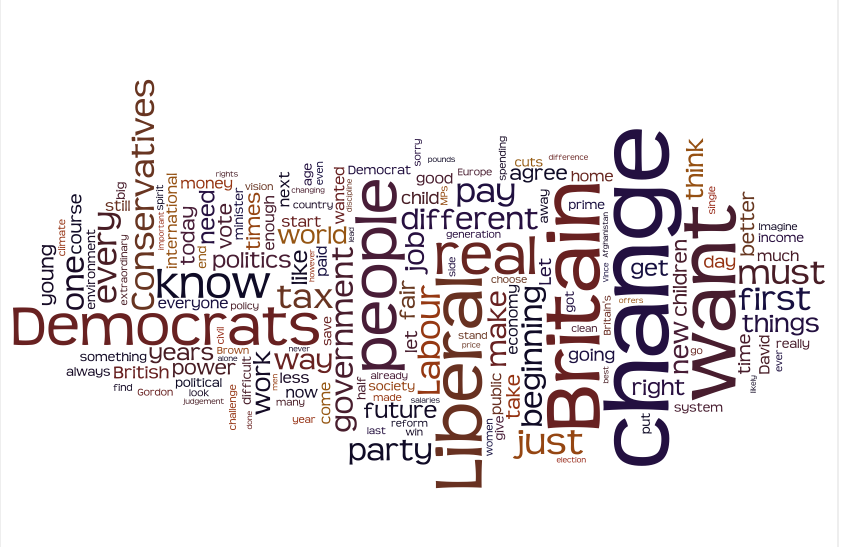
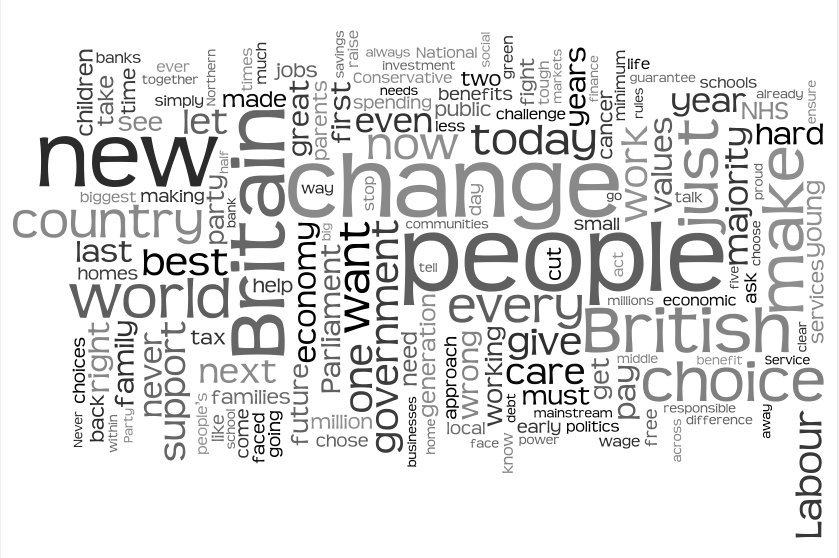
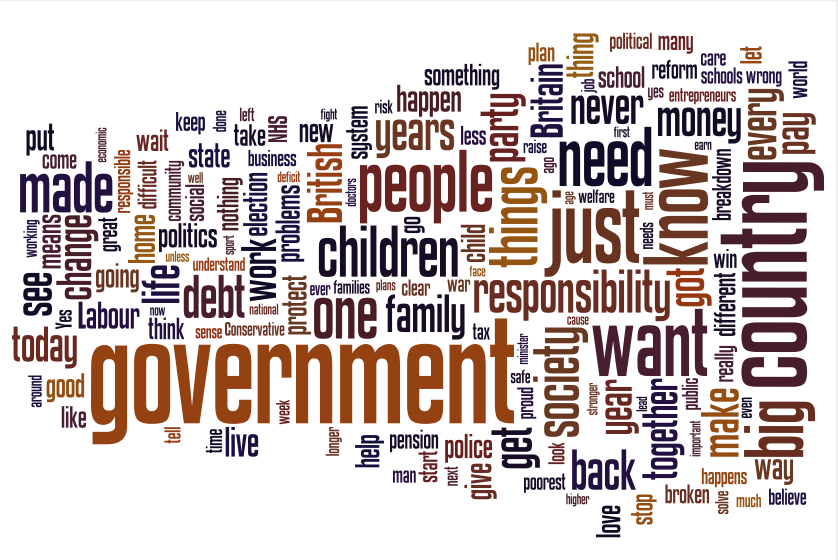
Whilst researching for the Politics project I came across some wordles from the US election of speeches from Obama and McCain. So I made my own from the speeches of Clegg, Cameron and Labour at their party conferences in late 2009. Here were the results.

Labour: Gordon Brown

Gordon Brown's speech to Labour Conference 2009

Conservative: David Cameron

David Cameron's speech- The Tory leader's conference address in full 2009

Liberal Democrats: Nick Clegg

Nick Clegg- Liberal Democrat leader's speech 2009

How much do you know about Politics?

April 27th, 2010 by Jo Turner-Attwell

In May I will be voting for the first time in the UK elections. This means I have spent large amounts of time researching and discussing the different parties and what they have to offer and I am finding it extremely hard to differentiate between the parties. In discussions with other voters my own age I became very aware what little experience many of us have in politics and within my own experience, aside from the influence of parents, guidance in making this decision for the first time is minimal.
This video from the Yahoo election page shows the extent to which this lack of knowledge can extend and was a real eye opener for me.

I believe learning about Politics is something that should be embedded somewhere within standard curriculums in the education system to avoid this sort of ignorance.
Pontydysgu is currently working on a European project called POLITICS which hopes to increase knowledge of Politics on both a national and European scale.

‘The POLITICS project is built around an e-book “Straight into Politics”. Learners will be invited to form (transnational) teams online and develop a digital and humorous story based on the scenario of a politically active young person who is convinced they can change the world for the better and organizes a election campaign.’

If you’d like to know more about this project this can be found out on the project website at http://www.politics-project.eu/index.htm.

Working and Learning

April 21st, 2010 by Jo Turner-Attwell

icould is a collection of videos where people talk about their career paths. It provides a diverse selection of stories from people of all ages and backgrounds and is an inspirational way to explore career possibilities.

I was browsing the icould videos and saw a tag to search by age. This videos was one of those thrown up. It caught my interest mainly because it made such a strong connection to work experience and the value of learning and working at the same time. These are two things that throughout my time with Pontydysgu I have held in increasing regard.
In my opinion two weeks of work experience in Year 10, in the English compulsory education system, isn’t enough. This video I felt went some of the way to showing why.

How many Facebook Photos can we take?

April 9th, 2010 by Jo Turner-Attwell

Recently I have been blogging a lot of media so I thought I’d do a traditional written post for a change. When I first started using Facebook one of the features I most enjoyed was the sharing of photos, and still do. A while back Graham blogged on the scalability of Facebook as a social network as people are beginning to have more contacts than they know what to do with, and statistics show that people are usually only in contact with a small proportion of these. I recently have been wondering if maybe these sort of scalability issues could apply to photos, as the amount of photos people have on their sites is reaching numbers in the thousands.
These are often people around the age of 18 and if Facebook retains it’s popularity what sorts of numbers will people reach in five or so years. Tens of thousands maybe? When things reach this stage, how would it be possible to organise all of these photos? I already find it difficult to save all of the photos I like and now rely on facebook to keep them for me, as the only true record of all my photos.
Will this be what Facebook becomes, a store of people’s life photos? My parents found that when they put together photo albums for my latest birthdays they struggled to find recent photos as the majority of these were online on Facebook and with no Facebook, they had no access to them.
I have noticed the significant amount of younger sisters, children, small cousins in pictures on Facebook meaning that when these children are finally old enough to enter the online world for themselves they already have a collection of photos waiting for them. This strikes me as an odd concept, as it means other people create someone’s online profile before they are in a position to do so themselves. It does however show how the perception of sharing information online has changed.
I recently have taken to browsing people’s profile pictures when i first add them on the grounds it is photos they have chosen to represent themselves and i don’t have to sift through large numbers of photos of half of their face. Maybe this will be the way things move forward, people will choose favourite photos or organise their photos into those that they feel best represent themselves for people to browse, whilst other photos will be looked at at the time they are uploaded for people to see what happened at certain event and will be compiled as part of a larger build up of a long term collection of photos.
My thinking on this is still is still at early stages but I do think it raises some interesting question as to the change in culture that sites such as facebook are creating and forsees some interesting issues for the future of sites such as facebook.

Careers Guidance- Is it good enough?

April 8th, 2010 by Jo Turner-Attwell

Recently I have been researching careers guidance in schools and therefore when I was back in the UK i took the opportunity to ask my family and friends about their own experiences. Here is an interview I did with Year 10 student Ellen.

The State of The Internet

April 7th, 2010 by Jo Turner-Attwell

I found this video JESS3 / The State of The Internet on Cool Infographics and loved it. It was embedded originally from Vimeo by JESS3. In addition to providing some really interesting statistics, it was the dynamic way of presenting them that particularly held my attention. Definitely worth watching.

JESS3 / The State of The Internet from JESS3 on Vimeo.

Vygotsky Research Poster

April 7th, 2010 by Jo Turner-Attwell

Lev Vygotsky’s theories are become more relevant today than ever before. This poster explores the way that Vygotsky’s fit today particularly with Personal Learning Environments. I made this whilst exploring the best mediums to display data. This poster does currently contain too much information and would be difficult to read if displayed physically. However online the zoom feature on scribd makes it possible to read the information in detail whilst still receiving the overall presentation on the document. It is not necessarily ideal but it is different to the standard blog posts I have previously done. Let me know what you think.

Vygotsky Research

Hans Rosling: Let my dataset change your mindset

April 5th, 2010 by Jo Turner-Attwell

Hans Rosling talk uses visualisation of datasets to show the development pathways countries have taken, and how they may differ from the ideas we have.

  • Search Pontydysgu.org

    News Bites

    2012 Horizon report

    An advance copy of the the NMC Horizon Report 2012 K-12 Edition, due to be launched on June 14, identifies mobile devices and apps and tablet computing as technologies expected to enter mainstream use in the first horizon of one year or less. Game-based learning and personal learning environments are seen in the second horizon of two to three years; and augmented reality and natural user interfaces emerged in the third horizon of four to five years.


    OER Quality

    A new project is attempting to define quality standards  for open educational resources in higher education; this is part of the OER Quality Project, a joint research between the universities of Barcelona, Santiago de Chile and the University of London.

    The researchers for this project are lecturers and academic librarians and aim to define a set of quality standards and develop a good practices guide both for content design and for  indexing open educational resources in institutional repositories.

    They are looking for university lecturers, readers or professors (distance learning lecturers welcome too) willing to answer 2 surveys  (20 minutes each) and to evaluate a set of OERs, according to certain guidelines and criteria, which will take 30 minutes to answer. To participate, please register here.


    Hangouts on Air

    Personally I am not a great fan of Google+, although as Google increasingly integrates its different services it is hard to avoid. But, as Stephen Downes points out in the ever valuable Oldaily, citing an original blog post by David Andrade, “by far and away the best thing about Google+ is the Hangout feature, essentially a way to have a videoconference with ten of your friends. This latest upgrade allows you to broadcast your Hangouts to as large an audience as you want. “With Hangouts on Air, you will be able to broadcast yourself publicly to the entire world, see how many viewers you have, and even record and reshare your broadcast. The public recording will be uploaded to your YouTube channel and to your original Google+ post.”

    With free skype video calls limited to two people and the increasing cost of proprietary synchronous elearning platforms like Blackboard Collaborate, Hangouts could become the system of choice for open online courses.


    Gadgets and widgets

    The Dutch SURFnet have announced the ‘Edu-Socializing Seminar’, to be held in Utrecht, the Netherlands, on June 12th and 13th. They say “Gadget and widget technology is gaining momentum in the Research and Educational community. Projects like the Role Project, Apache Rave, Sakai OAE and OpenConext implement and deploy these technologies, showcasing the possibilities and benefits of such loosely coupled and distributed environments. The projects address a wide variety of needs from within the community like, among others, personalized learning environments, mashing web and social content, distributed learning and online collaborations.

    The event seeks to explore trends and foster these developments internationally, by bringing together experts from different fields into one event and joining them in a community. With interactive sessions the workshop wants to enable sharing of ideas and knowledge. At the same time the event wants to trigger new developments. With dedicated breakout sessions, common challenges can be addressed and solutions can be targeted.”

    More details on the seminar wiki page.


    ECER 2010

    The keynotes, videos, radio shows and interviews from the ECER 2010 Conference in Helsinki:

    On the ECER 2010 website.

    Taccle handbook for teachers order form

    Here you find the Taccle handbook for teachers order form.

    Twitter

    Follow Graham Attwell on Twitter Follow Cristina Costa on Twitter Follow Dirk Stieglitz on Twitter

    Other Pontydysgu Spaces

    • Pontydysgu on the Web

      blip.tv
      Watch the Pontydysgu Videos
      pbwiki
      Our Wikispace for teaching and learning
      Sounds of the Bazaar Radio LIVE
      Join our Sounds of the Bazaar Facebook goup. Just click on the logo above.

      Our next programmes will be live from the German Moodlemoot in Emsden. Full details coming soon

  • Sounds of the Bazaar AudioBoo

  • Recent Posts

  • Archives

  • Meta

  • Upcoming Events

    • Thu, May 24 – Fri, May 25:Learning through virtual environments: A challenge for the promotion of positive parenting
  • Categories