ColiN00B (CC0), Pixabay
It does not seem likely that we are going to participate in any face to face conferences in the near future. But conferences are continuing online and in some ways there are increased opportunities for sharing ideas and knowledge. Anyway that was a preamble for the latest abstract that I, together with Sohia Roppertz and Ludger Dietmer have submitted for the 4th Crossing Boundaries on Vocational Education and Training in 2021.
1 Introduction
The growing use of Artificial intelligence (AI) and other technological innovations are leading to a fundamental change in the world of work, as tasks previously performed by humans can now potentially be performed/assisted by computers and computer-controlled machines (Brynjolfsson & McAffee, 2014; Dengler & Matthes ,2018).
This digital transformation places VET under high pressure to adapt (Seufert, 2018), to provide professional action competence within non academic technical, social, commercial and other occupations. VET schools and their teachers and trainers have the central task of preparing learners for the changing world of work. Technological change also is impacting the organisation of VET schools through the introduction of big data and e-government and at the implementation level in connection with e.g. adaptive learning systems and learning analytics (Seufert 2018).
Against this background, the question arises how vocational school teachers and trainers can be prepared for these tasks. While a survey undertaken through the Taccle AI project found most vocational teachers and trainers recognised the importance of AI, there are presently few opportunities for professional development (Author, forthcoming).
This paper reports on work in progress through the EU Erasmus Plus funded Taccle AI project examining the impact of AI on Vocational Education and Training, led by the University of Bremen Following initial research and the development of a Resource Toolkit, the project is developing a Massive Open Online Course (MOOC), to be offered in English and Germany and expected to be launched May 2021.
In section two of the paper we will examine the vision behind MOOCs and in section three will look at the different dimensions of a MOOC for professional development for teachers and trainers around AI. This will be followed by a discussion of how cooperative and project related MOOC design can support teachers and trainers in developing their professional practice. Finally we will draw some initial conclusions based on our work.
- Theoretical background
The first MOOC, led by George Siemens and Stephen Downes was in 2008 around the topic of Connectivism. According to Downes (2012) it was based on the realization that the use of distributed open resources would support – with ease – an attendance in the thousands. The vision grew out of the idea of Open Education, where everybody could access free online courses. The idea quickly took off, especially with the launch of Coursera and Udacity. Although the founders of these companies saw their innovation as disruptive to traditional education institutions, universities have been quick to pick up on the potential of MOOCs. In Europe one of the biggest MOOC providers is OpenLearn, through the UK Open University leading a consortium of educational providers.
2.1 Vision behind MOOCs
There has been and continues to be discussion over pedagogic approach to MOOC design, with advocates of so called cMoocs emphasising the active contribution of participants, using digital platforms and technologies while so called xMOOCs, for example from Stanford University, are more focused on the transmission of knowledge.
MOOCs are increasingly being used for professional development, for instance by companies like Siemens, and for teachers and trainers.
- MOOCs and AI – two dimensions
There are two key dimensions to the AI MOOC.
3.1 MOOCs as a Way to Learn about AI
The first is MOOCs as a way to learn about AI. This in turn has three key foci. After an initial introduction the course will examine both the impact of AI on the Changing world of Work and its implications in terms of skills, tasks and consequently curriculum. The second focus will be on the use of AI for teaching and learning in VET. The final section will examine the ethical implications of AI for VET.
3.2 Artificial Intelligence powered MOOCs
The second key dimension will be the integration of AI into the MOOC platform. While this work is still under development it is intended to incorporate Natural Language processing for the production of materials and Learning Analytics within the MOOC Platform.
- Implementation of cooperative and project related (more interactive) MOOCs design in professional development of VET teachers and trainers
New forms of learning are needed for AI in VET. MOOCs including practice and project-based learning can be used both in VET courses and for training teachers and trainers. The paper will discuss how MOOCs can be designed through a new didactical approach to teaching and learning.
The article will explore the concept of additional qualifications within apprenticeship training and how such concepts can be adapted to different European vocational settings. It will show how the new arrangements affect the teaching and learning of VET students (e.g. mechatronic apprentices), and new roles for VET teachers and trainers. Discussion will be based around examples, for instance the mechatronic students are working and learning in school based and training factory labs themselves developing AI projects (Author et Al, 2020a). This functional learning material allows student teams to plan, prepare, realize and demonstrate projects in which for example autonomous driving or robot functions are programmed, tested and presented to bigger audiences. These practice based developments will be incorporated in the MOOC.
- Conclusions
This paper will examine the question of whether MOOCs are suitable for the continuing education of VET teachers and trainers in the context of Artificial Intelligence. It will also clarify what kind of MOOCs types and settings can be connected to projects, how MOOCs can be implemented by VET teachers and trainers and how they have to be structurally designed in didactical terms. This includes the question how teachers and trainers have to be prepared for such new learning arrangements in order to develop vocationally oriented MOOCss (Author at Al, 2020b).
References
Author, Bekiaridis, G., Author., Tutlys, T., Perini, M., Roppertz, S., & Tutlys, V. (2020a). Artificial Intelligence in Policies, Processes and Practices of Vocational Education and Training. Institut Technik und Bildung. https://doi.org/10.26092/elib/307
Author, Author., Tutlys, T., Author, & Perini, Marco. (2020b). Digitalisation, artificial intelligence and vocational occupations and skills: What are the needs for training teachers and trainers? In C. Nägele, B. E. Stalder, & N. Kersh (Eds.), Trends in vocational education and training research, Vol. III. Proceedings of the European Conference on Educational Research (ECER), Vocational Education and Training Network (VETNET) (pp. 30–42). https://doi.org/10.5281/zenodo.4005713
Downes, S. 2012, The Rise of MOOCs, https://www.downes.ca/cgi-bin/page.cgi?post=57911, accessed 15 December, 2020
Brynjolfsson, E., & McAfee, A. (2014). The second machine age: Work, progress, and prosperity in a time of brilliant technologies. WW Norton & Company.
Dengler, K. & Matthes, B. (2018). Substituierbarkeitspotenzial von Berufen. Wenige Berufsbilder halten mit der Digitalisierung Schritt. IAB-Kurzbericht.
Seufert, S. (2018). Flexibilisierung der Berufsbildung im Kontext fortschreitender Digitalisierung. Bericht im Auftrag des Staatssekretariats für Bildung, Forschung und Innovation SBFI im Rahmen des Projekts «Berufsbildung 2030 – Vision und Strategische Leitlinien» Zugriff unter: https://edudoc.ch/record/132323 (1.12.2020)
Author, (forthcoming). Artificial Intelligence and Vocational Education and Training – Perspective of German VET teachers. Proceedings of the European Distance and E-Learning Network Research Workshop, 2020 Lisboa, 21 – 23 October 2020.)

 Soon after MOOCs had burst onto the scene, I was talking to a senior manager at a UK university. He was charged with leading their development of MOOCs. But despite his enthusiasm,he thought he would only be given two or three years to get things right. And the big thing he had to get right was making money.
 Rather than comment on the goings on in America yesterday, I will leave it to Susie Dent and her extremely timely Word of the Day tweet.

 UNESCO are increasingly active in the development in the use of Artificial Intelligence in Education. Next week – 7 and 8 of December they are hosting an International Forum on AI and the Futures of Education (AIED). The theme of the Forum is Developing Competencies for the AI Era. the Forum will bring togther education and technology experts from around the world to discuss AI skills for the futures of education and AI as a common good for education. UNESCO say participants will share policies and practices in defining the competencies required in the AI era, and examine strategies to prepare all people to live and work with AI effectively.


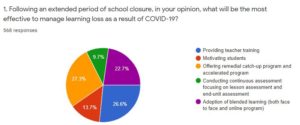 pandemic and proposes a gradual reopening of schools with an emphasis on the well being of both students, teachers school administration sand the entire community. A questionnaire survey composed of multiple choice questions was administered to teachers to understand their viewpoint on the safe reopening of schools.
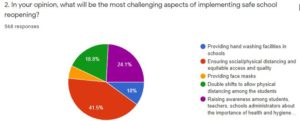 asked, following an extend period of school closure what in their opening will be the most effective to manage learning loss as a result of Covid 19 the survey had the following results: