GoogleTranslate Service


Comics and Projects

December 5th, 2007 by Graham Attwell

searchinpage_11

Projects are central to the development of new ideas and applications for learning and technology. Projects allow us the space to try out new ideas and the time and opportunity to explore and share those ideas. At least in theory. In truth we spend too much time chasing money, in matching our ideas to what policy makers and funders want and in filling in endless report forms. But, it goes with the territory.One thing I think we are woefully weak at it making the results of our projects available. Yes, we have our conference papers. and we have the project web sites, complete with partner logos and PDF downloads of reports. But far too seldom is the work presented in a way that the ideas are accessible or is there an engaging narrative of what we did and what we found out and how it might be used by others.Pontydysgu are not brilliant at this. But we have been thinking about the issue. One thing we decided to do was to present a brief overview of all the different projects we are engaged in, together with links to project web sites and resources.

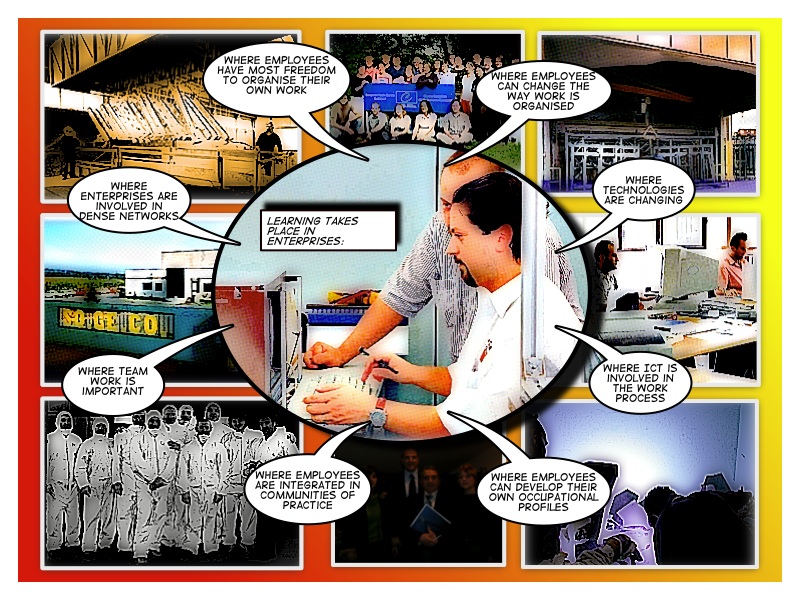
That section is now live on our web site, althoigh there is still some data to add. And at some time, I will try to turn some of the less transparent project descriptions, lifted from project applications and web sites, into some more convincing texts.We have also been looking at how to use multimedia to present our ideas – through podcasts and videos and slideshows. More recently we have been developing comics. Adrian Puscuta, our intern student form Bucharest has shown a real aptitude for this work. The first two of his Comic Books – ‘Searching, Lurking and the Zone of Proximal Development’ and ‘Personal Learning Environments – What they are and what they might be useful for’ are now on line in the Multimedia/Comics section of the site.I’d be interested in what you think. I like Comic books because of the power of the pictures and text together to construct a narrative. When I make a presentation I try to tell a story – the Comic Books are the nearest way I have found of telling those stories in an asynchronous media.

2 Responses to “Comics and Projects”

  1. This is briljant! But is this not very complex to produce? And I hope Pontydysgu when Adrian has left the building.

  2. Graham Attwell says:

    It is not as hard as it looks Wilfred. We use ComicLife. Perhaps the most difficult thing is producing the story boards, the narrative which holds it all together. The next thing is a good store of photos. Most of ours are Creative Commons licensed from Flickr. This takes a lot of time searching but obviously gets easier after you build up a stock. ComicLife is great because it comes with presets of filters. Obviously you could do it yourself in Photoshop but it would take for ever. and it comes with a great range of templates – although we have developed quite a lot of these ourselves.

    And then it is not so much complex but time consuming – but a lot of fun. I produced a project evaluation report as a cartoon book – it is the first such report I did which I think everyone read!

    NB. Although ComicLife used to be Mac only there is now a public beta of a PC version available.

Leave a Reply

Spam Protection by WP-SpamFree Plugin

  • Search Pontydysgu.org

    News Bites

    From a Jisc press release:

    Over 14,000 items of archived TV footage from 17 European countries are now available via the EUscreen online portal for teaching, research and general interest.

    EUscreen – the result of a collaboration between 36 partners across Europe – provides a rich insight into Europe’s television heritage with content dating from the 1920s to the present day.

    The portal includes rare footage and commentary on key events in history, including a 1962 interview with Martin Luther King about racial discrimination in the US.

    John Ellis, Professor of Media Arts at Royal Holloway and principal investigator on the EUscreen project, said: “This is a valuable resource for anyone interested in social history or indeed TV history, as it brings together tens of thousands of clips from across Europe. The portal is available to anyone (not only academics) and it is very easy to get absorbed and spend hours browsing all of the footage.”

    The expansive footage has also proved popular as a learning aid for foreign language students, with clips available in 14 languages.

    By the end of September 2012, there will be around 30,000 items of digital content freely available on the portal as the European providers continue to add carefully selected material.

    Explore the EUscreen footage


    Open online seminar

    Jisc are hosting an open, online seminar on ‘Making Assessment Count (MAC)’ on Friday 3rd Feb – 1-2pm. The presenters are Professor Peter Chatterton (Daedalus e-World Ltd) and Professor Gunter Saunders (University of Westminster).

    The mailing for the seminar says” “The objective of Making Assessment Count is primarily to help students engage more closely with the assessment process, either at the stage where they are addressing an assignment or at the stage when they receive feedback on a completed assignment. In addition an underlying theme of MAC is to use technology to help connect student reflections on their assessment with their tutors. To facilitate the reflection aspect of MAC a web based tool called e-Reflect is often used. This tool enables the authoring of self-review questionnaires by tutors for students. On completion of an e-Reflect questionnaire a report is generated for the student containing responses that are linked to the options the student selected on the questionnaire.”

    You can find out more ans sign up for the seminar at  http://jiscmac.eventbrite.co.uk/


    EC-TEL 2012

    The EC-TEL 2012: Seventh European Conference on Technology Enhanced Learning 21st Century Learning for 21st Century Skills takes place on 18-21 September 2012 at Saarbrücken in Germany.

    The focus for the conference includes:

    - How can schools prepare young people for the technology-rich workplace of the future?
    - How can we use technology to promote informal and independent learning outside traditional educational settings?
    - How can we use next generation social and mobile technologies to promote informal and responsive learning?

    The deadline for proposals is April 2.


    Visitors and Residents

    David White (University of Oxford) and Dr. Lynn Silipigni Connaway (OCLC) have been attracting quite a stir with their JISC-funded work on Visitors and Residents: What Motivates Engagement with the Digital Information Environment?, being undertaken as part of the Developing Digital Literacies programme webinar series.

    Slides, audio and a recording of the Blackboard Collaborate session where they presented some of the findings of their work can be found at http://bit.ly/jiscdiglitvr.


    ECER 2010

    The keynotes, videos, radio shows and interviews from the ECER 2010 Conference in Helsinki:

    On the ECER 2010 website.

    Taccle handbook for teachers order form

    Here you find the Taccle handbook for teachers order form.

    Twitter

    Follow Graham Attwell on Twitter Follow Cristina Costa on Twitter Follow Dirk Stieglitz on Twitter

    Other Pontydysgu Spaces

    • Pontydysgu on the Web

      blip.tv
      Watch the Pontydysgu Videos
      pbwiki
      Our Wikispace for teaching and learning
      Sounds of the Bazaar Radio LIVE
      Join our Sounds of the Bazaar Facebook goup. Just click on the logo above.

      Our next programmes will be live from the German Moodlemoot in Emsden. Full details coming soon

  • Sounds of the Bazaar AudioBoo

  • Recent Posts

  • Archives

  • Meta

  • Upcoming Events

      There are no events.
  • Categories