No ‘Team GB’ for education!
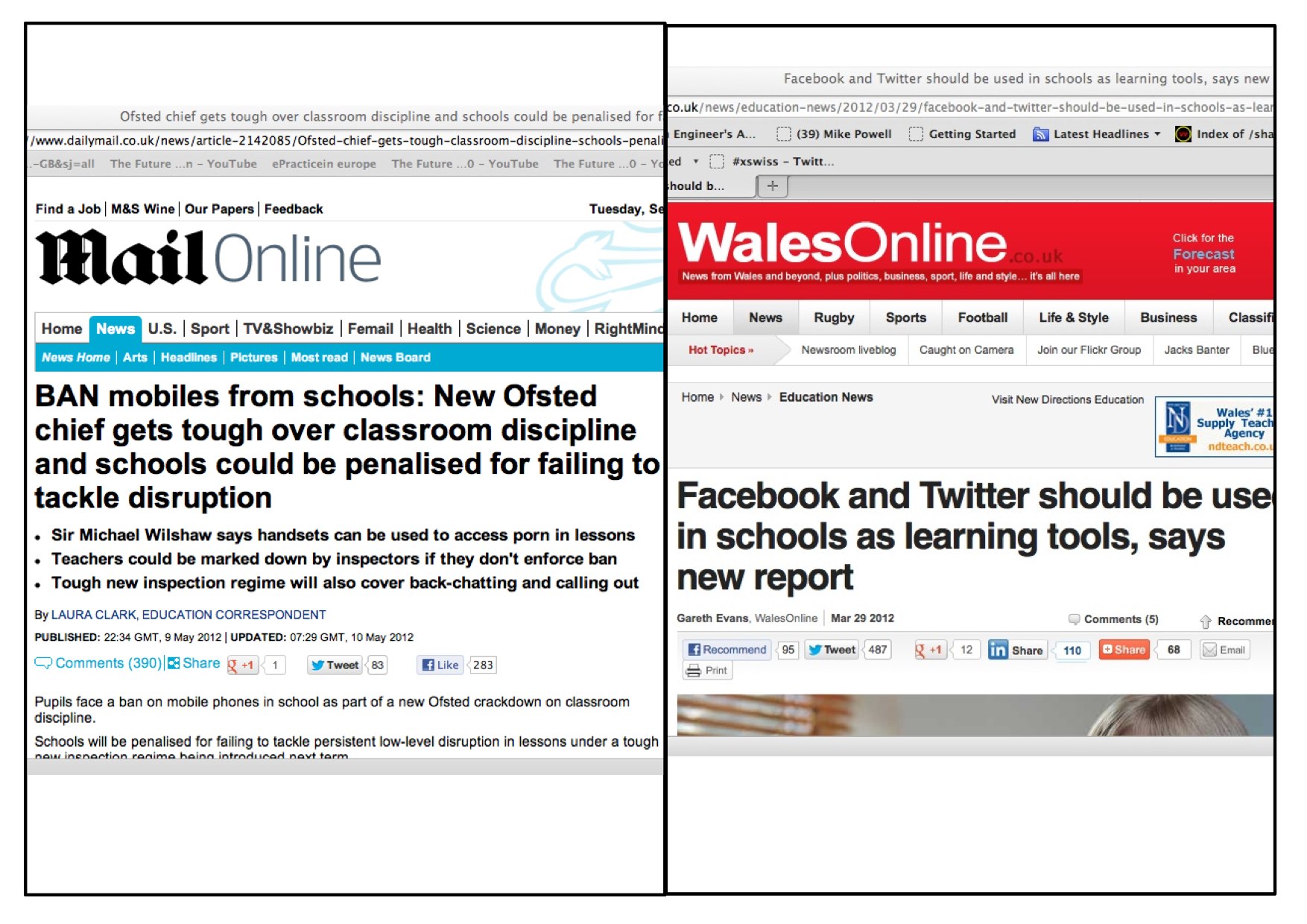 The Wales Government has announced its plans to implement the recommendations of a report it commissioned earlier this year “Find it, make it, use it, share it: learning in Digital Wales.” We are quite excited that Wales is one of the pioneers in developing a whole-country strategy for the promotion of digital technologies in school classrooms – including advocating the widespread use of mobile devices, a shift to a PLE rather than MLE focus and the use of social software for learning. There are one or two things we disagree with, such as the heavy emphasis on a ‘national’ collection of resources, but the rest of the report is exciting, forward thinking and realistic. There is a serious commitment to mass staff development at all levels – surely the biggest barrier to take up of new technologies in the classroom – including defining a set of digital competences for teachers. This report also recommends that these competences (personal AND pedagogic) be compulsory in ITT courses.
The other section of the report which will cause major ripples is the chunk entitled “External conditions for success” which seem to us to identify all of the brick walls which teachers come up against and suggests that they should be dismantled. I am going to quote the report in full because it is music to the ears of most of us involved with e-learning in schools.
Universal take-up of digital opportunities assumes that:
- all learning providers, and indeed all classrooms, can connect to the internet at sufficient speeds to enable efficient use of digital resources
- interface equipment – whiteboards, PCs, tablets, mobile devices, etc. – are available widely enough within learning providers to give quick and easy access to resources. ‘Bring your own device’ solutions may be appropriate here
- learners and teachers are not prevented from using resources by general restrictions imposed by local authorities or learning providers on certain types of hardware (e.g. smart phones), software (e.g. ‘apps’) or web resources (e.g. Facebook, YouTube or Twitter)
- learners and their parents/carers have adequate access at home (and increasingly on mobile devices) to ensure that technology-enhanced learning in the classroom can be replicated and deepened outside the learning provider.
LEAs, take note!!
The main vehicle for turning the report into reality will be an organisation called the ‘Hwb’ (no, not a funny way of spelling Hub, ‘hwb’ means to promote, push or inspire). Its remit will be to lead, promote and support the use of digital resources and technologies by learners and teachers across Wales and create and develop a national digital collection for learning and teaching in English and Welsh. Both Pontydysgu and the Taccle2 project in Wales are committed to doing what we can to support the Hwb and will make sure that all our resources and experience in the field are freely available.
The driving force behind it all is Leighton Andrews, the Minister for Education in Wales – with whose politics I usually disagree – but I am very happy to admit that he has come up trumps with this one! He is knowledgable, committed and comes across as a genuinely enthusiastic technophile with an understanding of what education could look like in the future and a clear vision of how, in Wales, we are going to get there. (“Just like Michael Gove!”, I hear my English colleagues say….). I must admit, that even as a card-carrying member of a different party (byddwch chi’n dyfalu!), devolution has been all good in terms of education and we have had two excellent Ministers. Look at the image on the top of this post and you may understand why we are looking forward to an increasing divergence and autonomy. Team GB? No thanks!