Clippings

Clipmarks.com is a very cool service. Here you see our clippings.

Announcing Serennu ar sgeip

January 24th, 2013 by Graham Attwell

I seem to have spent the last two weeks in meetings. Breakfast meetings, slype meetings, FlashMeeting, pub meetings (my favourite). Anyway one of the best of the meetings was with a team of students at HsKa – the technical university of Karlsruhe in Germany. The students have been working with us over the last five months on a project to develop a new platform called Serennu ar sgeip for school teachers to manage virtual presentations form people in different occupations to students in their class.

Today we had the final review presentation with the students and their teachers. And it was awesomely good – both the presentation and the platform. This is a teaser post. Both the teachers and members of the team have promised ot right up their experiences of the project to post on this blog. We will also talk about our perceptions of the project in a mini series which we will be running here. And of course we will tell you more about the platform based on wordpress and available under an open source license.

Congratulations to the HsKa team. We are looking forward to your reflections.


No ‘Team GB’ for education!

September 30th, 2012 by Jenny Hughes

The Wales Government has announced its plans to implement the recommendations of a report it commissioned earlier this year “Find it, make it, use it, share it: learning in Digital Wales.”  We are quite excited that Wales is one of the pioneers in developing a whole-country strategy for the promotion of digital technologies in school classrooms – including advocating the widespread use of mobile devices, a shift to a PLE rather than MLE focus and the use of social software for learning.  There are one or two things we disagree with, such as the heavy emphasis on a ‘national’ collection of resources, but the rest of the report is exciting, forward thinking and realistic.  There is a serious commitment to mass staff development at all levels – surely the biggest barrier to take up of new technologies in the classroom – including defining a set of digital competences for teachers. This report also recommends that these competences (personal AND pedagogic) be compulsory in ITT courses.

The other section of the report which will cause major ripples is the chunk entitled “External conditions for success” which seem to us to identify all of the brick walls which teachers come up against and suggests that they should be dismantled. I am going to quote the report in full because it is music to the ears of most of us involved with e-learning in schools.

Universal take-up of digital opportunities assumes that:

  • all learning providers, and indeed all classrooms, can connect to the internet at sufficient speeds to enable efficient use of digital resources
  • interface equipment – whiteboards, PCs, tablets, mobile devices, etc. – are available widely enough within learning providers to give quick and easy access to resources. ‘Bring your own device’ solutions may be appropriate here
  • learners and teachers are not prevented from using resources by general restrictions imposed by local authorities or learning providers on certain types of hardware (e.g. smart phones), software (e.g. ‘apps’) or web resources (e.g. Facebook, YouTube or Twitter)
  • learners and their parents/carers have adequate access at home (and increasingly on mobile devices) to ensure that technology-enhanced learning in the classroom can be replicated and deepened outside the learning provider. 

LEAs, take note!!

The main vehicle for turning the report into reality will be an organisation called the ‘Hwb’ (no, not a funny way of spelling Hub, ‘hwb’ means to promote, push or inspire). Its remit will be to lead, promote and support the use of digital resources and technologies by learners and teachers across Wales and create and develop a national digital collection for learning and teaching in English and Welsh.  Both Pontydysgu and the Taccle2 project in Wales are committed to doing what we can to support the Hwb and will make sure that all our resources and experience in the field are freely available.

The driving force behind it all is Leighton Andrews, the Minister for Education in Wales – with whose politics I usually disagree – but I am very happy to admit that he has come up trumps with this one!  He is knowledgable, committed and comes across as a genuinely enthusiastic technophile with an understanding of what education could look like in the future and a clear vision of how, in Wales, we are going to get there.  (“Just like Michael Gove!”, I hear my English colleagues say….).  I must admit, that even as a card-carrying member of a different party (byddwch chi’n dyfalu!), devolution has been all good in terms of education and we have had two excellent Ministers.   Look at the image on the top of this post and you may understand why we are looking forward to an increasing divergence and autonomy.  Team GB? No thanks!


Protected: test del me

August 31st, 2012 by Graham Attwell

This post is password protected. To view it please enter your password below:


Recognising learning with badges

June 19th, 2012 by Graham Attwell

Moving into uncharted waters: are open badges the future for skills accreditation?

I am ever more interested in the idea of badges in generla and the Mozilla Badges project in particular.

Having said this I think some of the pilot work has been on the wrong track – in providing accreditation for vocational competence in fields with pre-existing qualifications, rather than looking at areas lacking existing froms of recognition.

Badges should be about recognising learning. And it is probably more important in motivating learners that they are able to recognise their own learning. So I see badges as an extension tot he assessment for learning movement. In this respect the sample badge on the Mozilla Open Badges project site is unhelpful. I know it is up to the provider to determine the forms of assessment and that Mozilla does not determine who can become a provider. But the example inevitably will influence how potential providers view badges. Assessment needs to be an active process, contirbuting both to the leaners’s understanding and facilitating the process fo recogniciton. Simple check boxes as in the example above do neither.

L like the Mozilla Backpack and obviously a great deal of effort is being put into developing a robust architecture. But just as important as the electronic badges is something learners can display. Jenny Hughes has suggested we should provide learners with a badge holder (at least for younger learners) and that they should be allowed to select one badge to wear to school each day.

The badges could look very similar to the popular football cards being distributed by German supermarkets. If youlook at the back of the card (below) thereis even space for several metadata fields.

In a follow up post I will discuss several practical ideas for piloting the badges.


Teaching and Learning with social software

November 14th, 2011 by Graham Attwell
Now I think Michael Idinopulos from Social Text is going a little over the top when he claims the approach below is unique. But he is right in saying that traditional approaches to training using social software don’t work and we need to develop new pedagogic approaches.
clipped from www.socialtext.com

Suppose you were trying to train someone who had never seen a telephone before. You could teach them how to dial, how to put someone on hold, how to work the mute button. But until they actually make a call and speak to another human being, they won’t get the point. And that’s exactly what happens when you use traditional training methods for social tools: they learn how to push the buttons, but they don’t get the point.

In traditional training, you interact with technology. In social training, you interact with other people by means of technology. The technology becomes a medium, like a telephone or a videoconference room, rather than the object of your interaction, like an MRI machine or a Boeing 777.

  blog it

Evaluation 2.0: How do we progress it?

October 11th, 2011 by Jenny Hughes

Have been in Brussels for the last two days – speaking at 9th European Week of Regions and Cities organized by DG Regio and also taking the opportunity to join other sessions. My topic was Evaluation 2.0. Very encouraged by the positive feedback I’ve been getting all day both face-to-face and through twitter. I thought people would be generally resistant to the idea as it was fairly hard-hitting (and in fairness, some were horrified!) but far more have been interested and very positive, including quite a lot of Commission staff. However, the question now being asked by a number of them of them is “How do we progress this?” – meaning, specifically, in the context of the evaluation of Regional Policy and DG Regio intervention.

Evaluation 2.0 in Regional Policy evaluation
I don’t have any answers to this – in some ways, that’s not for me to decide! I have mostly used Evaluation 2.0 stuff in the evaluation of education projects not regional policy. And my recent experience of the Cohesion Fund, ERDF, IPA or any of the structural funds is minimal. However, the ideas are generic and if people think that there are some they could work with, that’s fine!

That said, here are some suggestions for moving things forward – some of them are mine, most have been mooted by various people who have come to talk to me today (and bought me lots of coffee!)

Suggestions for taking it forward

  • Set up a twitter hashtag #evaluation2.0. Well that’s easy but I don’t know how much traffic there would be as yet!
  • Set up a webpage providing information and discussion around Evaluation 2.0. More difficult – who does that and who keeps it updated? Maybe, instead, it is worth feeding in to the Evalsed site that DG Regio maintain, which currently provides information and support for their evaluators. I gather it is under the process of review – a good opportunity to make it more interactive, to make more use of multimedia and with space for users to create content as well as DG Regio!
  • Form a small working group or interest group – this could be formal or informal, stand alone or tied to their existing evaluation network. Either way, it needs to be open and accessible to people who are interested in developing new ideas and trying some stuff out rather than a representative ‘committee’.
  • Alternatively, set up an expert group to move some ideas forward.
  • Or how about a Diigo group?
  • Undertake some small-scale trials with specific tools – to see whether the ideas do cross over from the areas I work in to Regional Policy.
  • Run a couple of one-day training events on Evaluation 2.0 focusing on some real hands-on workshops for evaluators and evaluation unit staff rather than just on information giving.
  • Check out with people responsible for evaluation in other DGs whether there is an opportunity for some joint development (a novel idea!) Unlike other ‘perspectives’ it is not tied to content or any particular theoretical approach.
  • Think about developing some mobile phone apps for evaluators and stakeholders around content specific issues – I can easily think of 5 or 6 possibilities to support both counterfactual, quantitative approaches and theory-based qualitative approaches. Although the ideas are generic, customizing the content means evaluators would have something concrete to work with rather than just ideas.
  • Produce an easy-to-use handbook on evaluation 2.0 for evaluators / evaluation units who want practical information on how to do it.
  • Ring fence a small amount of funding to support one-off explorations into innovative practice and new ideas around evaluation.
  • Encourage the evaluation unit to demonstrate leadership in new approaches – for example, try streaming a live internet radio programme around the theme of evaluation (cheap and easy!); set up a multi-user blog for people to post work in progress and interesting observations of ongoing projects using a range of media as well as text-based major reports; make some podcasts of interviews with key players in the evaluation of Regional Policy; set up a wiki around evaluation rather than having to drill down through the various Commission websites; try locating projects using GPS data so that we can all see where the action is taking place! Keep a twitter stream going around questions and issues – make use of crowd sourcing!
  • Advertise the next European Evaluation Society biennial conference, in Helsinki, October 1st – 5th 2012 “Evaluation in the networked society: New concepts, New challenges, New solutions” (There you go Bob, I just did!)
  • Broaden the idea of Evaluation 2.0 and maybe get rid of the catchphrase! We are already using the power of the semantic web in evaluation to mash open and linked data, for example. Should we be now be talking about Evaluation 3.0?? Or should we find another name – Technology Enhanced Evaluation? We could have TEE parties instead of conferences – Europe’s answer to the American far right ; )

P.S. Message to the large numbers of English delegates at the conference

When you left Heathrow yesterday to come to Brussels, I do hope you waved to the English Rugby team arriving home from the Rugby World Cup in New Zealand.

(Just as well this conference was not a week later or I’d have leave a similar message for the French delegates…..)


  • Search Pontydysgu.org

    News Bites

    MOOCs and beyond

    A special issue of the online journal eLearning Papers has been released entitled MOOCs and beyond. Editors Yishay Mor and Tapio Koshkinen say the issue brings together in-depth research and examples from the field to generate debate within this emerging research area.

    They continue: “Many of us seem to believe that MOOCs are finally delivering some of the technology-enabled change in education that we have been waiting nearly two decades for.

    This issue aims to shed light on the way MOOCs affect education institutions and learners. Which teaching and learning strategies can be used to improve the MOOC learning experience? How do MOOCs fit into today’s pedagogical landscape; and could they provide a viable model for developing countries?

    We must also look closely at their potential impact on education structures. With the expansion of xMOOC platforms connected to different university networks—like Coursera, Udacity, edX, or the newly launched European Futurelearn—a central question is: what is their role in the education system and especially in higher education?”


    The cost of austerity and privatisation

    There is growing concern over the consequences of the English (Scotland, Wales and Northern Ireland have different policies) government’s cutbacks and privatisation of  careers guidance for young people. The International Centre for Guidance Studies reports on a discussion paper called ‘Cost to the Economy of Government Policy on Career Guidance: A Business Case for Funding and Strengthening Career Guidance in Schools‘ from Lizzie Taylor who is an Careers England Affiliate Member. “The report claims that the economic consequence of current government policy on career education is an escalating annual cost to young people in reduced and lost earnings, reaching £676m p.a. in 2018 before dropping back slightly to £665 m p.a.2022. The total cost in reduced and lost earnings to young people in the period 2013 to 2022 is estimated as £3.2bn.”


    Open Education 2030

    The Institute for Prospective Technological Studies (IPTS) –part of the Joint Research Center of the European commission –  is calling upon experts and practitioners to come up with visionary papers and imaginative scenarios on how Open Education in 2030 in Europe might look with a major focus on Open Educational Resources and Practices, in different education sectors.

    The foresight scenarios submitted can be normative or descriptive, idealistic or provocative, critical or imaginary, reflective or polemic, imaginative or concrete, comprehensive or selective, general or specific. They should be both inspiring and scientifically sound.

    Submissions are free to choose any angle, subject, approach, but they say the future vision and/or scenario should address the key question of how Open Education in 2030 in Europe might look, and include the role of OER.

    More details from the EU Europa website.


    PLE Conference Update

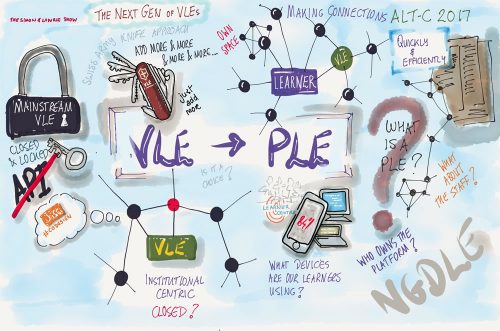
    I wasn’t overoptimistic about the Personal Learning Environments Conference this year. Discussions about PLEs have been subsumed in the hype over MOOCs. And most conferences are struggling with the ongoing recession. But I am delighted that we have received 59 submissions including a number of great proposals for interactive workshops.

    The PLE Conference takes place on 10 and 12 July in Berlin.


    Twitter

    Follow Graham Attwell on Twitter Follow Cristina Costa on Twitter Follow Dirk Stieglitz on Twitter

    Other Pontydysgu Spaces

  • Sounds of the Bazaar AudioBoo

  • Recent Posts

  • Archives

  • Meta

  • Upcoming Events

      There are no events.
  • Categories