GoogleTranslate Service


Putting learners in control of their data
February 17th, 2008 by Graham Attwell

kite2

The issue of data ownership and control is becoming a regular theme on this blog. Witness my rant against the UK governments development of am electronic database to track every teenager from the age of 14, recording their personal details, every exam result and exclusions. The database is intended to include a CV.

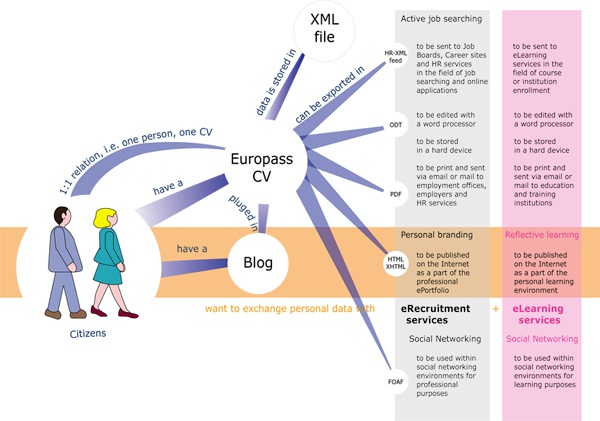
I had an interesting talk with Margarita Perez-Garcia last Friday. Margarita led the European Kite project. Rather than providing a centralised database for a CV, outside the control of the leaner, the Kite project has developed a plug in version ofht eEuropean CV format. The project has developed the plug in for three systems – WordPress, Elgg and Dotclear. It is available under a GPL lisence and is compatable e with the HR-XML standard.

I think this is a great project. Why?

  • It puts learners in control of their own data
  • It is useful – data only needs to be added once and users can decide what data is displayed in any particular instance
  • It is based on a ‘bottom up’ approach to standards (using what works)
  • It is not difficult to see how the work could be further extended
  • and – of course – it is open source.

One of the reasons I like this so much is that it is a European project which has produced something useful. The sowfatre can be downloaded from the labs.Libre tracker.

2 Responses to “Putting learners in control of their data”

  1. There are so many aspects to consider so that the debate is anything but simple. Balancing off the value of UK’s great work in developing strong NVQs, portability of assesments and artifacts, interoperability of systems, the ability to evaluate the performance of the system(s) and institution itself, and of course the value/risk to learners as well as their interests in security, privacy, confidentiality and security is a difficult task. The rights and safety of the individual learner certainly has to come first, so it is essential to take that into account while trying to simultaneously leverage the best value to citizens and institutions. Thank you and keep up the great discussion!

Tweetbacks/Trackbacks/Pingbacks

  1. [...] een tweede bericht (Putting learners in control of their data) geeft Attwell aan hoe het volgens hem wel zou moeten en welke technologie daarbij ingezet kan [...]

Leave a Reply

Spam Protection by WP-SpamFree Plugin

  • Search Pontydysgu.org

    News Bites

    Open online seminar

    Jisc are hosting an open, online seminar on ‘Making Assessment Count (MAC)’ on Friday 3rd Feb – 1-2pm. The presenters are Professor Peter Chatterton (Daedalus e-World Ltd) and Professor Gunter Saunders (University of Westminster).

    The mailing for the seminar says” “The objective of Making Assessment Count is primarily to help students engage more closely with the assessment process, either at the stage where they are addressing an assignment or at the stage when they receive feedback on a completed assignment. In addition an underlying theme of MAC is to use technology to help connect student reflections on their assessment with their tutors. To facilitate the reflection aspect of MAC a web based tool called e-Reflect is often used. This tool enables the authoring of self-review questionnaires by tutors for students. On completion of an e-Reflect questionnaire a report is generated for the student containing responses that are linked to the options the student selected on the questionnaire.”

    You can find out more ans sign up for the seminar at  http://jiscmac.eventbrite.co.uk/


    EC-TEL 2012

    The EC-TEL 2012: Seventh European Conference on Technology Enhanced Learning 21st Century Learning for 21st Century Skills takes place on 18-21 September 2012 at Saarbrücken in Germany.

    The focus for the conference includes:

    - How can schools prepare young people for the technology-rich workplace of the future?
    - How can we use technology to promote informal and independent learning outside traditional educational settings?
    - How can we use next generation social and mobile technologies to promote informal and responsive learning?

    The deadline for proposals is April 2.


    Visitors and Residents

    David White (University of Oxford) and Dr. Lynn Silipigni Connaway (OCLC) have been attracting quite a stir with their JISC-funded work on Visitors and Residents: What Motivates Engagement with the Digital Information Environment?, being undertaken as part of the Developing Digital Literacies programme webinar series.

    Slides, audio and a recording of the Blackboard Collaborate session where they presented some of the findings of their work can be found at http://bit.ly/jiscdiglitvr.


    Learning and New Technologies

    Graham Attwell is delivering a keynote presentation on Learning and New Technologies to the ‘Encouraging participation in continuing training in Romania, with focus on disadvantaged employees’ project in Bucharest on Wednesday 7 December.


    ECER 2010

    The keynotes, videos, radio shows and interviews from the ECER 2010 Conference in Helsinki:

    On the ECER 2010 website.

    Taccle handbook for teachers order form

    Here you find the Taccle handbook for teachers order form.

    Twitter

    Follow Graham Attwell on Twitter Follow Cristina Costa on Twitter Follow Dirk Stieglitz on Twitter

    Other Pontydysgu Spaces

    • Pontydysgu on the Web

      blip.tv
      Watch the Pontydysgu Videos
      pbwiki
      Our Wikispace for teaching and learning
      Sounds of the Bazaar Radio LIVE
      Join our Sounds of the Bazaar Facebook goup. Just click on the logo above.

      Our next programmes will be live from the German Moodlemoot in Emsden. Full details coming soon

  • Sounds of the Bazaar AudioBoo

  • Recent Posts

  • Archives

  • Meta

  • Upcoming Events

      There are no events.
  • Categories